


Ao Qin : The Dragon King of the Southern Seas
At a glance
| Description | |
|---|---|
| Origin | Chinese Mythology |
| Classification | Animals |
| Family Members | Ao Guang, Ao Run, Ao Shun (Brothers) |
| Region | China |
| Associated With | Southern Seas |
Mythlok Perspective
In Mythlok’s Perspective, Ao Qin is most compelling not as an isolated sea deity, but as part of the Chinese tradition of giving natural forces a human and divine identity. Like Poseidon in Greek mythology, he represents the sea’s power and unpredictability, yet his role is more closely tied to the regulation of rain and water within a cosmic order. His story demonstrates how Chinese mythology transformed dependence on nature into a system of divine guardianship.
Ao Qin
Introduction
Ao Qin (敖欽), commonly known as the Dragon King of the South Sea, is a figure in Chinese mythology associated with one of the Four Seas. In the popular tradition represented by Journey to the West, the Four Dragon Kings govern the seas in the four cardinal directions, with Ao Qin ruling the South Sea. Together, these Dragon Kings embody the ancient Chinese belief that powerful spiritual beings governed water, rain, storms, and other forces of nature.
Ao Qin’s importance comes less from having a large body of individual legends and more from his place within the wider tradition of the Chinese Dragon Kings. Dragons in Chinese culture have long been associated with rain and water, making the Dragon Kings especially important to communities whose lives depended on agriculture, rivers, fishing, and maritime travel. As the ruler of the southern sea, Ao Qin represents one part of this larger sacred geography.
The traditions surrounding the Dragon Kings developed through the interaction of Chinese folk religion, Daoist beliefs, Buddhist influences, and regional customs. As a result, accounts of Ao Qin are not completely uniform. His name, family relationships, and role can differ between literary works and later traditions. This variation is an important feature of Chinese mythology, where legends were continually adapted across different regions and periods.
Physical Traits
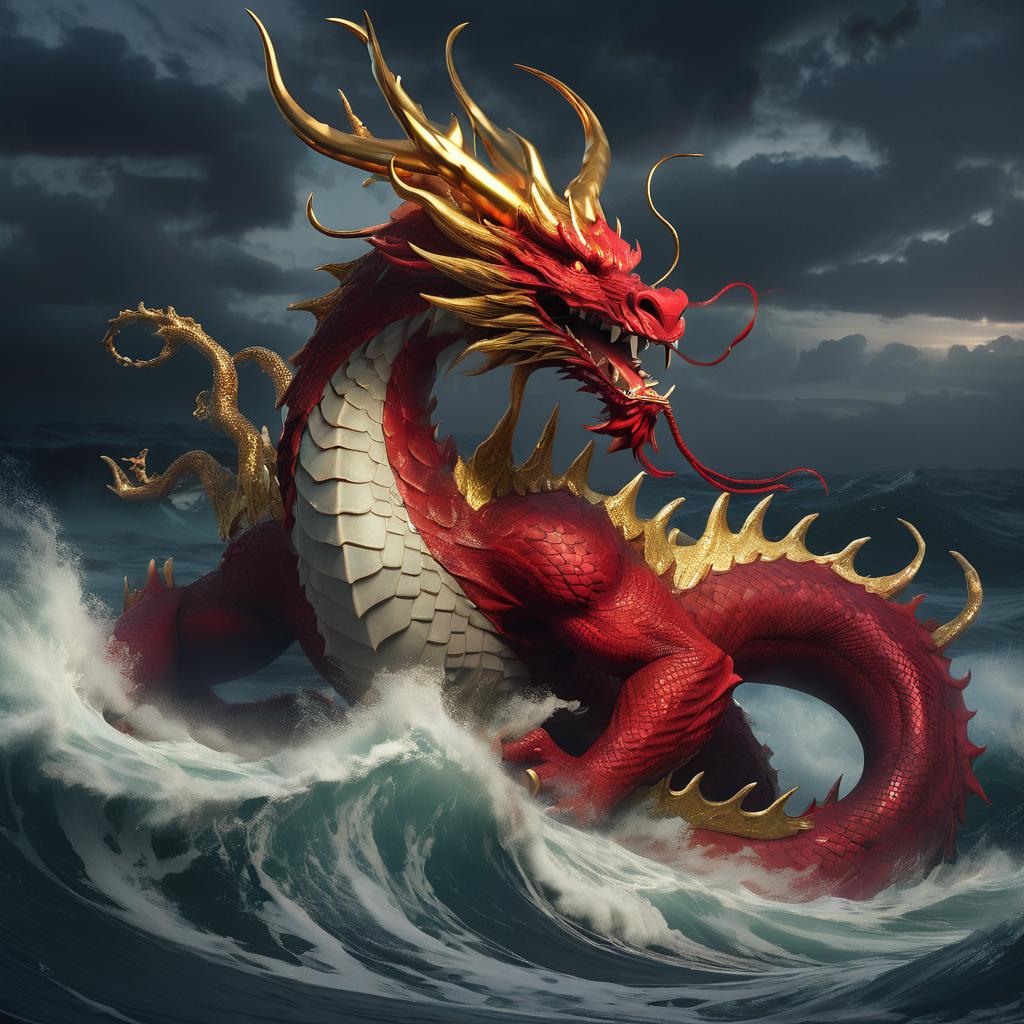
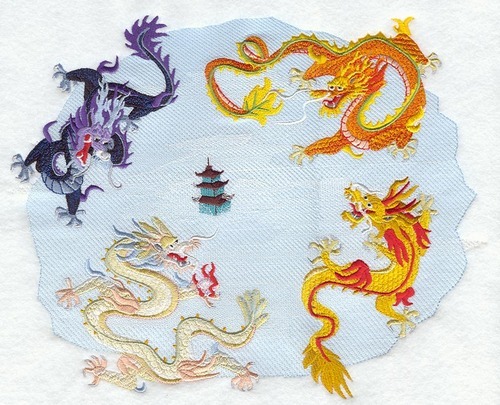
There is no single ancient description that establishes a distinctive physical appearance for Ao Qin. Like other Dragon Kings, he is generally represented through the traditional imagery of the Chinese dragon. This typically includes a long, serpentine body, scales, horns, whiskers, claws, and a powerful dragon’s head. In religious art and popular representations, Dragon Kings may also be portrayed in human form as dignified rulers wearing elaborate robes and royal headgear.
These characteristics reflect the broader symbolism of the Chinese dragon rather than a unique physical description of Ao Qin himself. Dragons were associated with supernatural power, water, rain, authority, and transformation, while their regal appearance reflected the Dragon Kings’ status as rulers of the aquatic realms.
Ao Qin’s connection with the South can also be understood within traditional Chinese cosmology. The southern direction was associated with summer and the element of fire in the system of correlative cosmology. However, this association should not be taken to mean that Ao Qin was primarily a fire deity. His principal mythological identity remains that of the Dragon King governing the South Sea and its waters.
Family
In the popular tradition of the Four Dragon Kings, Ao Qin is regarded as one of four dragon rulers governing the seas in the cardinal directions. He is generally identified alongside Ao Guang of the East Sea, Ao Run of the West Sea, and Ao Shun of the North Sea. These figures are commonly treated as brothers, although their names and relationships vary between different Chinese literary and religious traditions.
The Four Dragon Kings form part of a larger hierarchy of supernatural beings associated with the regulation of water and weather. Their stories often intersect with heavenly authorities and other gods, reflecting the idea that natural phenomena could be governed through an ordered spiritual hierarchy.
Ao Qin should not, however, be confused with every dragon prince or sea deity appearing in Chinese mythology. In particular, Ao Bing, the dragon prince associated with the famous story of Nezha, is traditionally identified as a son of Ao Guang, the Dragon King of the East Sea. There is therefore no reliable basis for describing Ao Bing as Ao Qin’s son or for presenting the two as close members of the same immediate family.
The differing family structures found in Chinese stories demonstrate that mythology did not develop as one fixed system. Names and genealogies were often reshaped by individual authors, religious traditions, and regional folklore.
Other names
Ao Qin is most commonly identified as the South Sea Dragon King, or Nanhai Longwang (南海龍王/南海龙王). The title describes both his position and his divine domain. He may also be referred to simply as a Longwang (龍王/龙王), meaning “Dragon King,” although this is a general religious title rather than a name unique to Ao Qin.
The name Ao Qin can appear in different romanized forms, including Aoqin and Ao Ch’in, depending on the transliteration system used by a particular source. These forms refer to the same name rather than separate mythological characters.
There is also an important variation between Chinese literary traditions. In Journey to the West, the South Sea Dragon King is known as Ao Qin. Other works use different names for the Dragon King associated with the southern sea. In Investiture of the Gods, for example, the South Sea Dragon King is generally identified as Ao Ming rather than Ao Qin. This difference illustrates why Chinese mythological figures should be studied according to the specific text or tradition in which they appear. The title “Dragon King of the South Sea” is therefore the clearest way to identify Ao Qin across discussions of Chinese mythology.
Powers and Abilities
Ao Qin’s powers are primarily connected with his position as a Dragon King and ruler of the South Sea. Within Chinese religious and mythological traditions, Dragon Kings are associated with water, rain, storms, and the regulation of weather. Their ability to influence rainfall was particularly significant in an agricultural society where too little or too much water could determine the success of a harvest.
As the South Sea Dragon King, Ao Qin can therefore be understood as a supernatural authority over the waters within his domain. Dragon Kings could be approached through prayers and rituals for rain, protection from dangerous weather, and safe passage across waterways. Their role reflects the belief that natural forces were subject to spiritual as well as physical laws.
The ability to move between different forms is also common in Chinese dragon mythology. Dragons and other supernatural beings may appear as animals, humans, or other manifestations when interacting with mortals. However, specific stories of Ao Qin transforming into a human should not be treated as a defining individual power unless they are tied to a particular literary source.
Ao Qin’s importance consequently lies in his role within the larger Dragon King tradition rather than in a unique catalogue of supernatural abilities. His authority over the southern waters represents the broader Chinese mythological idea that the forces of nature could be personified and governed by powerful spiritual beings.
Modern Day Influence
Ao Qin’s modern significance comes primarily from the continuing popularity of the Four Dragon Kings and the wider Chinese dragon tradition. The Dragon Kings remain familiar figures in Chinese folklore, religious traditions, literature, television, animation, games, and other forms of popular culture. Their association with rain, water, storms, and supernatural authority continues to make them recognizable figures within adaptations of Chinese mythology.
Ao Qin is particularly important in literary traditions such as Journey to the West, where the Dragon Kings appear as powerful rulers of the seas who can interact with gods, immortals, and human characters. The wider Dragon King tradition also appears in stories involving figures such as Nezha and Sun Wukong, although the identities and relationships of individual Dragon Kings can differ between works.
His modern representation is therefore often shaped by the broader image of the Chinese dragon rather than by a large independent cycle of stories about Ao Qin himself. Contemporary artists and storytellers may portray him as a powerful sea dragon, an imposing divine ruler, or a guardian of the southern waters, drawing on established Chinese dragon imagery while adapting the character for new audiences.
Ao Qin also illustrates an important feature of Chinese mythology: its traditions are not confined to a single canonical version. Different texts, religious practices, and regional traditions have produced variations in the names and identities of supernatural figures. Understanding these differences helps place Ao Qin within the broader history of Chinese mythology rather than treating every later depiction as part of one uniform ancient tradition.
Today, Ao Qin is best understood as the South Sea representative of the Four Dragon Kings and as part of the enduring Chinese tradition of personifying the power of water and weather. His mythology reflects a culture in which the sea was both a source of life and a force capable of immense destruction, deserving respect from those who depended upon it.
Related Images



Source
Dragon University. (2023). The Nine Sons of the Dragon: Exploring Chinese Mythology. https://dragon.university/the-nine-sons-of-the-dragon-exploring-chinese-mythology/
Kuiken, C. J. (2011). The other Neng. University of Groningen. https://research.rug.nl/files/33172267/KuikenCJ-TheOtherNeng-herzien2011.pdf
Natalia Surii. (2024). The Legend of the Four Dragon Kings. https://www.nataliasuri.com/the-legend-of-the-four-dragon-kings-guardians-of-chinas-rivers/
God Checker. (2023). AO QIN – Chinese Mythology. https://www.godchecker.com/chinese-mythology/AO-QIN/
Wikipedia. (2025). Dragon King. https://en.wikipedia.org/wiki/Dragon_King
Yang, L. (2005). Handbook of Chinese Mythology. Oxford University Press.
Birrell, A. (1999). Chinese Mythology: An Introduction. Johns Hopkins University Press.
Wu, C. (2012). The Four Dragon Kings and Their Role in Taoist Cosmology. Journal of Chinese Religious Studies, 45(2), 123–138.
Teiser, S. F. (1996). The Ghost Festival in Medieval China. Princeton University Press.
Lagerwey, J. (2010). China: A Religious State. University of Hong Kong Press.
Frequently Asked Questions
Who is Ao Qin in Chinese mythology?
Ao Qin is the Dragon King of the Southern Sea and one of the four Dragon Kings who control the waters and weather of the world.
What does Ao Qin represent?
He symbolizes the South, summer, and the powerful monsoon rains that bring life and sometimes destruction.
Is Ao Qin related to other Dragon Kings?
Yes. He is one of four Dragon King brothers, including Ao Guang (East), Ao Run (West), and Ao Shun (North).
Where does Ao Qin rule?
His domain is the Southern Sea, often associated with warmer oceans and regions linked to maritime trade and tropical storms.
Does Ao Qin appear in popular stories or media?
Ao Qin appears in folklore connected to the sea palaces and sometimes features in adaptations involving dragons, storms, and ocean kingdoms.


