


Ao Shun : The Chinese Dragon of Northern Seas
At a glance
| Description | |
|---|---|
| Origin | Chinese Mythology |
| Classification | Animals |
| Family Members | Ao Run, Ao Qin, Ao Guang |
| Region | China |
| Associated With | Northern Seas |
Mythlok Perspective
In Mythlok’s Perspective, Ao Shun is most compelling as part of China’s Four Dragon Kings rather than as an isolated deity with an extensive personal mythology. His authority over the North Sea resembles that of Njord in Norse mythology, another figure associated with the sea, maritime prosperity, and the forces that shape human life around water. Yet their roles differ: Njord is principally a god of seafaring and prosperity, while Ao Shun belongs to a divine system that governs water and weather through a cosmic geography of the Four Seas.
Ao Shun
Introduction
Ao Shun (敖顺) is a Dragon King in Chinese mythology, best known as the Dragon King of the North Sea (北海龙王) in the Four Seas tradition associated with Journey to the West. He is one of four Dragon Kings who govern the seas associated with the cardinal directions, alongside Ao Guang of the East Sea, Ao Qin of the South Sea, and Ao Run of the West Sea.
The Dragon Kings occupy an important place in Chinese religious and literary traditions because dragons were closely associated with water, rainfall, rivers, seas, and the forces that sustained agriculture. Rather than being simply creatures of fantasy, Dragon Kings became powerful supernatural authorities who could be approached through prayer and ritual, particularly when communities needed rain or protection from dangerous waters.
Ao Shun, however, should not be treated as a deity with a large independent mythology of his own. Much of what is associated with him comes from the broader traditions surrounding the Dragon Kings and from classical Chinese literature. His most recognizable identity is therefore that of one of the Four Sea Dragon Kings and the ruler of the North Sea in Journey to the West.
Physical Traits
Classical Chinese mythology does not provide a detailed, consistent physical description unique to Ao Shun. His appearance is generally understood through the traditional imagery of the Chinese dragon, an animal associated with supernatural authority over water and weather.
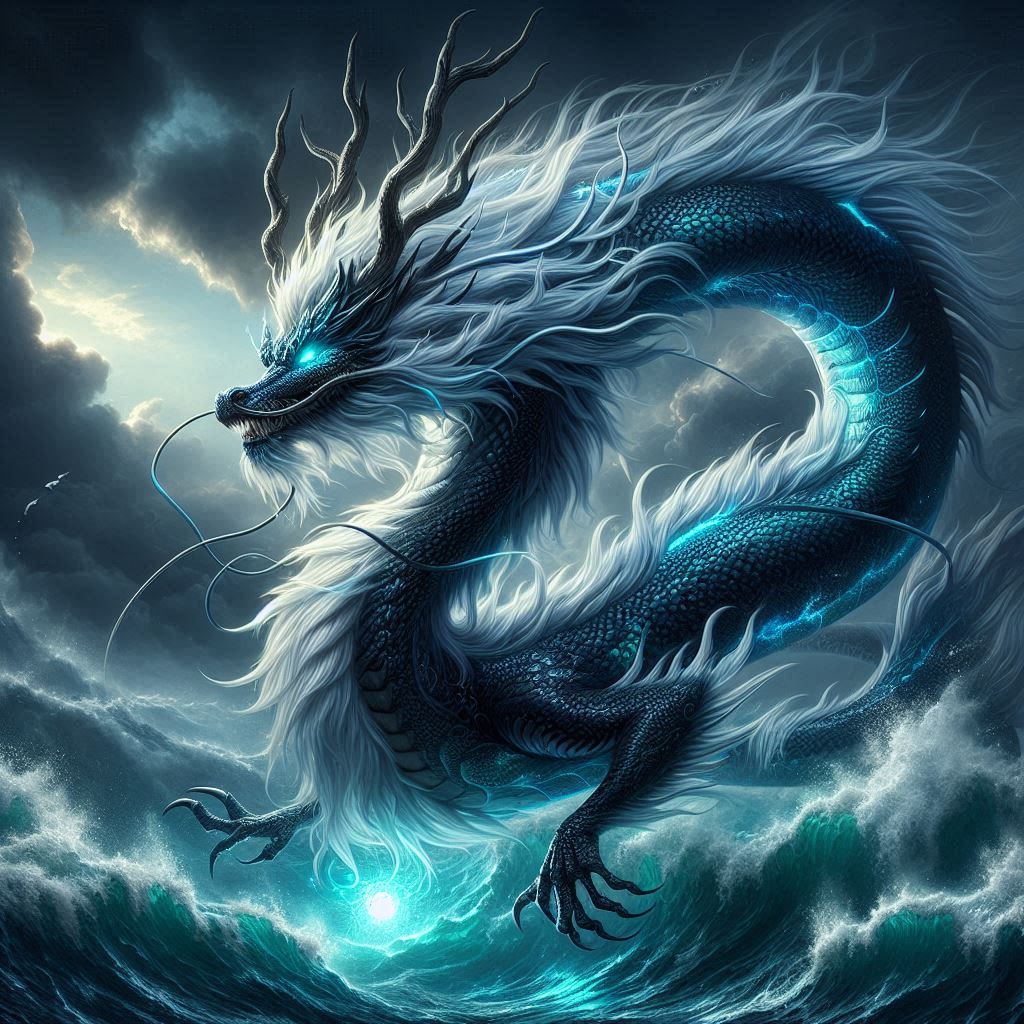
In artistic representations, a Dragon King may appear as a long, serpentine dragon with scales, horns, claws, whiskers, and a powerful, elongated body. Dragon imagery in China varies considerably between periods and artistic traditions, so there is no single canonical appearance that can be identified as the definitive form of Ao Shun.
Dragon Kings can also appear in human form in Chinese stories and religious art. This reflects the broader supernatural ability of dragons and other deities to move between different forms. When represented as a ruler, a Dragon King may be shown wearing elaborate robes and displaying the attributes of an imperial or divine sovereign.
The familiar image of Ao Shun as a dark or icy northern dragon, however, should be understood as modern artistic interpretation rather than an established classical description. His connection with the North comes primarily from his title and domain, not from a documented physical association with ice or snow.
Family
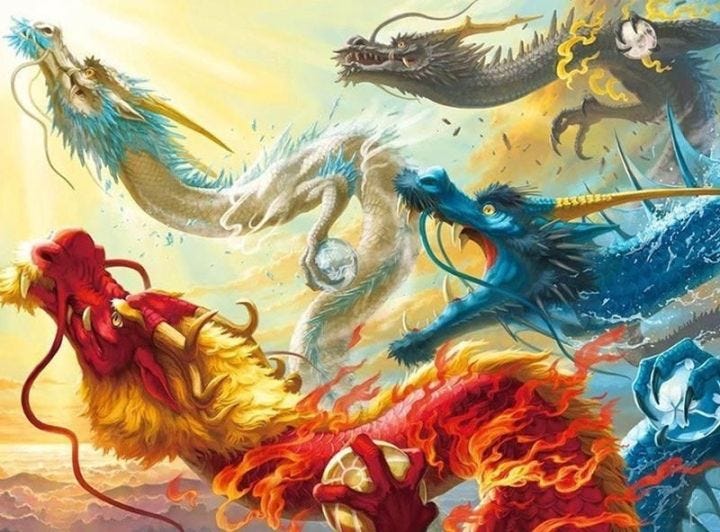
Ao Shun belongs to the group of four Dragon Kings who govern the Four Seas. In the version of the tradition made particularly famous by Journey to the West, the four are Ao Guang, Ao Qin, Ao Run, and Ao Shun. Ao Guang governs the East Sea, Ao Qin governs the South Sea, Ao Run governs the West Sea, and Ao Shun governs the North Sea. Together, these four rulers represent the supernatural administration of the seas surrounding the Chinese world.
The Dragon Kings are commonly presented as members of the same dragon lineage, although Chinese mythology contains different traditions concerning dragon ancestry and genealogy. It is therefore safer to describe Ao Shun as one of the four Dragon Kings rather than assign him a single universally accepted father or family tree.
Ao Shun also has a son, Mo’ang (摩昂), who appears in Journey to the West. The character demonstrates that the Dragon Kings could possess their own families and descendants within the novel’s supernatural world.
An important textual complication concerns Ao Shun’s own domain. Journey to the West identifies him as the North Sea Dragon King in its early chapters, but a later passage reverses the identities of Ao Shun and Ao Run. Other works of Chinese literature also use different names for the Dragon Kings. Consequently, the Four Seas tradition was not completely uniform across every classical source.
Other names
The most important name associated with Ao Shun is 敖顺 (Áo Shùn). His principal title is Beihai Longwang (北海龙王), meaning Dragon King of the North Sea. The title is more useful for identifying his mythological role than speculative epithets sometimes attributed to him. Names such as “Xuanlong” or “Shunlong” should not be treated as established alternative names for Ao Shun without a specific textual or regional source.
The surname Ao (敖) is shared by the Four Dragon Kings in the familiar literary tradition. Thus, Ao Guang, Ao Qin, Ao Run, and Ao Shun are conventionally presented as members of the same Dragon King family. The name and title can nevertheless vary between Chinese traditions and literary works. This is particularly important when comparing Journey to the West with other works of classical mythology, where the identities of the Four Sea Dragon Kings are not always identical.
Powers and Abilities
Ao Shun’s abilities are best understood as part of the broader supernatural powers attributed to the Dragon Kings. His principal authority is over the North Sea, while Dragon Kings more generally are associated with water, rainfall, storms, and other natural forces connected with the sea. Water control is therefore central to Ao Shun’s mythological identity. As a Dragon King, he belongs to a class of deities capable of influencing water and weather. In Chinese religious traditions, Dragon Kings could be invoked for rainfall, making them particularly significant to agricultural communities whose livelihoods depended on seasonal water.
Ao Shun is also associated with the supernatural governance of the sea. Dragon Kings occupy underwater palaces and preside over aquatic beings in Chinese mythology, functioning in many stories almost like divine administrators. Their authority is not simply physical; they participate in the wider supernatural hierarchy that connects earthly nature with the celestial order. Shape-shifting is another ability associated with dragons and Dragon Kings in Chinese literature. They can appear in dragon form or assume human appearances when interacting with other supernatural beings and mortals.
Ao Shun’s role should not, however, be expanded into a list of specifically documented powers such as control over ice, blizzards, magical pearls, or marine ecosystems. These features belong either to broader dragon symbolism, other Dragon King traditions, or later fantasy interpretations rather than to a clearly established Ao Shun mythology. His most important power is therefore his divine authority over the North Sea within the Four Dragon Kings tradition, combined with the broader Dragon King association with water and rain.
Modern Day Influence
Ao Shun remains part of the wider cultural legacy of the Chinese Dragon Kings, although he is considerably less prominent in popular culture than figures such as Ao Guang or the Dragon Kings as a collective group. His importance today largely comes from the continued popularity of classical Chinese mythology and works such as Journey to the West.
In literature and screen adaptations, Ao Shun can appear alongside the other Dragon Kings as a supernatural ruler connected with the sea. Journey to the West is particularly important because it helped establish the familiar literary identity of Ao Shun as the North Sea Dragon King. Modern adaptations may reinterpret his personality, appearance, powers, and relationship with other characters, meaning that contemporary portrayals should not automatically be treated as evidence for ancient mythology.
The wider tradition of Dragon King worship also survives in Chinese religious culture. Dragon Kings have historically been venerated as water and rain deities, with temples, rituals, and prayers connected with rainfall, agriculture, waterways, and protection from natural hazards. These traditions are broader than Ao Shun individually and should not be confused with evidence of widespread modern worship specifically devoted to him.
The dragon itself remains one of the most recognizable symbols in Chinese culture, representing supernatural authority, power, prosperity, and a close relationship with the forces of nature. Ao Shun contributes to this larger mythology as one of the rulers of the Four Seas. His significance is therefore best understood not through a collection of invented individual characteristics, but through his place within the Four Dragon Kings tradition. Ao Shun represents the North Sea within this supernatural geography and illustrates how Chinese mythology transformed the dragon from a legendary creature into a powerful divine figure associated with water, weather, and the ordering of the natural world.
Related Images

Source
Allen, R. (2018). AO SHUN – Chinese Mythology. Godchecker. https://www.godchecker.com/chinese-mythology/AO-SHUN/
Wikipedia contributors. (2025). Chinese mythology. Wikipedia. https://en.wikipedia.org/wiki/Chinese_mythology
Dragon University. (2023, August 8). The nine sons of the dragon: Exploring Chinese mythology. Dragon University. https://dragon.university/the-nine-sons-of-the-dragon-exploring-chinese-mythology/
Sixth Tone. (2024, February 8). How the dragon king emerged from the waves. Sixth Tone. https://www.sixthtone.com/news/1014617/how-the-dragon-king-emerged-from-the-waves
Wikipedia contributors. (2025). Dragon King. Wikipedia. https://en.wikipedia.org/wiki/Dragon_King
Schipper, M., Ye, S., & Yin, H. (2025). China’s creation and origin myths: Cross-cultural explorations in oral and written traditions. [PDF]. https://www.scribd.com/document/707604386/Mineke-Schipper-editor-Shuxian-Ye-editor-Hubin-Yin-editor-China-s-Creation-and-Origin-Myths-Cross-cultural-Explorations-in-Oral-and-Written
Kuiken, C. J. (2011). The other Neng [PDF]. University of Groningen. https://research.rug.nl/files/33172267/KuikenCJ-TheOtherNeng-herzien2011.pdf
Yang, L. (2005). Handbook of Chinese Mythology. Oxford University Press.
Birrell, A. (1999). Chinese Mythology: An Introduction. Johns Hopkins University Press.
Wu, K. C. (1982). The Chinese Heritage. Crown Publishers.
Schafer, E. H. (1963). The Divine Woman: Dragon Kings and Rainmaking in Chinese Religion. University of California Press.
Teiser, S. F. (1994). The Ghost Festival in Medieval China. Princeton University Press
Frequently Asked Questions
Who is Ao Shun in Chinese mythology?
Ao Shun is the Dragon King of the Northern Sea, one of the four Dragon Kings who rule over the waters and weather of the world in Chinese mythology.
What does Ao Shun represent?
He symbolizes the North, winter, cold seas, and the powerful, unpredictable force of water during the darker seasons.
Is Ao Shun related to other Dragon Kings?
Yes. Ao Shun is one of four brothers, along with Ao Guang of the East, Ao Qin of the South, and Ao Run of the West.
Where does Ao Shun rule?
He rules the Northern Sea, a mythical ocean linked to frigid waters, deep currents, and powerful storms.
Does Ao Shun appear in literature and folklore?
Ao Shun appears in classic tales and later works connected to the Dragon Kings and is often portrayed as a guardian of balance and the natural order of the seas.


