
Xi You Ji Zhi Da Nao Tian Gong (1961) : Sun Wukong’s Revolt Against Heaven
| Description | |
|---|---|
| Country of Origin | China |
| Language | Mandarin |
| Genre | Animated |
| Cast | Qiu Yuefeng, Ke Bi, Chen Kaige, Fu Runsheng, Shang Hua |
| Directed by | Wan Laiming |
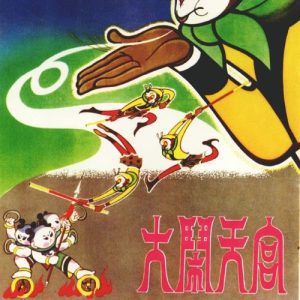
Xi You Ji Zhi Da Nao Tian Gong
Xi You Ji Zhi Da Nao Tian Gong is one of the most influential mythological films ever produced in China, not because of spectacle alone, but because of how confidently it translates a deeply symbolic episode from Journey to the West into visual language. Released in 1961 as an animated feature, the film focuses entirely on the legendary “Havoc in Heaven” episode, transforming Sun Wukong’s rebellion into a mythological parable about cosmic order, authority, and uncontainable spiritual force. Even decades later, it remains a benchmark for how mythology can be adapted without flattening its meaning.
At its core, the film is not a full retelling of Journey to the West, but a concentrated mythic moment. By isolating Sun Wukong’s defiance of the Heavenly Court, the story sharpens its symbolic edge. Heaven here is not simply a divine paradise but a rigid bureaucratic cosmos, ruled by hierarchy, titles, and ritualized obedience. The Jade Emperor and celestial officials behave less like omnipotent gods and more like administrators guarding a fragile system. This portrayal closely mirrors classical Chinese cosmology, where divine order is structured, procedural, and vulnerable to disruption when balance is lost.
Sun Wukong’s mythological role is handled with remarkable clarity. He is neither villain nor traditional hero, but a raw force of cultivation energy that refuses to be contained. His immortality is not portrayed as divine blessing but as spiritual inevitability, earned through Daoist practice, alchemical mastery, and cosmic audacity. The film emphasizes his rejection of imposed status, particularly in the famous sequence where he is given the hollow title of “Protector of the Horses.” Mythologically, this moment is crucial. It exposes the Heavenly Court’s misunderstanding of Sun Wukong’s nature. You cannot pacify chaos by assigning it a desk and a badge.
The animation style itself reinforces the mythic themes. Drawing heavily from classical Chinese ink painting, Peking opera movement, and folk art aesthetics, the film visually rejects Western realism. Characters move in exaggerated, symbolic gestures rather than naturalistic motion, echoing how gods and spirits are described in early Chinese literature. This stylistic choice aligns perfectly with mythological storytelling, where form exists to convey meaning rather than mimic reality. Every leap, cloud ride, and weapon clash feels ritualized, as if the viewer is watching a living scroll unfold.
One of the film’s greatest mythological strengths is its treatment of the Heavenly Army. The celestial generals, weapons, and formations are spectacular but ultimately ineffective against Sun Wukong. This is not just an action choice but a theological statement. In Journey to the West, brute divine force fails repeatedly against cultivated spiritual insight. Sun Wukong’s victories are not about strength alone but about his mastery over transformation, illusion, and adaptability. The film captures this by making his opponents visually impressive yet spiritually inflexible, reinforcing the idea that cosmic authority without wisdom is brittle.
The absence of Buddhist resolution in this adaptation is also telling. Since the film ends before the arrival of the Buddha, the myth remains unresolved, suspended in rebellion. This creates a fascinating mythological tension. Sun Wukong is triumphant, but the cosmos is destabilized. In the original epic, his eventual defeat and imprisonment under the Five Elements Mountain represents the necessity of restraint, humility, and guidance. By stopping short of this moment, the film allows viewers to sit with the discomforting question at the heart of the myth: what happens when spiritual power outpaces moral maturity?
Culturally, Xi You Ji Zhi Da Nao Tian Gong reflects a uniquely Chinese understanding of myth as social metaphor. The Heavenly Court’s obsession with titles, order, and appearances mirrors human governance structures, while Sun Wukong embodies the disruptive potential of the individual spirit. Mythologically, this places the story in a long tradition where immortals and tricksters expose the limitations of authority. Rather than presenting Heaven as infallible, the film shows it as incomplete, in need of transformation just as much as the rebellious monkey.
What makes the film endure is its refusal to dilute myth into simple morality. Sun Wukong is joyful, destructive, clever, and reckless all at once. Heaven is dignified, lawful, and yet profoundly insecure. This moral ambiguity is essential to the original mythology and is preserved with unusual confidence for an animated film of its era. The result is not just entertainment but mythic education, offering viewers an intuitive understanding of Daoist and folkloric ideas about balance, excess, and the dangers of rigid order.
Even today, Xi You Ji Zhi Da Nao Tian Gong stands as one of the purest cinematic expressions of Chinese myth. It does not modernize the story through explanation or simplification. Instead, it trusts the power of symbols, movement, and silence. For anyone interested in mythological storytelling, especially how ancient cosmologies can be visualized without losing their philosophical depth, this film remains essential viewing.