
Diyu : The Chinese Underworld of Judgment and Rebirth
| Description | |
|---|---|
| Mythology | Chinese Mythology |
| Description | Multi-layered courts of hell, Bureaucratic trials |
| Ruler/Guardian | Yanluo Wang |
| Inhabitants | Souls, Demons, Torturers, Clerks |
| Nature | Punishment & purification |
Mythlok Perspective
In Mythlok’s Perspective, Diyu is less a dungeon of horror and more a moral machine. It transforms invisible karma into structured accountability. Unlike the Greek Hades or the Norse Hel, which function primarily as destinations, Diyu functions as correction. Its closest parallel lies in the Indian Naraka, yet its bureaucratic detail reflects a uniquely Chinese worldview. Diyu reveals how cultures project their social order into eternity.
Diyu
Introduction
Diyu (地狱), often translated as “earth prison,” is the realm of the dead in Chinese belief where souls are judged after death. Unlike the eternal damnation associated with some Western ideas of hell, Diyu is a place of moral reckoning and purification. It is a transitional realm where punishment corresponds to one’s deeds, and suffering ultimately prepares the soul for rebirth.
The concept of Diyu took shape as Buddhist ideas of Naraka entered China during the Han dynasty and merged with earlier traditions connected to Mount Tai and ancestral spirit worship. Over centuries, these strands blended with Taoist cosmology and Confucian ethics, creating a highly structured underworld governed by courts, magistrates, and karmic law. Diyu became not only a mythic destination but a moral system that reinforced values such as filial piety, social responsibility, and honesty.
Rather than chaos, Diyu represents order. It mirrors the bureaucratic structure of imperial China, turning the afterlife into an extension of cosmic administration. In this way, Diyu stands as one of the most elaborate depictions of the underworld in world tradition.
Description
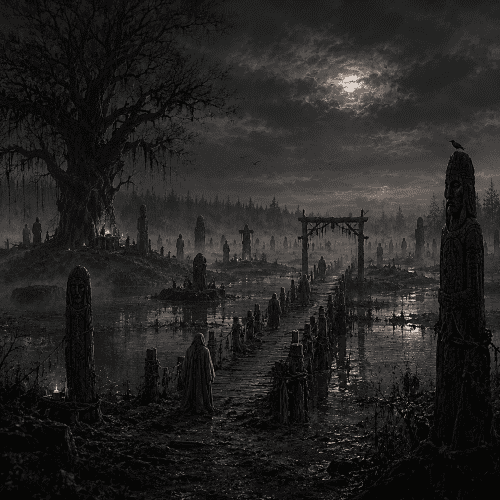
Diyu is typically imagined as a vast subterranean complex beneath the earth. Some traditions describe it as lying under Mount Tai, while others situate it in the shadowy capital of the dead known as Youdu, the “Dark Capital.” It is depicted as a network of courts, corridors, rivers, and chambers filled with officials and tormented souls.
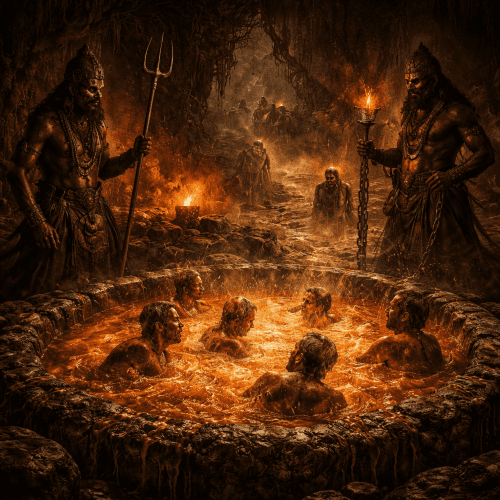
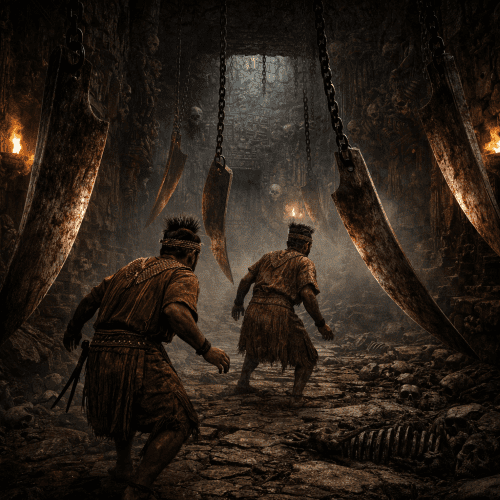
Many accounts speak of the Ten Courts of Hell, each presided over by a king who judges specific categories of sin. Alongside this structure is the idea of the Eighteen Levels of Hell, where punishments correspond precisely to misdeeds. Liars may have their tongues cut, corrupt officials may be crushed under heavy stones, and murderers may endure boiling or dismemberment. These torments are not random acts of cruelty but symbolic reflections of the crime committed.
Importantly, Diyu is not eternal for most souls. Punishment continues until karmic debt is repaid. Afterward, the soul proceeds toward reincarnation, often through the Bridge of Forgetfulness, where memories of past lives are erased before rebirth. This purgatorial dimension distinguishes Diyu from permanent damnation.
Ruler/Guardian
The most recognized ruler of Diyu is Yanluo Wang, the Chinese adaptation of Yama from Indian tradition. In Chinese belief, he serves as a stern magistrate who presides over judgment in the underworld. Souls stand before him to have their earthly deeds examined. In the expanded Ten Courts system, Yanluo Wang is one of ten kings, each governing a specific court and set of punishments. These rulers operate like imperial judges, supported by clerks who maintain detailed registers of human actions. The image is administrative rather than chaotic, emphasizing accountability over vengeance.
Among the guardians of Diyu are the fearsome Ox-Head and Horse-Face, known as Niutou and Mamian. These beings escort souls to trial and ensure that no one escapes their karmic reckoning. Compassion also exists within this realm. The bodhisattva Dizang, known for his vow to empty the hells before attaining Buddhahood, descends into Diyu to aid suffering souls. His presence ensures that justice is balanced with mercy.
Inhabitants
The primary inhabitants of Diyu are the souls of the deceased awaiting judgment or undergoing punishment. The duration of their stay depends on the gravity of their actions. Minor wrongdoers may pass through swiftly, while those guilty of severe crimes remain longer. Diyu is also populated by an extensive bureaucracy of demons, scribes, and wardens. These officials record deeds, enforce punishments, and escort souls between courts. The bureaucratic structure reflects the hierarchical organization of imperial China, reinforcing the belief that moral order extends beyond death. In some traditions, wandering spirits who died unjustly or without proper rites linger near the thresholds of Diyu. Ritual offerings by descendants can ease their suffering and facilitate their progression toward rebirth.
Access
Entry into Diyu occurs at death. Underworld messengers such as Heibai Wuchang guide the soul through gates and along the Yellow Springs Road toward judgment. Proper funeral rites are believed to smooth this passage.
Certain sacred sites are linked symbolically to the entrance of Diyu. Fengdu Ghost City is traditionally associated with the gateway to the underworld. Pilgrims visit it to confront vivid depictions of the Ten Courts and reflect on moral conduct. Though rare, mythic narratives tell of living individuals temporarily entering Diyu through divine intervention or spiritual power, usually to rescue a loved one or receive a moral revelation.
Instances of Visit
One famous tale concerns Mulian, who descends into Diyu to rescue his mother from torment. His journey emphasizes filial devotion and the power of ritual merit to transform karmic fate. In the Ming dynasty novel Journey to the West, the Monkey King Sun Wukong storms the underworld and erases his name from the Book of Life and Death. This episode blends satire with cosmic rebellion, presenting Diyu as both fearsome and bureaucratically vulnerable. Historical legend also recounts that Emperor Taizong of Tang briefly toured the underworld before being restored to life, reinforcing the moral seriousness of judgment.
Symbolism
Diyu represents visible karma. It dramatizes moral cause and effect, transforming abstract ethics into vivid imagery. Every punishment reflects a specific wrongdoing, turning the underworld into a moral classroom. Its bureaucratic structure mirrors earthly governance. Registers, courts, and magistrates reinforce the Confucian belief that order and hierarchy sustain both society and cosmos. Yet Diyu is also transformative. Because suffering is finite and rebirth follows, it symbolizes renewal rather than eternal despair. Justice exists not to destroy but to purify.
Comparative Analysis
Diyu shares strong parallels with the Buddhist Naraka, from which it partly derives, especially in its graded punishments and karmic logic. However, its court system and administrative detail are distinctly Chinese. Unlike the eternal Hell of medieval Christian imagination, Diyu is temporary for most souls. Compared to the Greek Hades or the Norse Hel, which are relatively neutral realms of the dead, Diyu is intensely moralized and judicial. Its fusion of bureaucracy and karma makes it uniquely structured among global underworld traditions.
Modern Influence
Diyu continues to shape cultural life in Chinese-speaking societies. During the Hungry Ghost Festival, families burn offerings to aid ancestors in the afterlife, reinforcing intergenerational responsibility. Temple murals still depict the Ten Courts, warning against corruption and cruelty. Fengdu Ghost City remains a tourist site where visitors confront sculpted scenes of judgment. In modern cinema, literature, and gaming, Diyu appears as a surreal realm of cosmic justice and bureaucratic drama. Its imagery remains powerful because it makes morality visible.
Sources
Teiser, Stephen F. The Ghost Festival in Medieval China. Princeton University Press, 1988.
Eberhard, Wolfram. A Dictionary of Chinese Symbols: Hidden Symbols in Chinese Life and Thought. Routledge, 1986.
De Visser, Marinus Willem. The Religion of Ancient China. Kessinger Publishing, 2004.
Lai, Whalen. “Hell and the Gods: The Chinese Buddhist Vision of the Afterlife.” History of Religions, Vol. 19, No. 3 (1980), pp. 227–244.
Wikipedia. (2024, plus ongoing edits). Diyu. In Wikipedia. https://en.wikipedia.org/wiki/Diyu
Frequently Asked Questions
What is Diyu in Chinese belief?
Diyu is the Chinese underworld where souls are judged, punished according to karma, and eventually prepared for reincarnation.
Is Diyu the same as Hell?
Not exactly. Diyu is usually temporary and purgatorial, unlike the eternal damnation found in some Western traditions.
Who rules Diyu?
Yanluo Wang and the Ten Kings of Hell preside over the courts, assisted by various underworld officials and guardians.
What are the Ten Courts of Hell?
They are judicial divisions within Diyu, each responsible for judging specific sins and assigning corresponding punishments.
How does Diyu influence modern culture?
Diyu appears in festivals like the Hungry Ghost Festival, temple art, literature, films, and games, continuing to shape moral imagination.