


Sun Wukong : The Chinese Monkey King Who Defied the Gods
At a glance
| Description | |
|---|---|
| Origin | Chinese Mythology |
| Classification | Hybrids |
| Family Members | N/A |
| Region | Chinese |
| Associated With | Mischief, Shapeshifting, Adventures |
Mythlok Perspective
Sun Wukong represents elemental chaos shaped into consciousness. Unlike purely benevolent deities, he embodies raw natural force learning restraint. His evolution reflects the universal truth that power without wisdom leads to collapse, while discipline transforms destruction into balance. Across cultures, Sun Wukong parallels figures like Loki from Norse tradition and Hanuman from Indian epics. Like Loki, he is disruptive and clever. Like Hanuman, he possesses devotion-driven strength. Yet only Sun Wukong uniquely journeys from rebellion to enlightenment, making him one of the most complete transformation archetypes in world legend.
Sun Wukong
Introduction
Sun Wukong, better known as the Monkey King, is one of the most celebrated figures in Chinese literature and folklore. He appears most famously in Journey to the West, the 16th-century novel traditionally attributed to Wu Cheng’en. Born from a magical stone on Flower-Fruit Mountain, Sun Wukong possesses extraordinary strength, supernatural longevity, shapeshifting abilities, and an irrepressible sense of independence. His story combines adventure, humor, rebellion, and spiritual transformation, making him one of the most enduring figures in Chinese storytelling.
Sun Wukong initially seeks freedom from mortality and the limitations imposed upon him by Heaven and the natural order. His quest for immortality leads him to supernatural teachers and eventually into open conflict with the celestial bureaucracy. After declaring himself the “Great Sage Equal to Heaven,” he challenges the authority of Heaven itself. Yet his story does not end with rebellion. Following his defeat and imprisonment by the Buddha, Sun Wukong becomes the protector of the monk Tang Sanzang on the journey to retrieve Buddhist scriptures from the West. Through the trials of the pilgrimage, his rebellious nature gradually becomes disciplined and directed toward a greater purpose.
Physical Traits
Sun Wukong is depicted as a supernatural monkey with a distinctly human-like intelligence and personality. He emerges from a stone egg formed on Flower-Fruit Mountain and is initially known as the Stone Monkey. After becoming king of the monkeys, he embarks on a quest for immortality and eventually acquires extraordinary supernatural abilities.
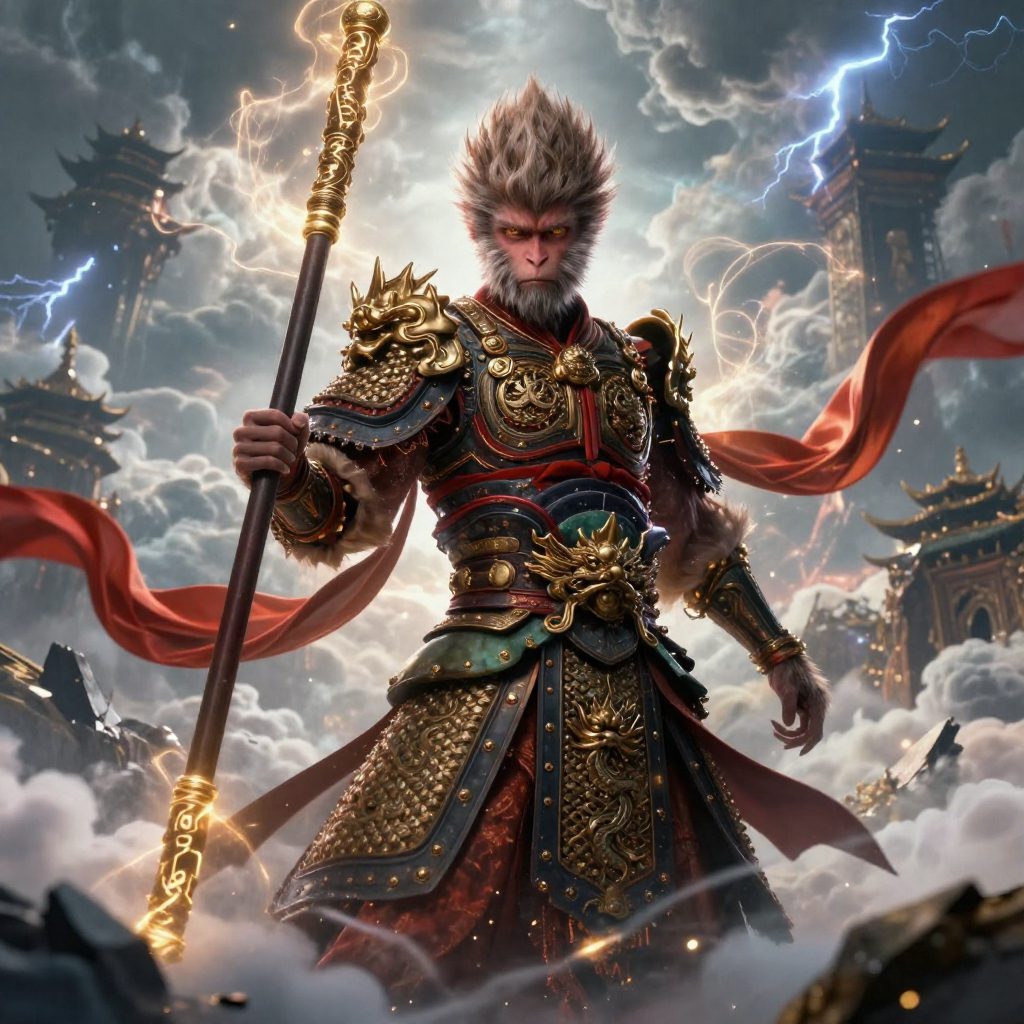
One of his most recognizable features is his pair of fiery, golden eyes. These are the result of his punishment in Laozi’s Eight-Trigram Furnace and allow him to recognize many supernatural disguises and see through illusions. His body is also extraordinarily resilient, allowing him to survive weapons, punishments, and supernatural forces that would destroy an ordinary creature.
Sun Wukong’s most iconic possession is the Ruyi Jingu Bang, the magical iron staff that he obtains from the Dragon King of the Eastern Sea. The staff can change its size according to his will, becoming enormous in battle or small enough to be carried in his ear. His physical prowess, agility, and supernatural endurance complement his mastery of the weapon.
He is also famous for his transformations. Rather than literally representing only seventy-two possible creatures, the “Seventy-Two Transformations” refers to a collection of transformation techniques through which Sun Wukong can assume numerous forms, including animals, insects, people, and other beings or objects.
Family
Sun Wukong has no conventional human family. He is born from a magical stone rather than from parents, and his earliest community consists of the monkeys living on Flower-Fruit Mountain. After discovering the Water-Curtain Cave, he becomes their king and takes the title of Handsome Monkey King. Seeking freedom from aging and death, Sun Wukong leaves his mountain kingdom to search for a teacher. He eventually studies under the mysterious Patriarch Subhuti, who teaches him supernatural techniques, including transformation and the famous cloud-somersault.
His most important relationships later develop during the pilgrimage to the West. He becomes the protector and disciple of Tang Sanzang, traveling alongside Zhu Bajie and Sha Wujing. Although these companions frequently argue and Sun Wukong retains his mischievous temperament, the journey gradually transforms him from a rebellious supernatural being into a disciplined protector. Later traditions and adaptations sometimes expand his family or relationships, but these should be distinguished from the central Journey to the West narrative.
Other names
Sun Wukong is known by several names and titles that reflect different stages of his story. His personal name, Sun Wukong (孫悟空), is commonly translated as “Awakened to Emptiness” or “Awakened to Vacuity.” The name reflects the novel’s Buddhist philosophical themes and foreshadows his eventual spiritual transformation. Before becoming widely known as Sun Wukong, he is called the Stone Monkey and later the Handsome Monkey King (Mei Houwang) after the monkeys of Flower-Fruit Mountain recognize him as their leader.
His most famous self-appointed title is Great Sage Equal to Heaven (Qitian Dasheng). Sun Wukong adopts this grand title during his rebellion against Heaven, asserting himself as an equal to the celestial authorities. Although Heaven eventually recognizes his title in an attempt to control him, his defiance ultimately brings him into direct conflict with the celestial order.
At the conclusion of his pilgrimage, Sun Wukong receives the Buddhist title Victorious Fighting Buddha (Douzhansheng Fo). This title represents the culmination of his transformation from an unruly rebel into an enlightened and disciplined protector.
Powers and Abilities
Sun Wukong possesses an extraordinary collection of supernatural abilities. His strength allows him to wield the Ruyi Jingu Bang, which is described in Journey to the West as weighing 13,500 jin. The staff can change its size and weight according to his will, making it both a formidable weapon and a highly versatile magical object.
His famous cloud-somersault allows him to travel 108,000 li in a single leap, an enormous distance that emphasizes his supernatural speed and mobility. He is also an exceptionally skilled martial artist who can fight celestial warriors, demons, monsters, and other supernatural beings.
Sun Wukong’s Seventy-Two Transformations allow him to assume a wide variety of forms. He uses these abilities for combat, disguise, infiltration, escape, and deception. His transformations are complemented by another unusual technique involving the hairs of his body. By plucking hairs and transforming them, he can create temporary copies, animals, objects, weapons, and other forms.
His supernatural longevity is one of the defining features of his character. His quest to escape death leads him through several stages of cultivation and encounters with objects associated with immortality. He also removes his name from the registers of the dead, consumes the peaches of immortality, and later survives the Eight-Trigram Furnace. Together, these experiences make him extraordinarily difficult to kill.
Yet Sun Wukong’s greatest strengths are not purely physical. He is intelligent, resourceful, quick-witted, and highly skilled at deception. He frequently defeats stronger opponents through cleverness rather than brute force. His mischievous nature can create problems for his companions, but the same ingenuity repeatedly allows him to protect Tang Sanzang and overcome seemingly impossible obstacles.
Modern Day Influence
Sun Wukong remains one of the most influential figures from Chinese mythology and literature. His story has inspired countless adaptations in Chinese opera, cinema, television, animation, comics, novels, and video games. His distinctive combination of supernatural abilities, humor, rebelliousness, and eventual spiritual growth has made him particularly adaptable to modern storytelling.
His influence has also extended beyond China. One of the most famous examples is Son Goku from Dragon Ball, whose early character design, name, monkey imagery, staff, magical cloud, and adventurous journey draw directly from the Monkey King tradition. Sun Wukong has likewise inspired characters and themes in numerous other Asian and international works of popular culture.
Modern interpretations often emphasize different aspects of the Monkey King. Some portray him primarily as a rebellious trickster who challenges authority, while others focus on his loyalty, martial prowess, humor, or spiritual development. Contemporary works may also substantially reinterpret his abilities, personality, appearance, or mythology.
At the heart of the original story, however, Sun Wukong represents more than raw power or rebellion. His journey is one of transformation. The creature who once challenged Heaven must eventually learn discipline, loyalty, humility, and responsibility. His evolution from the Stone Monkey to the Victorious Fighting Buddha is what gives the Monkey King his enduring place in Chinese literary and cultural tradition.
Related Images


Sources
Britannica. (n.d.). Sun Wukong. Encyclopaedia Britannica. https://www.britannica.com/topic/Sun-Wukong
China Highlights. (n.d.). Sun Wukong (Monkey King). https://www.chinahighlights.com/travelguide/chinese-mythology/sun-wukong.htm
Shahar, M. (1994). The religious and literary origins of Sun Wukong. The Journal of Asian Studies, 53(4), 1131–1165. https://doi.org/10.2307/2059721
Shahar, M. (2015). Oedipal god: The Chinese Nezha and his Indian origins. University of Hawai‘i Press.
Stein, R. A. (1990). The world in miniature: Container gardens and dwellings in Far Eastern religious thought. Stanford University Press.
University of Minnesota Libraries. (n.d.). Journey to the West research archive. https://journeytothewest.library.umn.edu
World History Encyclopedia. (n.d.). Sun Wukong. https://www.worldhistory.org/Sun_Wukong/
Wu, C. (16th century/2012). Journey to the West (A. C. Yu, Trans.). University of Chicago Press.
Frequently Asked Questions
Who is Sun Wukong?
Sun Wukong is the Monkey King from Chinese legend and the central heroic figure of the classic novel Journey to the West. He is known for his immense strength, rebellious personality, and spiritual journey from chaos to enlightenment.
How was Sun Wukong born?
Sun Wukong was born from a magical stone formed through the combined energies of Heaven and Earth. When the stone split open, he emerged fully alive, already possessing supernatural awareness and extraordinary potential.
What powers does Sun Wukong have?
Sun Wukong possesses multiple forms of immortality, superhuman strength, and the ability to travel vast distances by riding clouds. He is also famous for mastering the seventy-two transformations, allowing him to shapeshift into animals, objects, and mythical beings.
Why was Sun Wukong punished by Heaven?
Sun Wukong was punished for openly rebelling against the celestial hierarchy and defeating Heaven’s strongest warriors. His refusal to submit to divine authority ultimately led to his imprisonment beneath a sacred mountain for five hundred years.
What does Sun Wukong symbolize?
Sun Wukong symbolizes the conflict between ego and wisdom, representing uncontrolled power seeking purpose. His transformation reflects the universal journey from rebellion and desire toward discipline, responsibility, and spiritual awakening.


