Oceanian Mythology
Oceanian mythology encompasses the diverse traditional stories, cosmologies, and spiritual beliefs of peoples across the Pacific, including Polynesia, Melanesia, and Micronesia. Spread across thousands of islands, these traditions are as varied as the cultures and environments of the Pacific itself. Although there is no single Oceanian belief system, recurring themes include relationships between people, ancestors, the natural world, the ocean, the sky, and the unseen forces that shape existence.
Relationships with ancestors and the dead are important in many Oceanian traditions, although their roles differ considerably between cultures. In some Polynesian societies, revered ancestors could become associated with divine or supernatural beings and continue to influence the lives of their descendants. These traditions reflect the importance of genealogy, identity, social relationships, and connections between generations.
Creation and origin stories take many forms throughout Oceania. In Māori tradition, for example, Rangi and Papa — the sky father and earth mother — are primordial figures whose separation allows light and space to enter the world. Across Polynesia, cultural hero Maui is associated with extraordinary deeds that include fishing up islands and slowing or capturing the sun, although the details differ between cultures. In Hawaiʻi, Pele is closely associated with volcanoes, fire, and the formation of the islands, reflecting the close relationship between sacred traditions and the Pacific landscape.
Melanesian traditions are exceptionally diverse, encompassing numerous local systems of spirits, ancestors, sacred places, and ritual practices. Some traditions describe supernatural beings associated with land, sea, fertility, health, food, and social relationships. Ancestors and spirits may be regarded as sources of protection or assistance in some communities, while in others supernatural beings may also be feared or approached with caution.
In Micronesia, traditional stories and religious traditions often feature sky gods, patron deities, spirits, and culture heroes associated with activities such as fishing, navigation, food production, and technology. The region is also renowned for sophisticated traditions of ocean navigation, with navigators using stars, winds, waves, currents, and other environmental signs to travel between islands. These forms of ancestral voyaging knowledge remain an important part of Pacific cultural heritage.
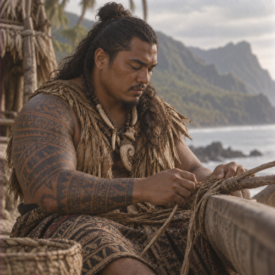
Oceanian traditions continue to find expression through tattoos, dance, chants, visual art, canoe building, navigation, and oral storytelling. These practices can preserve history, identity, knowledge, and relationships between generations while adapting to contemporary life. Cultural initiatives across the Pacific also work to maintain Indigenous languages and transmit traditional knowledge to younger generations.
Today, the traditional stories of Oceania remain living parts of many Pacific cultures and communities. Rather than representing a single mythology, they form a vast collection of distinct traditions shaped by individual islands, languages, histories, landscapes, and relationships with the sea. Together, they provide a rich record of how Pacific peoples have understood their origins, their communities, the natural world, and their place within it.