
Xibalba : The Maya Underworld Beneath the Earth
| Description | |
|---|---|
| Mythology | Mayan Mythology |
| Description | Place of fright, Subterranean court of trials |
| Ruler/Guardian | Hun-Came, Vucub-Came |
| Inhabitants | Spirits, Lords, Predators |
| Nature | Punishment |
Mythlok Perspective
From the Mythlok perspective, Xibalba is best understood not as a place of punishment but as an elemental domain of ordeal and transition. Where the Maya heavens express order and continuity, Xibalba embodies descent, uncertainty, and the intelligence required to endure fear. Comparable ideas surface in the Egyptian Duat and the Norse Hel, realms where passage matters more than judgment and survival depends on knowledge rather than virtue. Xibalba reminds us that mythology often frames death not as an end to be rewarded or condemned, but as a necessary crossing that reshapes existence itself.
Xibalba
Introduction
Xibalba, meaning “Place of Fright” in the K’iche’ Maya language, stands as one of the most intricate and psychologically charged visions of the underworld in global sacred traditions. Rather than offering moral reward or eternal punishment, Xibalba reflects the Maya understanding of death as an unavoidable passage shaped by fear, deception, and endurance. Deeply rooted in caves, cenotes, and subterranean waters, it represents the realm most souls must face after death. Its most complete narrative expression appears in the Popol Vuh, where the descent of the Hero Twins reframes the underworld not as an end, but as a testing ground where intelligence and adaptability outweigh brute strength.
Description
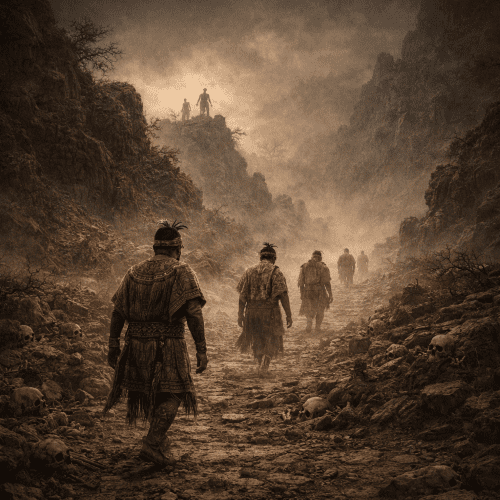
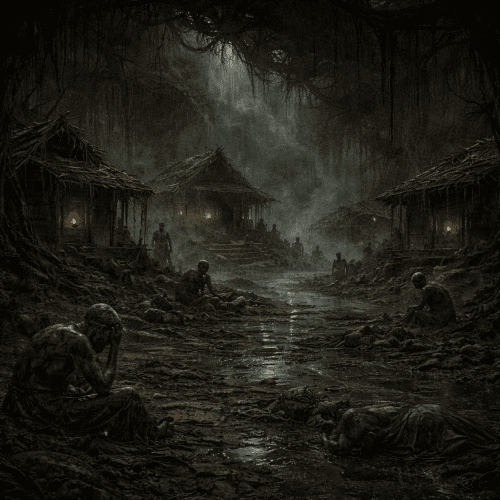
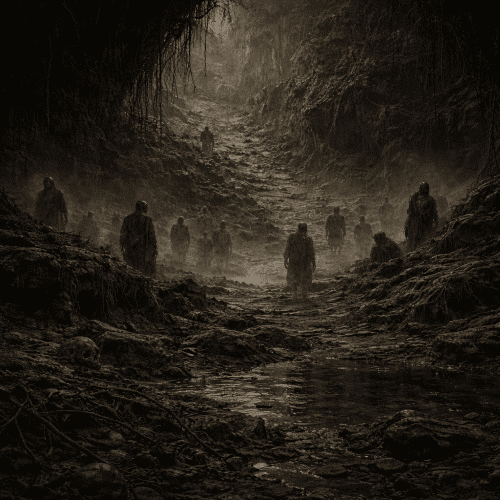
Xibalba is envisioned as a vast underground domain structured as a city of decay and ritual danger. Ancient sources describe it as lying beneath the earth’s surface, reached through steep descents and guarded pathways. The realm is defined by a sequence of deadly environments designed to confuse, humiliate, and destroy visitors. Rivers of scorpions, blood, and pus mark the approach, followed by a crossroads of speaking roads colored red, white, yellow, and black, each meant to mislead the unwise. Within Xibalba stand the infamous Houses of Trial, where darkness, extreme cold, jaguars, fire, blades, and bats test the limits of survival. Maya cosmology often describes Xibalba as having nine layers, a number echoed in the stepped architecture of royal tomb pyramids. The entire realm is anchored symbolically beneath the world tree, whose roots pierce the underworld while its trunk and branches bind earth and sky.
Ruler/Guardian
Authority in Xibalba rests with Hun-Came, “One Death,” and Vucub-Came, “Seven Death,” the supreme lords of the underworld. These rulers preside over a council of death deities who govern specific forms of human suffering, including disease, pain, blood loss, and physical decay. Far from passive judges, the Lords of Xibalba are active tricksters who summon mortals and heroes into rigged contests meant to ensure failure. Figures such as Xiquiripat and Cuchumaquic spread illness through blood, while others induce swelling, stabbing pains, or skeletal collapse. Though once feared and appeased through ritual offerings, these lords are ultimately exposed as fallible beings, capable of being deceived and defeated through wit rather than force.
Inhabitants
Beyond its ruling council, Xibalba is populated by a host of malevolent and impersonal entities that carry out its grim functions. Shrieking bats armed with blade-like wings patrol the skies, owls act as messengers and executioners, and spectral attendants enforce the trials imposed by the lords. Demonic ballplayers challenge visitors in contests designed to humiliate or kill, reflecting the sacred yet dangerous role of the ballgame in Maya culture. These inhabitants are not embodiments of moral evil but agents of inevitability, sustaining the machinery of death rather than judging the worth of souls.
Access
Entrances to Xibalba were believed to exist in places where the earth opened itself: caves, sinkholes, and water-filled cenotes. In the northern Maya world, cenotes held particular importance, as entering the water symbolized both death and return to the womb of creation. Caves in regions such as modern-day Guatemala and Belize were seen as living portals where rituals, blood offerings, and sacrifices connected the human world to the underworld. Some Maya traditions also associated the Milky Way with the celestial road to Xibalba, linking the fate of souls to astronomy as well as geography. Access was not voluntary for most; only heroes or those who died violent or unusual deaths were believed to bypass its trials.
Instances of Visit
The most famous descent into Xibalba is undertaken by the Hero Twins, Hunahpu and Xbalanque. Summoned by the Lords of Death after their ballgame echoed through the underworld, they retraced the fatal path that had once claimed their father, Hun Hunahpu. Unlike their predecessors, the twins survived the deceptive crossroads and endured the Houses of Trial through clever improvisation and strategic sacrifice. Their eventual defeat of the Lords of Xibalba, achieved through feigned deaths and resurrection, dismantled the authority of the underworld gods. This victory restores cosmic balance and culminates in the transformation of the twins into celestial bodies, often interpreted as the sun and the moon.
Symbolism
Xibalba embodies the Maya view of existence as cyclical rather than morally linear. It represents fear not as punishment but as an essential threshold of transformation. Its association with water, caves, and maize agriculture reinforces the idea that death feeds life, just as buried seeds yield crops. The nine-layered descent mirrors stages of initiation, while the inversion of the thirteen heavens above maintains cosmic equilibrium. Xibalba teaches that survival depends on awareness, memory, and adaptability, reflecting a worldview where wisdom, not virtue alone, determines fate.
Comparative Analysis
When compared to Greek Hades, Xibalba similarly lacks moral judgment, yet it is far more hostile and deceptive in its structure. Norse Hel shares the bleak neutrality of the Maya underworld, though it lacks Xibalba’s elaborate trials. Egyptian Duat parallels Xibalba in its series of dangerous passages, but the Maya realm replaces judgment rituals with tests of intelligence and endurance. What distinguishes Xibalba most clearly is its emphasis on the sacred ballgame and the triumph of twins, symbols of duality and balance rather than solitary heroism.
Modern Influence
Xibalba continues to shape modern imagination and cultural practice. Sacred caves and cenotes remain central to contemporary Maya rituals, preserving the ancient understanding of the underworld as a living presence. In popular culture, Xibalba has influenced films, novels, and video games that emphasize descent narratives and psychological trials, while archaeological tourism around cenotes and cave systems draws global attention to Maya cosmology. Academic scholarship and indigenous storytelling alike continue to reinterpret Xibalba not as a relic of fear, but as a profound metaphor for human confrontation with mortality.
Sources
Christenson, A. J. (2007). The Popol Vuh: The definitive edition of the Mayan book of the dawn of life and the glories of gods and kings. Mesoweb.
EBSCO Research Starters. (2018). The Lords of Xibalba (Mayan myth). https://www.ebsco.com/research-starters/religion-and-philosophy/lords-xibalba-mayan-myth
Freidel, D., Schele, L., & Parker, J. (1993). Maya cosmos: Three thousand years on the shaman’s path. William Morrow.
National Geographic Society. (2012, February 24). Underworld. https://www.nationalgeographic.com/travel/article/underworld
Taube, K. A. (2004). Death and the underworld in Maya iconography. Ancient Mesoamerica, 15(1), 93–106. https://doi.org/10.1017/S095653610400108X
Tedlock, D. (Trans.). (1996). Popol Vuh: The definitive edition of the Mayan book of the dawn of life and the glories of gods and kings. HarperPerennial.
Wikipedia contributors. (2026). Xibalba. In Wikipedia, The Free Encyclopedia. Retrieved January 20, 2026, from https://en.wikipedia.org/wiki/Xibalba
World History Encyclopedia. (2014, October 20). Xibalba. https://www.worldhistory.org/Xibalba/
Frequently Asked Questions
What is Xibalba in Maya belief?
Xibalba is the Maya underworld, understood as a realm of fear, trials, and inevitable descent rather than moral punishment. Most souls were believed to pass through Xibalba after death, where they encountered deception, hardship, and testing environments that reflected the Maya view of death as a transformative stage in the cosmic cycle.
Who ruled Xibalba?
Xibalba was ruled by Hun-Came (“One Death”) and Vucub-Came (“Seven Death”), the supreme Lords of Death. They presided over a council of other underworld deities who governed disease, pain, bloodshed, and decay, actively interfering in human life rather than judging souls after death.
How did the Maya believe one entered Xibalba?
The Maya believed Xibalba could be entered through natural openings in the earth such as caves, cenotes, and deep sinkholes, which were seen as living portals to the underworld. In some traditions, the Milky Way was also viewed as a cosmic road leading souls toward Xibalba after death.
Why is Xibalba important in the Popol Vuh?
Xibalba is central to the Popol Vuh because it is the setting of the Hero Twins’ descent and confrontation with the Lords of Death. Their successful navigation of Xibalba’s trials restores cosmic balance and demonstrates that intelligence, memory, and adaptability can overcome even the forces of death.
Is Xibalba similar to hell?
Xibalba is not comparable to hell in the later moral sense of eternal punishment. It lacks judgment based on good or evil and instead functions as a neutral but hostile realm of testing, where fear and endurance are universal experiences rather than consequences of moral failure.