


Indian Creation Story : The Legend of Hiranyagarbha
Mythlok Perspective
In Mythlok’s Perspective, the Indian Creation Story of Hiranyagarbha stands apart because it treats creation not as a simple event but as a living philosophical process. The cosmic egg represents both the birth of the universe and the awakening of consciousness itself. Unlike many mythologies that separate gods from creation, Hiranyagarbha suggests that existence and divinity are deeply interconnected. This idea closely parallels the Orphic Egg of Greek tradition and the cosmic egg of Chinese mythology, where creation emerges through division and transformation. Yet the Indian interpretation adds a uniquely metaphysical dimension by linking creation directly to universal consciousness and cyclical existence.
Indian Creation Story
Introduction
The Indian Creation Story surrounding Hiranyagarbha is one of the oldest and most philosophical origin myths in human civilization. The Sanskrit word Hiranyagarbha translates to “Golden Womb” or “Golden Egg,” symbolizing the cosmic source from which all existence emerged. First appearing in the Rigveda, particularly in the famous Hiranyagarbha Sukta (Rigveda 10.121), this concept later evolved through the Upanishads, Puranas, and Vedantic philosophy.
Unlike many creation myths that focus solely on gods shaping the world, the Indian Creation Story presents creation as a cosmic unfolding from a unified source. Before the heavens, the earth, or even time itself existed, there was only darkness and the endless cosmic waters. Within this vast emptiness appeared Hiranyagarbha, the radiant golden egg containing the potential of all life, matter, consciousness, and existence itself.
The story is both mythological and philosophical. It explains not only how the universe began but also how all forms of existence remain interconnected through a single cosmic origin. Over thousands of years, Hiranyagarbha became one of the defining symbols of Indian cosmology and spiritual thought.
Cosmic Origins
According to Vedic and Purāṇic traditions, creation began after a great cosmic dissolution known as Mahapralaya. During this state, nothing moved, no worlds existed, and darkness covered everything. The universe remained submerged within primordial waters, representing undifferentiated potential.
From this void emerged Svayambhu, the self-existent and self-born cosmic principle. This being was beyond ordinary perception and existed before creation itself. Svayambhu created the primordial waters and placed within them the seed of existence. That seed transformed into Hiranyagarbha, the glowing cosmic egg that floated in the waters of creation.
The Rigveda describes Hiranyagarbha as the primal force that existed before gods, humans, or the universe. The hymn praises this cosmic source as the origin of heaven, earth, and all living beings. Later Upanishadic interpretations linked Hiranyagarbha with Brahman, the universal and infinite consciousness underlying reality.
The cosmic egg remained suspended in darkness for a divine period before the process of manifestation began. This image of the golden egg floating upon endless waters became one of the most enduring metaphors in Indian cosmology.
Deities and Forces Involved
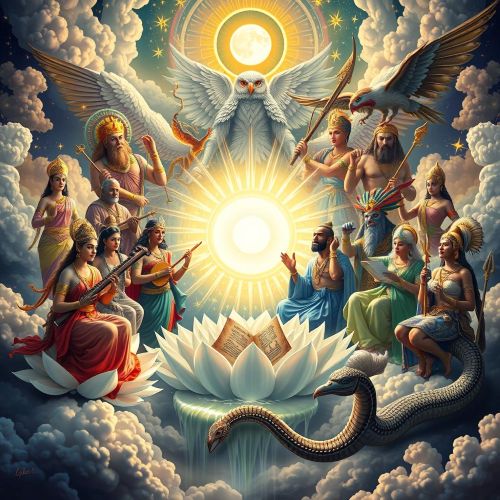
Several divine figures and cosmic principles are connected to the Indian Creation Story of Hiranyagarbha. Each tradition interprets the cosmic egg slightly differently, yet all agree on its role as the source of existence.
Prajapati, the lord of creation mentioned in the Rigveda, is often identified with Hiranyagarbha itself. In some traditions, Prajapati becomes the first conscious force to emerge from the cosmic egg and initiate creation.
Brahma later became the most widely recognized deity associated with Hiranyagarbha. Many Purāṇic accounts describe Brahma emerging from the golden egg before organizing the cosmos into heavens, earth, time, and living beings. Through Brahma, the universe gains structure and order.
Svayambhu also plays a foundational role as the self-manifested being who initiates creation by placing the cosmic seed into the primordial waters. In philosophical traditions such as Vedanta and Samkhya, Hiranyagarbha represents the bridge between the unmanifest absolute reality and the material universe.
Some Shaivite traditions interpret Hiranyagarbha as an expression of Shiva’s cosmic energy, while Vaishnavite traditions associate it with Vishnu resting upon the cosmic ocean before creation begins. Despite these differing theological interpretations, Hiranyagarbha remains the universal source from which creation unfolds.
Process
The Indian Creation Story describes creation as a gradual unfolding rather than an instant event. The process begins with the formation of the cosmic egg within the primordial waters. Inside Hiranyagarbha existed the potential for all forms of reality. The cosmic egg represented unity before division, containing heaven, earth, gods, time, and life within a single source. After a cosmic period of gestation, the egg split into two halves.
The upper half became Svarga, the heavens or celestial realm, while the lower half became Prithvi, the earth. Between them emerged the atmosphere and the cosmic space connecting all realms. The sun, moon, stars, oceans, mountains, and living beings gradually took shape from this original division.
Brahma then organized the newly formed universe. He established natural laws, cycles of day and night, and the rhythm of creation and destruction that governs existence. In several traditions, sacred rituals known as yajnas also play a role in sustaining and energizing creation.
Unlike linear creation stories, the Indian Creation Story emphasizes cyclical existence. The universe is repeatedly created, preserved, dissolved, and reborn across endless cosmic ages. Hiranyagarbha therefore represents not only the first creation but also the eternal process of cosmic renewal.
Symbolism
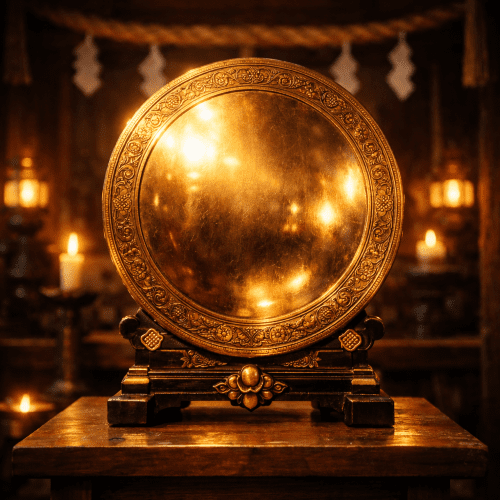
Hiranyagarbha carries deep symbolic meaning within Indian philosophy and spirituality. The image of the golden egg represents far more than a literal origin story. The golden color symbolizes purity, divinity, illumination, and spiritual perfection. Gold does not decay easily, making it an ideal symbol for eternal cosmic truth. The egg itself represents hidden potential, transformation, and birth. Before the egg opens, all possibilities remain contained within a unified form.
The dual meaning of garbha as both womb and embryo reflects the union of masculine and feminine creative forces. Hiranyagarbha therefore symbolizes the complete source of existence beyond ordinary divisions. In philosophical thought, Hiranyagarbha also represents the emergence of consciousness from the unmanifest absolute. The universe is not seen as separate from the divine but as an expression of cosmic consciousness itself.
The cyclical nature of the story mirrors the larger framework of Indian cosmology, where creation and destruction continuously repeat across infinite time. This understanding deeply influenced Indian spiritual traditions, emphasizing unity, interconnectedness, and transformation rather than a single fixed beginning.
Comparative Analysis
The cosmic egg motif appears in many cultures around the world, making Hiranyagarbha part of a broader human attempt to explain creation. In Greek Orphic tradition, the universe emerged from the Orphic Egg, from which the primordial being Phanes was born. Like Hiranyagarbha, the egg represented the source of cosmic order and divine life.
Chinese mythology tells of Pangu, who emerged from a cosmic egg and separated heaven from earth. The theme of division creating the structure of the universe closely resembles the Indian account. In the Finnish Kalevala, the world forms from fragments of a bird’s egg floating upon cosmic waters. Egyptian mythology also includes creation imagery connected to primordial waters and cosmic birth.
What makes the Indian Creation Story unique is its strong philosophical depth. Hiranyagarbha is not simply a container for creation but is often equated with the ultimate reality itself. The story combines mythology, cosmology, and metaphysical inquiry into a single symbolic framework. These similarities across cultures reveal how ancient civilizations independently used the egg as a universal symbol of birth, potential, and cosmic unity.
Legacy
The concept of Hiranyagarbha became one of the foundational ideas in Indian philosophy and religion. Its influence extends from Vedic literature to later Hindu schools of thought. The Hiranyagarbha Sukta of the Rigveda remains one of the most studied hymns in Vedic scholarship because it reflects early movements toward monistic and philosophical thinking. Later Upanishads expanded the idea by identifying Hiranyagarbha with Brahman, the universal soul.
In Advaita Vedanta, Hiranyagarbha became associated with cosmic consciousness and the manifested universe. The concept also influenced yogic traditions, where Hiranyagarbha is sometimes regarded as the primordial teacher of yoga. The cosmic egg model shaped Indian understandings of time, cosmology, divine order, and the relationship between spirit and matter. Its symbolic power ensured that it remained relevant across multiple schools of Indian thought for thousands of years.
Modern Influence
Even today, the Indian Creation Story of Hiranyagarbha continues to inspire spirituality, philosophy, and modern interpretations of cosmology. In yoga and meditation traditions, Hiranyagarbha symbolizes the universal consciousness that practitioners seek to realize within themselves. The idea of all existence emerging from a single source also resonates strongly with modern spiritual movements emphasizing unity and interconnectedness.
Comparative mythologists frequently study Hiranyagarbha alongside other global creation myths to understand shared symbolic patterns in human culture. Some modern thinkers even compare the cosmic egg concept to scientific theories about the universe originating from a singular point, although these comparisons remain symbolic rather than literal.
The imagery of the golden egg also appears in literature, visual art, films, and popular culture inspired by Indian mythology. Its enduring appeal lies in its ability to combine mystery, philosophy, and cosmic imagination into one timeless symbol.


Sources
Cornelia Dimitt, & J. A. van Buitenen (Eds. & Trans.). (1978). Classical Hindu mythology: A reader in the Sanskrit Purāṇas. Temple University Press.
O’Flaherty, W. D. (1981). Rig Veda. Penguin Books.
Griffith, R. T. (Trans.). (n.d.). The Hymns of the Rigveda. (Original work published circa 1500–1200 BCE)
Anonymous. (n.d.). Hiranyagarbha. Hinduism Encyclopedia. Retrieved from https://hinduism.en-academic.com/328/hiranyagarbha
Wikipedia contributors. (2005, December 23). Hiranyagarbha. Wikipedia. Retrieved from https://en.wikipedia.org/wiki/Hiranyagarbha
Sadhana Sansar. (2024, July 4). The Hiranyagarbha Sukta. Sadhana Sansar. Retrieved from https://www.sadhana-sansar.com/post/the-hiranyagarbha-sukta
Wisdom Library. (2024, September 17). Hiranyagarbha: Significance and symbolism. Wisdom Library. Retrieved from https://www.wisdomlib.org/concept/hiranyagarbha
The Apna Mandir. (2024, May 5). Was the golden egg created first in Hindu mythology? Apna Mandir Blog. Retrieved from https://www.theapnamandir.com/blogs/apna-mandir/was-the-golden-egg-created-first-in-hindu-mythology
Faron, A. (2024). The Cosmic Egg: Hiranyagarbha in Hindu Creation Myths. Hindu Cosmology.
Kohli, S. S. (1993). Dictionary of Mythological References in Guru Granth Sahib. Sikh Encyclopedia.
Frequently Asked Questions
What is the meaning of Hiranyagarbha in the Indian Creation Story?
Hiranyagarbha means “Golden Womb” or “Golden Egg” and represents the cosmic source from which the universe emerged.
Which text first mentions Hiranyagarbha?
Hiranyagarbha first appears in the Rigveda, especially in the Hiranyagarbha Sukta of Rigveda 10.121.
Who emerged from the cosmic egg in Indian mythology?
Many traditions state that Brahma emerged from Hiranyagarbha and began organizing the universe.
Why is the cosmic egg important in Indian mythology?
The cosmic egg symbolizes creation, unity, hidden potential, and the interconnected nature of existence.
How is Hiranyagarbha different from other creation myths?
The Indian Creation Story combines mythology with philosophy, presenting creation as both a cosmic and spiritual process.
