

Kalevala : Finland’s Epic of Heroes, Magic, and Creation
Listen
At a glance
| Attribute | Description |
|---|---|
| Mythology | Finnish Mythology |
| Language Written | Finnish |
| Age | Circa 1835 CE |
| Author | Elias Lönnrot |
| Main Characters | Väinämöinen, Ilmarinen, Lemminkäinen, Louhi, Kullervo, Joukahäinen |
Mythlok Perspective
In Mythlok’s Perspective, the Kalevala represents one of the clearest surviving windows into northern European mythic consciousness. Its emphasis on song-magic, natural spirits, and tragic fate reflects a worldview where knowledge and language are the true sources of power. Across cultures, similar narrative roles appear in other epics. Väinämöinen resembles bardic sages like Orpheus in Greek tradition, whose music could influence the natural world. The magical Sampo echoes cosmic artifacts such as the Hindu Kalpavriksha or Norse Yggdrasil, symbols of prosperity and cosmic order. These parallels reveal that despite geographic distance, many cultures imagined the universe through similar mythic patterns of creation, wisdom, and sacred power.
Kalevala
Introduction
The Kalevala is the national epic of Finland and one of the most important works of European folklore literature. Compiled in the 19th century by Finnish scholar Elias Lönnrot, the Kalevala preserves centuries of oral poetry and mythic storytelling from the Finnish and Karelian peoples. These poems, known as runes, were traditionally sung by villagers and storytellers and passed down through generations long before they were ever written down.
More than just a literary achievement, the Kalevala represents the mythic worldview of the ancient Finnic peoples. Its stories combine creation myths, magical contests, heroic adventures, tragic romances, and encounters with powerful spirits. The epic’s central narrative follows the struggles between the heroes of Kalevala and the mysterious northern land of Pohjola, often revolving around the magical artifact known as the Sampo.
The Kalevala also played a major role in shaping modern Finnish identity. At a time when Finland was under Russian rule, the epic helped inspire a cultural awakening that strengthened the Finnish language, arts, and national pride. Today, the Kalevala remains a defining cultural symbol and continues to influence literature, music, and global fantasy storytelling.
Historical Background
The Kalevala did not originate as a single written work. Instead, it emerged from a vast tradition of oral poetry that had existed for centuries across Finland and Karelia. These poems were performed in a distinctive rhythmic style known as trochaic tetrameter, now commonly called the Kalevala meter. This poetic form, characterized by repetition, rhythm, and alliteration, made it easy for singers to memorize and improvise long narratives.
During the early 19th century, Finnish physician and folklorist Elias Lönnrot began collecting these oral poems. Between 1828 and 1844 he traveled extensively through eastern Finland and Russian Karelia, recording thousands of verses from local singers. Many of these singers were elderly villagers who had inherited the songs through generations of tradition.
Lönnrot eventually gathered tens of thousands of lines of poetry and arranged them into a coherent narrative. His first version, called the Old Kalevala, was published in 1835 and contained 12,078 verses divided into 32 poems. He continued collecting additional material and revised the work into a larger edition known as the New Kalevala, published in 1849 with 50 poems and nearly 23,000 lines.
Although Lönnrot shaped the material into a structured story, much of the content came directly from ancient folklore. Scholars still debate how much of the final text represents original folk tradition and how much was edited or composed by Lönnrot to create narrative continuity.
Regardless of this debate, the Kalevala became a cultural milestone. It helped elevate the Finnish language at a time when Swedish and Russian dominated official life. The epic also inspired artists, musicians, and intellectuals during Finland’s national awakening, eventually contributing to the country’s independence in 1917.
Synopsis & Themes
The Kalevala begins with a creation myth that explains the origin of the world. The sky maiden Ilmatar descends into the primordial sea and becomes pregnant by the winds. When a bird lays eggs upon her knee, the eggs break apart and transform into the earth, sky, sun, moon, and stars. From Ilmatar is born the hero Väinämöinen, who becomes one of the central figures of the epic.
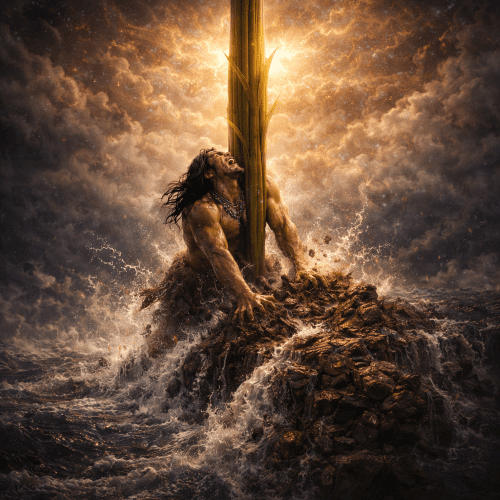
Väinämöinen is a wise singer and powerful magician whose songs can reshape reality. Throughout the epic he competes with rival sorcerers, journeys through mystical realms, and seeks knowledge through magical incantations. Another major storyline revolves around the mysterious Sampo, a magical device forged by the divine smith Ilmarinen. The Sampo is said to produce endless prosperity, grain, and wealth. After it is created for Louhi, the ruler of the northern land Pohjola, the heroes of Kalevala attempt to steal it back. This quest leads to conflict and eventually a great battle in which the Sampo is shattered.
The epic also contains tragic stories that explore the darker side of human nature. One of the most famous is the tale of Kullervo, a boy raised in slavery who grows into a violent and tormented figure. His life ends in tragedy after he unknowingly seduces his own sister, a story that reflects themes of fate, revenge, and moral consequence.
Another powerful moment is the fate of Aino, who rejects an arranged marriage to Väinämöinen and chooses death in the sea rather than surrender her freedom. Her story reflects the emotional depth present throughout the epic. Across its many narratives, the Kalevala explores themes of magic, nature, destiny, and human suffering. Songs and words carry immense power in the epic world, reflecting ancient shamanistic traditions where spoken incantations could influence the forces of nature.
Key Characters
The Kalevala features a rich cast of mythic figures who represent wisdom, craftsmanship, passion, and tragedy. Väinämöinen is the central hero of the epic. He is a wise old bard whose magical songs can control the elements and defeat enemies. He is also credited with creating the kantele, a traditional Finnish string instrument.
Seppo Ilmarinen is the legendary smith who forges the Sampo and other magical objects. He represents creativity, craftsmanship, and technological skill within the epic world. Lemminkäinen is a bold and reckless adventurer known for his charm and impulsive behavior. His journeys include a dangerous quest to the underworld river of Tuonela, where he is killed and later resurrected by his devoted mother.
Louhi, the Mistress of Pohjola, is one of the most powerful figures in the epic. She is both a ruler and a sorceress who commands powerful magic. Although often portrayed as an antagonist, she is also a complex character who protects her homeland and people. Kullervo is perhaps the most tragic character in the Kalevala. His life is defined by betrayal, suffering, and vengeance, making his story one of the darkest and most emotionally powerful sections of the epic. These characters embody archetypal roles found across world traditions: the wise sage, the divine craftsman, the reckless hero, the powerful sorceress, and the doomed warrior.
Cultural & Religious Significance
The Kalevala reflects the ancient spiritual beliefs of the Finnic peoples before the widespread adoption of Christianity. Many elements of the epic reveal traces of animism and shamanism, where natural forces such as forests, rivers, and animals were believed to possess spirits.
The epic also references the sky god Ukko, who was associated with thunder and weather. Ritual practices such as bear worship and sacred songs appear throughout the stories, suggesting deep connections between myth, nature, and daily life in ancient Finland. Beyond religion, the Kalevala became a powerful cultural symbol. The epic helped establish the Finnish language as a respected literary medium during a time when Swedish dominated education and administration.
Today the legacy of the Kalevala remains visible across Finnish culture. February 28 is celebrated as Kalevala Day, also known as Finnish Culture Day. Art, music, literature, and even place names throughout Finland continue to draw inspiration from the epic.
Modern Adaptations
The influence of the Kalevala extends far beyond Finland and continues to inspire artists around the world. One of the most famous painters associated with the epic is Akseli Gallen-Kallela, whose dramatic paintings of Kalevala scenes helped shape the visual identity of Finnish mythic storytelling.
Music has also been deeply influenced by the epic. Composer Jean Sibelius created several works inspired by Kalevala stories, including the Kullervo Symphony and The Swan of Tuonela. These compositions brought the epic’s themes to international audiences.
The Kalevala also left a lasting impact on modern fantasy literature. Author J.R.R. Tolkien studied the epic during his academic career and drew inspiration from it while developing the mythology of Middle-earth. The tragic character of Kullervo in particular influenced Tolkien’s creation of Túrin Turambar.
Modern adaptations continue to appear in film, comics, music, and video games. Finnish metal bands frequently incorporate Kalevala themes into their lyrics, while contemporary novels and graphic works reinterpret the epic’s stories for new audiences. Through these reinterpretations, the Kalevala continues to evolve as a living cultural tradition rather than simply a historical text.
Source
Lönnrot, E. (1849). Kalevala (W. F. Kirby, Trans., 1907). Everyman’s Library.
Crawford, J. M. (1888). The Kalevala: Epic of the Finnish people (Vols. 1–2). J. B. Lippincott.
Kuusi, M., Bosley, A., & Branch, M. (Eds.). (1997). Finnish folk poetry: Epic. Finnish Literature Society.
Honko, L. (1990). Religion and the Finns of Karelia. In M. Hoppál (Ed.), Finnish folk belief (pp. 21–36). Academia Scientiarum Fennica.
Finland.fi. (2026, February 25). 8 questions on the Kalevala, the epic that shaped Finland’s identity.
https://finland.fi/arts-culture/8-questions-on-the-kalevala-the-epic-that-shaped-finlands-identity/
EBSCO Research Starters. (2018). Kalevala by Elias Lönnrot. https://www.ebsco.com/research-starters/literature-and-writing/kalevala-elias-lonnrot
HerFinland. (2024, May 13). Kalevala of Finland: Exploring the world of the national epic. https://herfinland.com/kalevala-finland/
Wikipedia. (2024). Kalevala. https://en.wikipedia.org/wiki/Kalevala
Frequently Asked Questions
What is the Kalevala?
The Kalevala is the national epic of Finland, compiled by Elias Lönnrot in the 19th century from traditional Finnish and Karelian oral poetry.
Who wrote the Kalevala?
The Kalevala was compiled by Finnish scholar Elias Lönnrot, who collected thousands of lines of oral folklore during field expeditions.
What is the Sampo in the Kalevala?
The Sampo is a magical object forged by Ilmarinen that brings prosperity and wealth, becoming the central focus of conflict in the epic.
Who is the main hero of the Kalevala?
The primary hero is Väinämöinen, a wise singer and magician whose songs possess powerful supernatural abilities.
How did the Kalevala influence modern culture?
The Kalevala inspired Finnish national identity, influenced composers like Jean Sibelius, and helped shape fantasy literature, including the works of J.R.R. Tolkien.