

Navajo Creation Story : Journey Through the Four Worlds
| Description | |
|---|---|
| Origin | Navajo Mythology |
| Country | United States of America |
| Deities Involved | Holy Wind, Holy People, First Man, First Woman, Changing Woman |
| Symbolism | Four worlds, Corn, Wind, Cardinal directions, Harmony |
| Process | Emergence through four worlds, guided by Holy People, culminating in the Fourth World |
Mythlok Perspective
In Mythlok’s View, the Navajo Creation Story presents creation as a journey of correction rather than perfection. It frames existence as a continuous movement toward balance, where mistakes are necessary for growth. Unlike many traditions that center divine authority, this narrative emphasizes relational harmony between beings and environment. This approach closely mirrors the cyclical time of Indian Yugas and the layered emergence seen in Hopi traditions. Yet, the Navajo focus on ecological balance and gender duality offers a distinct worldview where survival depends not on dominance, but on alignment.
Navajo Creation Story
Introduction
The Navajo Creation Story, known as Diné Bahaneʼ, is the spiritual foundation of the Navajo people. It is not simply a myth of beginnings but a living philosophy that explains how the Diné emerged into the present world and how they are meant to live within it. Passed down through oral tradition by elders and medicine people, the story teaches balance, responsibility, and harmony—what the Diné call Hózhó.
At its core, the narrative describes a gradual emergence through multiple worlds, each representing stages of growth, conflict, and transformation. These worlds are not just physical realms but moral landscapes where behavior determines survival. As the Diné moved upward, they learned essential lessons about coexistence, respect, and the consequences of imbalance.
The Navajo Creation Story continues to shape ceremonies such as the Blessingway, reinforcing the idea that life must be lived in alignment with cosmic order. Even today, it remains central to Diné identity, land connection, and worldview.
Cosmic Origins
The Navajo Creation Story begins in the First World, often described as a dark, mist-filled realm known as Niʼ Hodiłhił. This world was small and fragile, surrounded by water and defined by four sacred clouds positioned in the cardinal directions. Each cloud carried a color and symbolic meaning: black in the north, white in the east, blue in the south, and yellow in the west.
From the meeting of these clouds came the first beings, including First Man and First Woman. They were not fully human in the way we understand today, but more like mist-forms—fluid and undefined, representing potential rather than completion. Life existed in a dim and uncertain state, populated by insect-like beings and spirit entities.
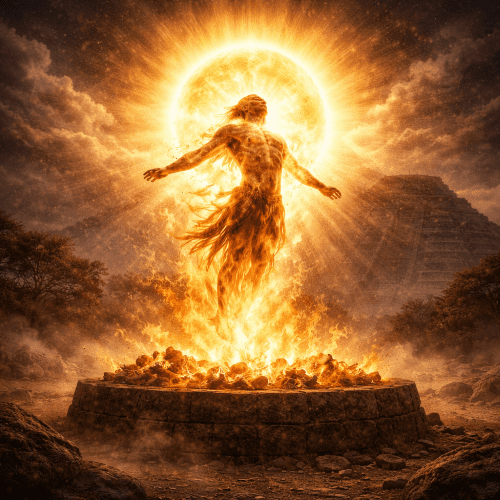
A vital force known as Holy Wind, or Niłchʼi Diyin, animated everything. This breath-like energy was not just physical but spiritual, giving movement, awareness, and purpose to all beings. In Diné belief, this wind continues to exist within every person, linking them directly to creation itself. The First World eventually became unstable due to overcrowding and conflict. This instability set the pattern for the entire narrative: when harmony breaks, transformation becomes necessary.
Deities and Forces Involved
The Navajo Creation Story features a complex network of beings and forces rather than a single creator figure. Central among them is Holy Wind, the invisible force that gives life and consciousness. Without it, nothing could move or exist with purpose.
First Man (Áłtsé Hastiin) and First Woman (Áłtsé Asdzą́ą́) serve as foundational figures. They are associated with white and yellow corn, symbolizing sustenance, fertility, and balance between masculine and feminine energies. Their partnership represents the necessity of duality in maintaining harmony.
The Holy People, or Diyin Dineʼé, act as guides throughout the emergence. These beings include figures like Talking God, Water Sprinkler, and later Changing Woman, who becomes central to life and renewal in the Fourth World. They are not distant gods but active participants who shape the environment and teach moral order.
Coyote also plays a critical role as a disruptive force. Known for trickery and impulsive behavior, Coyote introduces chaos into the system. His actions often trigger major events, including the flood that forces movement between worlds. Rather than being purely evil, he represents imbalance and the consequences of poor choices. Together, these figures embody a universe governed by relationships, where creation, destruction, and renewal exist in constant tension.
Process
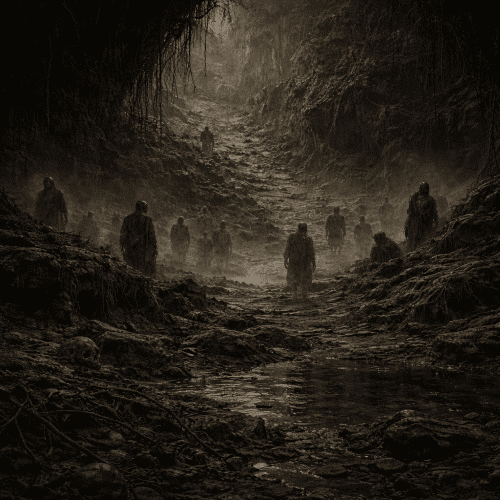
The Navajo Creation Story unfolds through a sequence of four worlds, each marking a stage in spiritual and social evolution. In the First World, life existed in a simple but unstable form. Conflict among its inhabitants made it impossible to remain, leading to the first emergence. The beings moved upward through an opening, often described as a reed or passage.
The Second World introduced animals and birds, creating a more complex environment. Initially, the newcomers were welcomed, but their behavior soon caused friction. Once again, disharmony led to expulsion, reinforcing the lesson that survival depends on respectful coexistence.
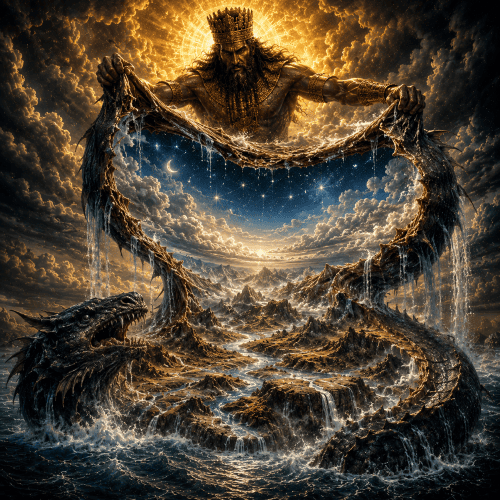
The Third World was more developed, featuring rivers, mountains, and early forms of culture. It was here that major events unfolded, including the separation of sexes and the rise of deeper conflicts. The turning point came when Coyote stole the children of a powerful water being, triggering a catastrophic flood. Guided by spiritual leaders, the people escaped by climbing through a reed into the next world.
The Fourth World, also known as the Glittering or White World, is the present world. Here, the Diné became fully human, and the structure of life as we know it was established. The sun, moon, and stars were placed in the sky, and sacred mountains defined the land. It is also in this world that death became permanent, marking a shift from cyclical existence to a more fixed reality. Each stage of emergence represents purification through experience, showing that growth comes from overcoming imbalance.
Symbolism
Symbolism lies at the heart of the Navajo Creation Story, with the number four serving as its central framework. The four worlds, four directions, four colors, and repeated cycles all emphasize completeness and balance.
The cardinal directions carry deep meaning. East represents beginnings and clarity, south reflects growth and emotion, west symbolizes relationships and reflection, and north embodies wisdom and endurance. Together, they form a holistic map for living.
Corn is another powerful symbol. Associated with First Man and First Woman, it represents life, nourishment, and continuity. It also reflects the agricultural foundation of Diné culture. The reed used for emergence symbolizes transition and safe passage between states of being. It is both a physical and spiritual bridge, marking transformation.
Perhaps most importantly, the story emphasizes interconnectedness. Every action affects the whole, and imbalance in one area leads to disruption everywhere. This idea is central to Hózhó, the guiding principle of harmony and beauty in Diné life.
Comparative Analysis
The Navajo Creation Story shares structural similarities with other emergence and multi-stage creation narratives around the world. Among the Hopi, for example, life also emerges through layered worlds, guided by spiritual beings. Both traditions emphasize moral growth through movement rather than a single act of creation.
In Mesoamerican traditions such as the Popol Vuh, humanity is formed through multiple attempts, each refining what it means to be human. This parallels the Navajo idea of gradual perfection through experience.
Unlike the linear narrative of Book of Genesis, which presents a definitive beginning, the Navajo story is cyclical and process-driven. It aligns more closely with concepts like the Yugas, where worlds evolve through phases.
What sets the Navajo Creation Story apart is its strong emphasis on balance between genders, ecological awareness, and the idea that moral failure—not divine punishment—drives transformation.
Legacy
The Navajo Creation Story continues to function as a living cultural framework. It shapes ceremonies, storytelling traditions, and social structures within the Diné community. Practices like sandpainting and chantways are deeply rooted in its symbolism and teachings.
It also defines the sacred geography of Dinétah, the traditional Navajo homeland. Mountains, rivers, and landmarks are not just physical features but spiritual anchors tied directly to the emergence narrative.
Despite historical challenges, including colonization and forced assimilation, the story has endured. Scholars and Diné storytellers have worked to preserve it while maintaining its sacred integrity. Its continued transmission ensures that future generations remain connected to their origins and values.
Modern Influence
Today, the Navajo Creation Story remains deeply relevant. It informs environmental perspectives, with many Diné communities advocating for land protection based on their spiritual connection to nature.
In education, the story is taught in both traditional and modern contexts, often in bilingual formats that preserve the Navajo language. It also influences contemporary art, music, and literature, where its themes are reinterpreted for new audiences.
The concept of Hózhó has even found applications in wellness and therapy, offering a framework for healing that emphasizes balance and interconnectedness. As global interest in indigenous knowledge grows, the Navajo Creation Story stands as a powerful example of how ancient wisdom can guide modern life.

Sources
Lessons of Our Land. (2017). Four worlds: The Dine story of creation [PDF]. https://www.lessonsofourland.org/wp-content/uploads/2017/08/PreK_Lesson-1_Four-Worlds-Story-of-Creation.pdf
O’Bryan, A. (1992). The Diné: Origin myths of the Navaho Indians. In J. Mooney (Ed.), Sacred texts. https://archive.sacred-texts.com/nam/nav/omni/omni02.htm
Ohio University. (2020). The four worlds gallery. https://www.ohio.edu/museum/art/virtual-exhibitions-tours/pattern-disruption-virtual/pattern-weavings/four-worlds
Wikipedia contributors. (2026). Diné Bahaneʼ. Wikipedia. https://en.wikipedia.org/wiki/Din%C3%A9_Bahane%CA%BC
EBSCO. (n.d.). Navajo creation myth. Research Starters. https://www.ebsco.com/research-starters/religion-and-philosophy/navajo-creation-myth
Griffin-Pierce, T. (1992). Earth is My Mother, Sky is My Father: Space, Time, and Astronomy in Navajo Sandpainting. University of New Mexico Press.
Reichard, G. A. (1950). Navajo Religion: A Study of Symbolism. Princeton University Press.
Matthews, W. (1995). Navaho Legends. University of Utah Press.
Gill, S. D., & Sullivan, I. F. (1992). Dictionary of Native American Mythology. ABC-CLIO.
McNeley, J. K. (1981). Holy Wind in Navajo Philosophy. University of Arizona Press.
Frequently Asked Questions
What is the Navajo Creation Story about?
The Navajo Creation Story explains how the Diné emerged through four worlds, learning balance, harmony, and moral responsibility along the way.
How many worlds are in the Navajo Creation Story?
There are four main worlds, each representing stages of growth, conflict, and spiritual evolution before reaching the present world.
Who are First Man and First Woman?
They are the first human-like beings in the story, symbolizing balance, creation, and the foundation of Diné life.
What is the role of Coyote in the story?
Coyote represents chaos and imbalance, often causing events that force change and teach important lessons.
Why is the number four important in Navajo belief?
The number four symbolizes completeness, seen in directions, colors, worlds, and cycles within the Navajo worldview.