

Babylonian Creation Story : How Marduk Created the World from Tiamat
| Description | |
|---|---|
| Origin | Babylonian Mythology |
| Country | Iraq |
| Deities Involved | Tiamat, Apsu, Ea, Qingu, Marduk |
| Symbolism | Chaos vs. order, Cosmic sacrifice |
| Process | Union of waters, Conflict, Victory, Cosmos formed |
Mythlok Perspective
In Mythlok’s Perspective, the Babylonian Creation Story stands alongside the Norse tale of Ymir and the Vedic sacrifice of Purusha as one of mythology’s greatest examples of a universe born from a divine body. Yet it is uniquely Babylonian because creation is inseparable from politics. Marduk’s victory is not simply about defeating chaos, it is about establishing rightful leadership and giving Babylon a sacred place at the center of the cosmos. The myth reminds us that every civilization explains not only how the world began, but also why its own values, rulers, and social order deserve legitimacy.
Babylonian Creation Story
Introduction
The Babylonian Creation Story is one of the oldest surviving accounts of how the universe came into existence. Preserved in the ancient epic Enūma Eliš (“When on High”), the story was written in Akkadian and became closely associated with Babylon and its chief god, Marduk. Rather than describing creation as a peaceful act, the myth portrays the cosmos emerging through conflict. At its heart stands Tiamat, the primordial goddess of the salt sea, whose defeat transforms a chaotic universe into an ordered one.
More than a simple tale of gods at war, the Babylonian Creation Story explains why the world exists in its present form, how divine authority was established, and why Babylon regarded Marduk as the rightful ruler of both heaven and earth. It also reflects the Mesopotamian understanding of nature, where rivers, seas, storms, and celestial bodies were seen as living expressions of divine power. Thousands of years later, the story continues to fascinate historians, mythologists, and readers because of its profound influence on later religious traditions and world mythology.
Cosmic Origins
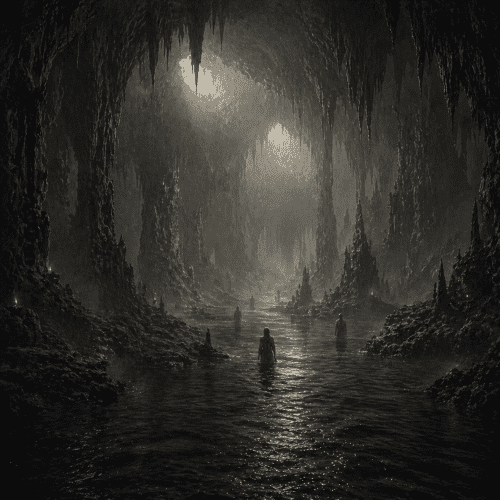
The Babylonian Creation Story begins before the existence of land, sky, or humanity. In the beginning there were only two primordial waters: Apsu, representing the fresh underground waters, and Tiamat, embodying the vast salt sea. Their mingling gave birth to the first generation of divine beings, making both deities the ancestors of the Mesopotamian pantheon.
From their union came Lahmu and Lahamu, followed by Anshar and Kishar, who in turn gave rise to Anu, the sky god. Anu fathered Ea (also known as Enki), the god of wisdom and magic. Each generation grew more powerful than the last, creating a universe filled with energetic young gods whose activity disturbed Apsu’s desire for silence.
Unlike many creation myths that begin with nothingness, the Babylonian Creation Story starts with water. For the people of Mesopotamia, whose civilization depended upon the life-giving rivers while constantly facing the threat of destructive floods, water symbolized both creation and danger. This duality lies at the heart of the myth.
Deities and Forces Involved
Several powerful figures shape the events of the Babylonian Creation Story, each representing different aspects of creation, authority, and cosmic balance. Tiamat begins as the nurturing mother of the gods and the personification of the salt sea. Although later traditions often portray her as a dragon-like monster, the Enūma Eliš primarily presents her as a primordial force of nature whose transformation into an enemy occurs only after tragedy strikes her family.
Apsu represents the fresh subterranean waters that sustain life. Frustrated by the younger gods’ constant noise, he decides to destroy them and restore the original silence. Before he can act, however, Ea discovers his plan and kills him using his superior magical knowledge.
The death of Apsu changes everything. Seeking justice, Tiamat creates an army of terrifying creatures, including giant serpents, horned beasts, scorpion-men, and other monstrous beings. She appoints Qingu as her new consort and grants him the Tablet of Destinies, a sacred object that symbolizes supreme divine authority.
The younger gods struggle to find someone willing to confront Tiamat until Marduk, the storm god and son of Ea, agrees to fight. In return, the assembled gods promise that if he wins, he will become their undisputed king. This agreement transforms the coming battle into both a cosmic conflict and a political statement about legitimate kingship.
Process
The central drama of the Babylonian Creation Story unfolds as a battle between the old forces of primordial chaos and the new generation of divine rulers.
After Apsu’s death, Tiamat prepares for war by assembling her monstrous army under Qingu’s command. Armed with powerful weapons and the authority of the Tablet of Destinies, her forces threaten the survival of the younger gods.
Marduk accepts the challenge after receiving absolute authority from the divine assembly. Carrying a bow, mace, and net while commanding the four winds, he confronts Tiamat in a decisive battle. He traps her with his net and unleashes powerful winds that force her mouth open, preventing her from closing it. At that moment, he fires an arrow that pierces her heart, ending the conflict.
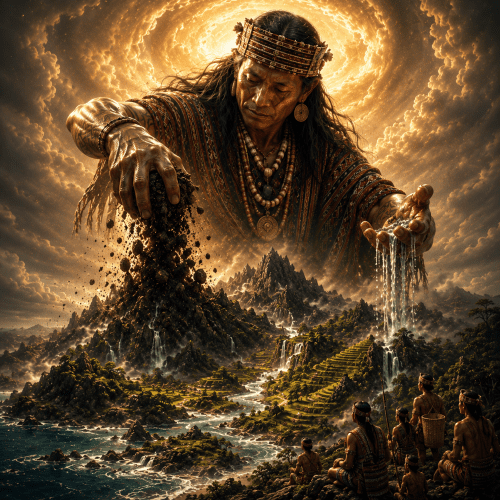
Victory alone does not complete creation. Marduk transforms Tiamat’s body into the structure of the universe. He divides her corpse into two halves, using one to create the heavens and the other to form the earth. He establishes the sky, fixes the stars in their places, regulates the movements of the moon, and organizes the calendar. Mesopotamian texts also describe rivers such as the Tigris and Euphrates flowing from parts of Tiamat’s body, emphasizing that even the world’s life-giving features originate from primordial chaos.
After defeating Tiamat, Marduk captures Qingu and removes the Tablet of Destinies. Humanity is then created from Qingu’s blood mixed with clay. According to the Enūma Eliš, humans are made to perform the labor of the gods, allowing the divine beings to devote themselves to governing the cosmos rather than maintaining it themselves.
Symbolism
The Babylonian Creation Story explores ideas that extend far beyond the origin of the physical world. At its core lies the relationship between chaos and order. Tiamat represents the unpredictable forces of nature that existed before civilization, while Marduk symbolizes the establishment of law, structure, and stability.
The myth also presents creation as an act of transformation rather than creation from nothing. The universe is built from existing divine matter, suggesting that order emerges by reshaping chaos instead of eliminating it completely. Even after her defeat, Tiamat remains part of the cosmos because the heavens and earth are literally formed from her body.
The Tablet of Destinies represents legitimate authority rather than mere physical strength. Possessing it signifies the right to rule, making Marduk’s victory both a military and political triumph. This reflects Babylon’s own rise to power, as the epic elevates Marduk above older Mesopotamian gods and presents Babylon as the divinely chosen center of the world.
Finally, humanity’s creation from Qingu’s blood highlights the Mesopotamian belief that people occupy a unique position between gods and nature. Humans possess a divine element but are expected to maintain temples, perform rituals, and support the cosmic order established by the gods.
Comparative Analysis
The Babylonian Creation Story shares striking similarities with creation myths from many cultures while remaining distinctly Mesopotamian in its message.
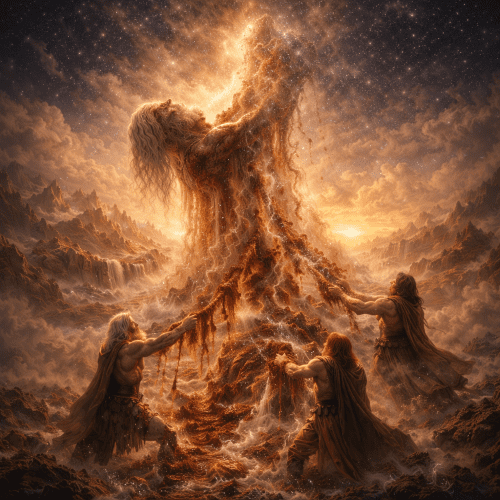
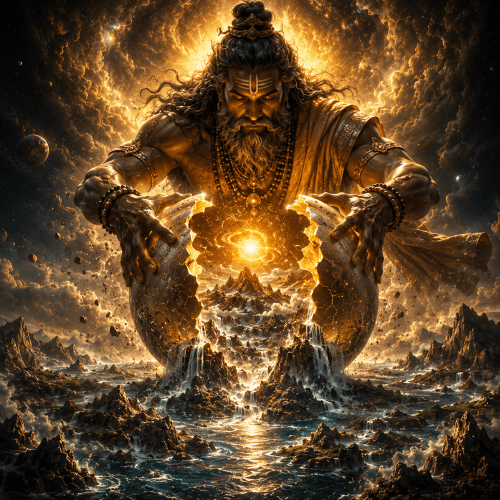
Perhaps the closest comparison is the Norse giant Ymir, whose body becomes the material from which the world is formed after he is slain by Odin and his brothers. Likewise, the Vedic story of Purusha describes the universe emerging from the sacrificial body of a primordial cosmic being.
Scholars have also noted linguistic connections between Tiamat and the Hebrew word tehom (“the deep”) found in the opening chapter of Genesis. While Genesis does not depict a battle between God and a sea goddess, both traditions begin with primordial waters before the ordered world is established. Most modern scholars, however, avoid claiming a direct borrowing and instead recognize these as related traditions within the broader ancient Near Eastern cultural world.
Egyptian mythology likewise begins with the primeval waters of Nun, although creation there occurs through emergence rather than violent conflict. These comparisons demonstrate that water was widely understood across the ancient world as the source of all existence, even if different cultures explained creation in different ways.
What distinguishes the Babylonian Creation Story is its political purpose. The Enūma Eliš was composed not only to explain the origin of the universe but also to justify Marduk’s supremacy and reinforce Babylon’s religious and royal authority.
Legacy
The Babylonian Creation Story became one of the most important literary works in ancient Mesopotamia. It was traditionally recited during the Akitu, the Babylonian New Year Festival, where it celebrated Marduk’s victory and reaffirmed the divine order governing both heaven and the Babylonian kingdom.
Interestingly, Tiamat herself was not widely worshipped as a popular deity. Outside the Enūma Eliš, references to her are relatively rare, suggesting that her importance was primarily theological rather than cultic. Her role was to embody the primordial state that had to be overcome for civilization to exist.
The epic also shaped later discussions about kingship, divine authority, and the relationship between order and chaos. Even today, historians view it as one of the most significant sources for understanding Babylonian religion and political ideology.
Modern Influence
The Babylonian Creation Story continues to inspire modern literature, games, films, and academic research. Tiamat has become one of mythology’s most recognizable primordial beings, although modern adaptations often emphasize her dragon-like appearance far more than her original role as a creator goddess.
Perhaps the best-known modern interpretation appears in Dungeons & Dragons, where Tiamat is reimagined as a five-headed dragon goddess. She has also appeared in novels, anime, video games, and fantasy series, becoming a universal symbol of ancient chaos and immense power.
Modern scholarship, however, increasingly encourages readers to look beyond the monster. The original Enūma Eliš portrays Tiamat as both mother and adversary, reminding us that creation itself emerges from the transformation of older, more chaotic forces. This richer interpretation reveals why the Babylonian Creation Story remains one of humanity’s most enduring and influential myths.

Sources
Britannica Editors. (2023). Tiamat | Mythology, demon, goddess, dragon, & popular culture. In Encyclopaedia Britannica. Retrieved from https://www.britannica.com/topic/Tiamat
Foster, B. R. (Ed. & Trans.). (2005). Enūma Eliš (The Babylonian Creation Epic) See Oracc: Tiamat (goddess). Retrieved from https://oracc.museum.upenn.edu/amgg/listofdeities/tiamat/index.html.
“Tiamat.” (n.d.). In Wikipedia. Retrieved from https://en.wikipedia.org/wiki/Tiamat.
World History Encyclopedia. (2026). Tiamat: The great Mesopotamian goddess of chaos. Retrieved from https://www.worldhistory.org/Tiamat/.
“Enuma Elish — The Babylonian Epic of Creation — Full Text.” (2018). World History Encyclopedia. Retrieved from https://www.worldhistory.org/article/225/enuma-elish—the-babylonian-epic-of-creation—fu/.
The Archaeologist (blog). (2025). The worship of Tiamat: The Babylonian chaos dragon. Retrieved from https://www.thearchaeologist.org/blog/the-worship-of-tiamat-the-babylonian-chaos-dragon.
Burkert, W. (1992). The Orientalizing Revolution: Near Eastern Influence on Greek Culture in the Early Archaic Age. Harvard University Press.
Jacobsen, T. (1976). The Treasures of Darkness: A History of Mesopotamian Religion. Yale University Press.
Dalley, S. (2000). Myths from Mesopotamia: Creation, the Flood, Gilgamesh, and Others. Oxford University Press.
Leick, G. (1998). A Dictionary of Ancient Near Eastern Mythology. Routledge.
Frequently Asked Questions
What is the Babylonian Creation Story?
The Babylonian Creation Story is the ancient Mesopotamian account of how the universe was created, recorded in the Enūma Eliš. It tells how Marduk defeated Tiamat and created the heavens, earth, and humanity.
Who is Tiamat in the Babylonian Creation Story?
Tiamat is the primordial goddess of the salt sea and one of the first beings in existence. She is both the mother of the gods and the embodiment of primordial chaos.
How did Marduk create the world?
After defeating Tiamat, Marduk divided her body into two parts to create the heavens and the earth. He then organized the stars, established cosmic order, and later created humanity using Qingu’s blood mixed with clay.
Why was the Enūma Eliš important to Babylon?
The Enūma Eliš established Marduk as the supreme god and reinforced Babylon’s political and religious importance. It was traditionally recited during the Babylonian New Year Festival.
Did the Babylonian Creation Story influence other myths?
Many scholars see thematic and linguistic connections between the Babylonian Creation Story and other ancient Near Eastern traditions, including Genesis, while also noting similarities with Norse, Vedic, and Egyptian creation myths.