

Slavic Creation Story : How the World Emerged from Water
| Description | |
|---|---|
| Origin | Slavic Mythology |
| Country | Poland, Russia, Ukraine |
| Deities Involved | Rod/Svarog, Chernobog |
| Symbolism | Water as life, Sand as stability, Duality of good vs. evil |
| Process | Devil dives for sand, God scatters it, Earth expands, Conflict ensues |
Mythlok Perspective
In Mythlok’s View, the Slavic Creation Story reveals a worldview where creation is not an act of dominance but of balance. The emergence of land from water reflects a deep respect for nature’s unpredictability and power. Unlike traditions that separate good and evil entirely, this story accepts their coexistence as necessary for existence. This perspective aligns closely with other cultures that embrace duality. The interplay between Perun and Veles mirrors the tension between order and chaos seen in Chinese Yin-Yang philosophy, while the earth-diver motif connects with Native American and Siberian traditions. Across cultures, creation often begins not with certainty, but with a descent into the unknown.
Slavic Creation Story
Introduction
The Slavic Creation Story is one of the most compelling origin narratives in European folklore, built around a striking idea: before anything existed, there was only water. This vast, endless ocean was not just empty space but a living, shifting force filled with potential. From this watery beginning, the world slowly took shape through cooperation, rivalry, and transformation.
Unlike traditions that focus on dramatic wars between gods, the Slavic vision of creation is quieter but deeply symbolic. It revolves around the act of diving into chaos to retrieve the very substance of life. Passed down through oral storytelling and later recorded by folklorists such as Alexander Afanasyev, these myths evolved over time, blending ancient beliefs with later religious influences. At its core, the story reflects a worldview where creation is not a single act, but a gradual emergence shaped by opposing yet interconnected forces.
Cosmic Origins
In the beginning of the Slavic Creation Story, there was no land, no sky, and no structured universe. Only an infinite, dark ocean stretched in every direction. This primordial sea represented pure chaos, a state where nothing had yet taken form but everything was possible.
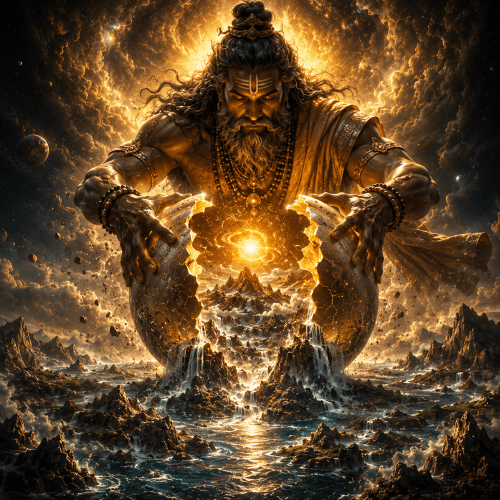
Some traditions describe this early phase as a union of water and darkness, inhabited by a primal force such as Rod, who existed before all creation. In other versions, a cosmic egg floats within these waters, containing the seeds of the universe and giving rise to Svarog, the divine craftsman.
Water in this context is not passive. It is the origin of life, the boundary between existence and non-existence, and the medium through which creation becomes possible. The absence of solid ground emphasizes the instability of the early cosmos, making the emergence of land a transformative and sacred moment.
Deities and Forces Involved
The Slavic Creation Story is defined by its dualistic structure. Creation is rarely the work of a single god. Instead, it unfolds through interaction between opposing forces that both cooperate and compete.
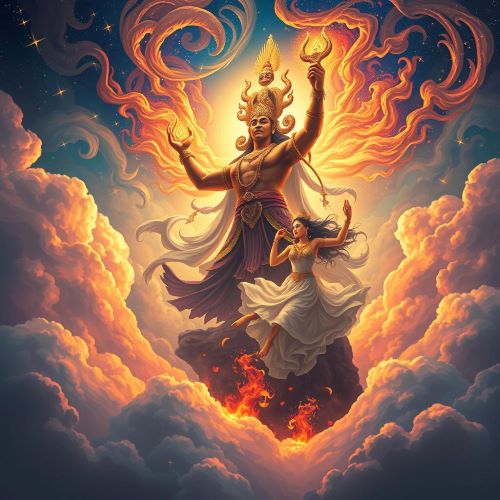
One of the most common pairings is a supreme creator figure, often associated with order, and a rival or trickster figure linked to chaos. In many versions, these roles are reflected in the dynamic between Perun and Veles. Perun represents the sky, law, and structure, while Veles is tied to water, the underworld, and unpredictability.
Other variations present a more abstract “God and Devil” pairing, shaped by later Christian influence but rooted in earlier pagan dualism. In these stories, both figures are necessary for creation. One brings intention and order, while the other introduces movement, risk, and expansion. This interplay highlights a key idea: the world is not born from purity alone, but from tension between opposing forces.
Process
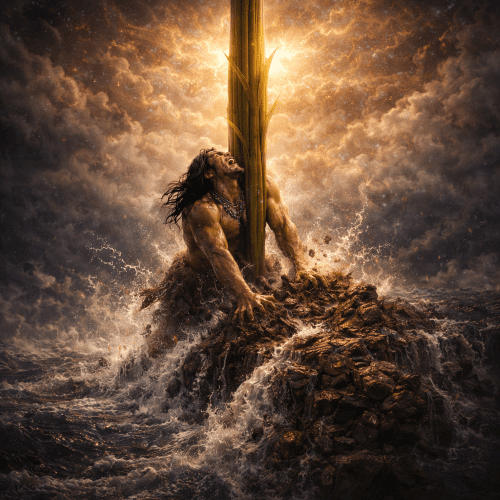
The central event in the Slavic Creation Story is the earth-diver myth, a motif found across many cultures but uniquely expressed here. The story begins with the divine figures floating over the endless ocean. Realizing that land must be created, one of them dives into the depths to retrieve a small amount of sand or mud from the ocean floor. In many versions, this task is carried out by the darker or trickster figure.
When the diver returns, the material is placed upon the surface of the water. What begins as a tiny patch of earth starts to grow. Slowly, it expands outward, forming the land. In some narratives, the diver attempts to hide a portion of the sand, often placing it in their mouth. When it later escapes, the earth expands uncontrollably, creating mountains, valleys, and uneven terrain. This detail adds a layer of unpredictability to creation, suggesting that the imperfections of the world are not accidents but part of its design.
As the land stabilizes, the sky separates from the earth, and the universe becomes structured into three realms: the divine realm above, the human world in the middle, and the underworld below.
Symbolism
The Slavic Creation Story is rich in symbolism, with each element carrying layered meaning. Water represents both chaos and potential. It is the source of life but also a reminder of instability and the unknown. Its role as a boundary between worlds reflects its importance in rituals and beliefs surrounding life and death.
The act of diving symbolizes a journey into the unknown. It can be understood as a descent into the subconscious or the realm of death, from which new life emerges. This makes creation not just a physical process, but a spiritual transformation.
The small amount of sand or mud used to form the earth represents the idea that vast worlds can grow from the smallest beginnings. It reinforces the theme of expansion, where creation is gradual rather than instantaneous. The duality between opposing forces reflects a broader Slavic worldview. Order and chaos are not enemies to be eliminated, but necessary partners in shaping reality.
Comparative Analysis
The Slavic Creation Story shares strong parallels with other global traditions, particularly those featuring the earth-diver motif. In many Siberian and Finno-Ugric myths, animals dive into a primordial ocean to retrieve mud, much like in Slavic narratives. This suggests deep cultural connections across northern Eurasia.
In Indian traditions, the concept of a cosmic ocean and the emergence of the universe from it echoes similar themes, particularly in stories involving the cosmic egg. Greek and Orphic traditions also describe creation emerging from an egg, reinforcing the idea of a shared Indo-European heritage.
Norse mythology, while different in structure, begins with a primordial void known as Ginnungagap. However, unlike the Slavic focus on water, the Norse story emphasizes the interaction between fire and ice. What sets the Slavic version apart is its strong emphasis on cooperation between opposing forces and the central role of water as both origin and boundary.
Legacy
The Slavic Creation Story survived centuries of cultural change, including the spread of Christianity across Slavic regions. Rather than disappearing, it adapted. In many folk tales, the original gods were replaced with Christian figures, but the structure of the story remained intact.
These myths were preserved in oral traditions across Russia, Poland, Ukraine, and the Balkans. They influenced epic songs, seasonal rituals, and local beliefs about rivers, lakes, and forests. Even today, elements of the story continue to shape cultural identity. Water remains a sacred element in many traditions, symbolizing purification, renewal, and connection to the past.
Modern Influence
In modern times, the Slavic Creation Story has found new life in literature, games, and visual storytelling. Works inspired by Slavic folklore often draw on its themes of duality, nature, and cosmic balance.
Fantasy series like those by Andrzej Sapkowski incorporate water spirits and mythological elements rooted in these traditions. Video games and films continue to reinterpret the earth-diver motif, bringing ancient ideas into contemporary narratives.
Beyond entertainment, the story has gained relevance in ecological discussions. Its portrayal of water as the source of life resonates strongly in conversations about environmental preservation and sustainability.
Sources
Wikipedia contributors. (2020, September 3). Slavic creation myths. Wikipedia. https://en.wikipedia.org/wiki/Slavic_creation_myths
Thalira. (2026, March 24). Slavic creation myth: Rod, the cosmic egg, and the birth of the world. https://thalira.com/blogs/quantum-codex/slavic-creation-myth-rod-birth-world
Kotar, N. (2019, November 29). Symbols of the cosmos in Slavic mythology. https://nicholaskotar.com/2019/11/29/symbols-of-the-cosmos-in-slavic-mythology/
Kotar, N. (2018, July 27). Water in Slavic mythology: The giver of life and death, Part 1. https://nicholaskotar.com/2018/07/27/water-part-one/
Wikipedia contributors. (2018, April 14). Slavic water spirits. Wikipedia. https://en.wikipedia.org/wiki/Slavic_water_spirits
Afanasyev, A. (1859). Russian Folk Tales and Mythology. Moscow: Imperial Press.
Ivanits, L. (1989). Russian Folk Belief. Armonk, NY: M.E. Sharpe.
Warner, E. (1997). Myths and Legends of Russia. London: Aquarian Press.
Frequently Asked Questions
What is the Slavic Creation Story about?
It describes how the world formed from a primordial ocean, where divine beings retrieved earth from the depths to create land.
Who created the world in Slavic myths?
Creation often involves dual forces like God and the Devil or Perun and Veles working together and in conflict.
What is the earth-diver myth in Slavic tradition?
It is a story where a figure dives into cosmic waters to bring back mud, which expands into the earth.
Why is water important in the Slavic Creation Story?
Water represents chaos, origin, and transformation, serving as the foundation from which life emerges.
Is the Slavic Creation Story similar to other myths?
Yes, it shares themes with Siberian, Indian, and other Indo-European traditions, especially the earth-diver motif.