
Epic of Mwindo : The Journey from Rejection to Wise Leadership
At a glance
| Attribute | Description |
|---|---|
| Mythology | Nyanga Mythology |
| Language Written | Nyanga (oral), Reproduced in English/French |
| Age | Centuries-old oral tradition |
| Author | Kahombo Mateene & Daniel Biebuyck (Reproduction) |
| Main Characters | Mwindo, Shemwindo, spirits, allies |
Mythlok Perspective
In Mythlok’s View, the Epic of Mwindo represents the evolution of power from instinct to wisdom. Mwindo’s journey is not about conquest but about restraint, showing that true authority lies in balance rather than dominance. His descent into the underworld mirrors an internal transformation, where anger is reshaped into clarity. This arc closely parallels figures like Gilgamesh from Mesopotamia and Rama from Indian tradition, both of whom transition from force to responsibility. Yet Mwindo stands apart in how forgiveness becomes the ultimate act of strength, making the epic one of the most philosophically mature hero narratives in world tradition.
Epic of Mwindo
Introduction
The Epic of Mwindo is one of the most remarkable oral narratives from Central Africa, preserved by the Nyanga people of the Democratic Republic of the Congo. Passed down through generations of skilled storytellers, this epic is not just a tale of heroism but a living cultural archive. It recounts the life of Mwindo, a child born with extraordinary abilities who challenges fate, survives betrayal, and ultimately transforms into a just and compassionate ruler. Unlike many heroic tales that glorify conquest alone, the Epic of Mwindo evolves into a story about wisdom, restraint, and reconciliation. Its structure blends prose, song, and performance, making it both a literary and performative masterpiece. Even today, it stands as a powerful example of how oral traditions can preserve complex philosophical ideas, social values, and spiritual beliefs across centuries.
Historical Background
The Epic of Mwindo originates from the Nyanga people, a Bantu-speaking community living in the forested and mountainous regions near Lake Kivu. For centuries, their traditions have been maintained through oral performance rather than written records, allowing the story to adapt and evolve with each generation. This fluid nature explains why multiple versions of the epic exist, each shaped by the performer and audience.
The first major documentation of the epic came in 1969 when anthropologist Daniel Biebuyck recorded a full recitation by the bard Shepege Candi Rureke. The transcription revealed a narrative of over 6,000 lines, combining rhythmic speech with musical elements. However, the written version only captures a fragment of its true essence, as live performances involve gestures, instruments, and audience interaction.
The epic reflects a blend of Nyanga traditions and influences from neighboring forest communities, including Pygmy groups, whose ecological knowledge and spiritual practices are subtly embedded in the narrative. This cultural layering gives the Epic of Mwindo a rare depth, where mythology, environment, and social structure intersect seamlessly.
Synopsis & Themes
The story begins in the village of Tubondo, where Chief Shemwindo attempts to control destiny itself. Fearing a prophecy that a son will overthrow him, he orders that no male children be born. Despite this, his wife Nyamwindo gives birth to Mwindo in a miraculous way—emerging from her finger, already speaking and carrying a magical scepter.
From the moment of his birth, Mwindo faces rejection. His father repeatedly tries to kill him through burial, drowning, and other violent means, but each attempt fails due to Mwindo’s supernatural resilience. As he grows, Mwindo journeys across land and water, gaining allies and mastering his powers. His path eventually leads him back to confront his father, but the conflict does not end in simple revenge.
Instead, the narrative shifts toward transformation. After pursuing Shemwindo into the underworld and overcoming trials set by its ruler, Mwindo chooses forgiveness over destruction. He restores life to those lost and establishes a more balanced rule.
The Epic of Mwindo explores themes that feel strikingly modern. It examines the futility of resisting fate, showing how fear-driven decisions often bring about the very outcomes they seek to avoid. It also emphasizes that true leadership is not rooted in domination but in wisdom and empathy. The journey from vengeance to reconciliation forms the emotional core of the story, reflecting a broader human struggle between power and morality.
Key Characters
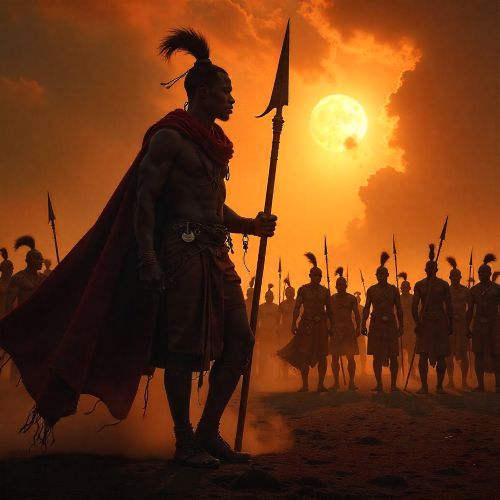
At the heart of the epic is Mwindo himself, a hero unlike many others. He is not defined by brute strength but by intelligence, adaptability, and moral growth. His magical conga scepter symbolizes authority and spiritual power, allowing him to command forces beyond the human realm. Over time, he evolves from a wronged child seeking justice into a ruler who understands the importance of balance.
Shemwindo, his father, represents the dangers of fear and unchecked authority. His attempts to control destiny ultimately lead to his downfall, yet his story does not end in tragedy. Through Mwindo’s forgiveness, he is given a chance at redemption, reinforcing the epic’s emphasis on second chances. Nyamwindo, Mwindo’s mother, plays a quieter but essential role. Her defiance ensures Mwindo’s survival, and her presence anchors the story in themes of maternal strength and resilience.
Supporting figures such as Mwindo’s aunts and uncles highlight the importance of community. They provide guidance, protection, and support, reminding the audience that no hero succeeds alone. Supernatural beings, including underworld rulers and elemental forces, further expand the narrative’s scope, placing Mwindo within a vast cosmic hierarchy rather than a purely human world.
Cultural & Religious Significance
The Epic of Mwindo serves as a moral and philosophical guide within Nyanga society. It reinforces the idea that leadership must be grounded in humility and fairness rather than fear. Through Mwindo’s journey, audiences learn that justice should not be separated from compassion, and that reconciliation is often more powerful than revenge.
The epic also reflects a deeply spiritual worldview. The boundaries between the human world, the natural environment, and the spiritual realm are fluid. Animals, ancestors, and deities all play active roles, illustrating an interconnected universe where every action carries weight. Mwindo’s ability to move between these realms positions him as a mediator, bridging gaps between opposing forces.
Performances of the epic are communal events, often tied to ceremonies and social gatherings. They function as both entertainment and education, ensuring that cultural knowledge is passed on in an engaging and memorable way. In this sense, the Epic of Mwindo is not just a story but a living tradition that continues to shape identity and worldview.
Modern Adaptations
In the modern era, the Epic of Mwindo has gained recognition far beyond its place of origin. Scholars study it as one of the great epics of the world, often comparing it to narratives like Gilgamesh or the Ramayana for its depth and structure. Its themes of leadership, justice, and moral growth resonate across cultures, making it highly relevant in contemporary discussions.
Adaptations have taken many forms. Children’s books such as The Magic Flyswatter reintroduce Mwindo as a hero for younger audiences, simplifying the narrative while preserving its core message. Theatre productions and storytelling festivals have revived its performative aspects, bringing the epic back to life through music and movement.
Digital platforms and academic institutions continue to explore the story, analyzing its symbolism and cultural significance. In a world increasingly dominated by written and visual media, the Epic of Mwindo stands as a reminder of the enduring power of oral storytelling and its ability to convey complex ideas in deeply human ways.


Source
Biebuyck, D. P. (1971). The Mwindo epic from the Banyanga (Congo Republic). University of California Press. https://www.ucpress.edu/books/the-mwindo-epic-from-the-banyanga/paper
Biebuyck, D. P., & Mateene, K. (1969). The Mwindo epic. University of California Press.
Encyclopedia.com. (n.d.). Mwindo. UXL Encyclopedia of World Mythology. https://www.encyclopedia.com/history/encyclopedias-almanacs-transcripts-and-maps/mwindo
Fabulahub. (2024). The Epic of Mwindo. https://fabulahub.com/en/story/epic-mwindo/sid-393
The Enlightenment Journey. (2024). Mwindo: Heroic figure in the mythology of Congo. https://theenlightenmentjourney.com/mwindo-heroic-figure-in-the-mythology-of-congo/
Wikipedia. (2006). Mwindo epic. https://en.wikipedia.org/wiki/Mwindo_epic
Shepege, C. R. (performer), & Biebuyck, D. P. (recorder). (1969). Epic of Mwindo [Oral performance]. Published in Biebuyck (1971)
Frequently Asked Questions
What is the Epic of Mwindo about?
The Epic of Mwindo tells the story of a miraculous child who survives multiple attempts on his life, defeats injustice, and ultimately becomes a wise and compassionate leader.
Where does the Epic of Mwindo originate?
It comes from the Nyanga people of the Democratic Republic of the Congo and has been preserved through oral storytelling traditions.
Why is Mwindo considered unique among epic heroes?
Mwindo’s strength lies in intelligence and moral growth rather than physical power, and his story emphasizes forgiveness over revenge.
What are the main themes of the Epic of Mwindo?
Key themes include fate versus control, justice and mercy, leadership, resilience, and the balance between human and spiritual worlds.
Is the Epic of Mwindo still relevant today?
Yes, it is studied globally and continues to inspire discussions on leadership, ethics, and cultural preservation.