

Halmasti : The Legendary Wolf of Pakistan’s Mountains
| Description | |
|---|---|
| Origin | Pakistan |
| Classification | Cryptid |
| Demeanour | Malevolent |
| Habitat | Remote Valleys, Roads |
| Status | Not Proven |
Mythlok Perspective
In Mythlok’s View, Halmasti represents a universal archetype of the “threshold guardian,” a force that emerges when life is most fragile. It is less a creature and more a manifestation of collective anxiety tied to birth, death, and sudden catastrophe. Its evolution into a roadside omen reflects how human fears adapt to new environments. Comparable figures exist worldwide. The Black Dog of European lore appears as a death omen on lonely roads, while Tiangou in Chinese tradition embodies celestial disruption. Halmasti stands between these ideas, combining earthly danger with cosmic symbolism, making it a uniquely layered expression of fear.
Halmasti
Introduction
Halmasti is one of the most unsettling figures to emerge from the folklore of Chitral, a remote mountainous region in Pakistan. The name itself is derived from the Khowar language, where it is associated with thunder or destructive lightning, immediately tying the creature to raw, uncontrollable natural force. Unlike many ancient legends that fade into obscurity, Halmasti has evolved alongside modern life. It exists both as a traditional fear tied to life’s most vulnerable moments and as a contemporary roadside legend whispered among night drivers.
What makes Halmasti particularly compelling is how it bridges two worlds. On one side, it is deeply rooted in pre-Islamic belief systems that interpret natural chaos through supernatural beings. On the other, it has absorbed Islamic practices, with protective rituals often involving Quranic recitations. This fusion reflects how folklore adapts rather than disappears. Even today, stories persist of a massive creature racing alongside vehicles at night, often linked to fatal accidents, reinforcing its role as an omen rather than a simple monster.
Physical Attributes
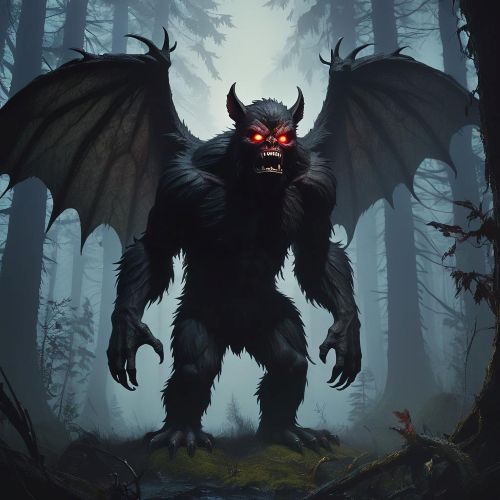
Descriptions of Halmasti are strikingly consistent despite being passed down orally for generations. It is most commonly portrayed as a gigantic hound or wolf, often compared to the size of a horse. Its body is elongated and muscular, built for speed rather than brute force. The creature’s fur is typically described as dark red or rust-colored, a detail that reinforces its association with fire, blood, and danger.
Eyewitness accounts frequently mention glowing eyes and an oversized muzzle, sometimes said to emit flames. This fiery aspect is not merely aesthetic. It symbolically aligns Halmasti with lightning and thunder, reinforcing the idea that it is not just an animal but a manifestation of violent celestial energy. Some traditions even describe its hide as unusually thick, suggesting that it is not easily harmed.
One of the most widely accepted traits is its aversion to iron. Across Chitral, it has long been believed that placing iron objects, such as knives, near vulnerable individuals can repel the creature. This detail connects Halmasti to a broader global pattern where iron is seen as a protective element against supernatural forces.
First Sighting/Reporting
Unlike modern cryptids that often have a documented first sighting, Halmasti belongs to a much older narrative tradition. There is no singular origin point or recorded encounter that marks its beginning. Instead, it has always existed within the oral storytelling culture of Chitral.
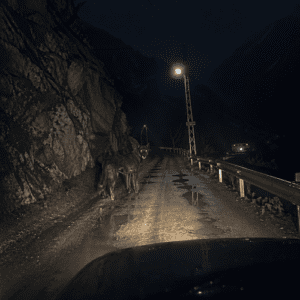
However, the nature of reported sightings has changed significantly over time. Historically, the creature was associated with homes and community spaces, particularly during births and deaths. In more recent decades, especially with the construction of roads through remote valleys, the legend has shifted. Jeep drivers traveling at night began reporting encounters with a large, fast-moving animal pacing their vehicles. These sightings often coincided with dangerous or fatal accidents, giving the creature a renewed relevance in modern life.
This transition from household fear to highway omen shows how folklore evolves with infrastructure and lifestyle changes. The environment may shift, but the underlying fear remains consistent.
Other Names
While Halmasti is the primary name used in Khowar-speaking regions, its conceptual roots extend far beyond Chitral. The creature shares strong parallels with several mythological beings across cultures, suggesting a long history of adaptation and reinterpretation.
In Mesopotamian traditions, figures like Lilith were associated with harming infants and preying on vulnerable individuals. Similarly, Iranic folklore speaks of entities known as “Al” or “Hal,” which target mothers and newborns. In Turkic traditions, Al-Basti appears as a spirit linked to punishment and moral judgment.
Another striking parallel can be found in Tiangou, the celestial dog believed to descend from the sky during eclipses, bringing chaos and fear. The resemblance is particularly strong in the imagery of a powerful, sky-connected hound associated with sudden, destructive events. These cross-cultural echoes suggest that Halmasti is not an isolated creation but part of a broader archetype that has taken on a unique identity in Chitrali culture.
Modus Operandi
Halmasti’s behavior is defined by its focus on liminal moments, times when life transitions from one state to another. It is believed to appear during births and deaths, moments considered spiritually vulnerable.
In the case of newborns, the creature is said to target infants left unattended. To prevent this, families traditionally ensured constant supervision during the early days of a child’s life. If a baby had to be left alone, an iron object would be placed nearby as protection. This practice reflects both fear and precaution, blending superstition with practical caregiving.
During death rituals, Halmasti is believed to visit places where bodies are washed or recently buried. Communities respond by maintaining a presence in these spaces, often accompanied by continuous prayers or Quranic recitations. The goal is not to confront the creature but to prevent its arrival altogether.
In its modern form, the creature’s modus operandi extends to roadways. Drivers describe it as pacing alongside vehicles, almost as if guiding them toward danger. Whether interpreted as a supernatural being or a psychological manifestation of fear, its role as a harbinger of misfortune remains consistent.
Pop Culture References
Halmasti has not yet achieved mainstream global recognition, but its presence in digital culture is steadily growing. Social media platforms have become a new stage for its revival, with short-form videos dramatizing encounters and retelling local stories for wider audiences.
Online folklore communities frequently compare Halmasti to other regional creatures, placing it alongside figures like Pakistan’s Barmanu. Blogs and digital storytelling platforms have also begun incorporating it into fictional narratives, blending traditional elements with modern horror tropes.
This digital transformation has shifted Halmasti from a localized fear to a shareable myth. While it may not yet appear in major films or television, its increasing visibility suggests that it is moving toward a broader cultural footprint.
Current Status
Today, Halmasti exists in a state of cultural transition. In urban areas, belief in the creature has largely diminished, replaced by scientific explanations and changing lifestyles. However, in more remote parts of Chitral, particularly among older generations, the legend still carries weight.
Night drivers continue to recount encounters, especially during long journeys through isolated mountain roads. While these stories are often met with skepticism, they persist as part of the region’s living folklore.
Rather than disappearing, Halmasti has adapted. It no longer dominates daily life as it once did, but it survives as a symbol of uncertainty, danger, and the unknown. Its presence in digital media ensures that it will continue to evolve, reaching new audiences while retaining its core identity.




Source
Chitral Today. (2019, October 18). Monsters and spirits of Khowar folklore. https://chitraltoday.net/2019/10/18/monsters-and-spirits-of-khowar-folklore/
Haroon Shuaib. (2020, September 29). Fanciful fables of Pakistan, part 2. Youlin Magazine. https://www.youlinmagazine.com/article/fanciful-fables-of-pakistan-part-2/MjA5NQ==
Indus Tales. (n.d.). Halmasti of Chitrali mythology. https://indus-tales.com/halmasti-of-chitrali-mythology/
Simple English Wikipedia. (2024, July 27). Halmasti. https://simple.wikipedia.org/wiki/Halmasti
The Friday Times. (2019, October 18). Monsters and spirits of Khowar folklore. https://thefridaytimes.com/18-Oct-2019/monsters-and-spirits-of-khowar-folklore
The Friday Times. (2021, December 19). From Karsaz’s Churail to the Hathora group: Urban legends we grew up with. https://www.thefridaytimes.com/19-Dec-2021/from-karsaz-s-churail-to-the-hathora-group-urban-legends-we-grew-up-with
Wikipedia. (2005, November 11). Pakistani folklore. https://en.wikipedia.org/wiki/Pakistani_folklore
Frequently Asked Questions
What is Halmasti?
Halmasti is a mythical thunder-associated hound from Chitral, believed to appear during births, deaths, and ominous nighttime encounters.
Why is Halmasti feared?
It is linked to misfortune, especially harming newborns or appearing before accidents, making it a powerful omen in local belief.
What does Halmasti look like?
It is described as a massive red-furred wolf or hound, sometimes with glowing eyes and the ability to emit flames.
How do people protect themselves from Halmasti?
Traditional practices include placing iron objects nearby and reciting prayers to ward off the creature.
Is Halmasti real or proven?
There is no scientific evidence of its existence; it remains a powerful cultural legend and evolving urban myth.