

Batsquatch : The Flying Cryptid of Washington State
| Description | |
|---|---|
| Origin | United States of America |
| Classification | Cryptid |
| Demeanour | Evil |
| Habitat | Volcanic Eruptions |
| Status | Not Proved |
Mythlok Perspective
In Mythlok’s Perspective, Batsquatch symbolizes the fusion of two archetypes — the wildman and the winged omen. Its emergence after a volcanic eruption suggests a psychological response to environmental catastrophe. When nature erupts violently, stories follow. Cross-culturally, Batsquatch parallels the Mothman of West Virginia, another winged humanoid associated with disaster. It also echoes ancient griffin myths, where hybrid creatures guard or haunt wild landscapes. Yet Batsquatch is distinctly modern. It was born not from temple carvings or epic poetry, but from post-eruption anxiety and regional storytelling in the Pacific Northwest.
Batsquatch
Introduction
In the dense forests surrounding Mount St. Helens and Mount Rainier, stories have emerged of a mysterious creature known as the Batsquatch. This eerie blend of bat and Sasquatch has become a staple of American folklore, especially among cryptozoology fans and paranormal enthusiasts. Since the 1980s, this winged enigma has been linked to unexplained sightings and eerie encounters in the Pacific Northwest.
Physical Attributes
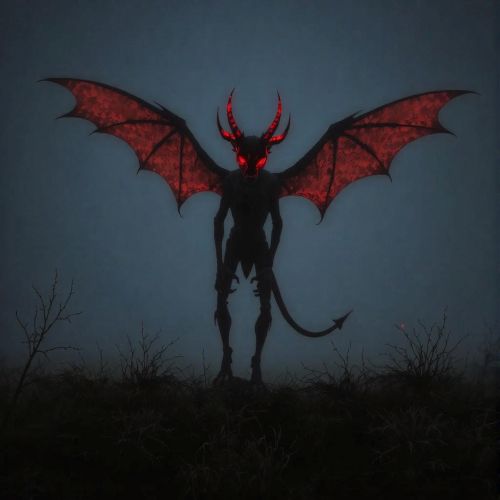
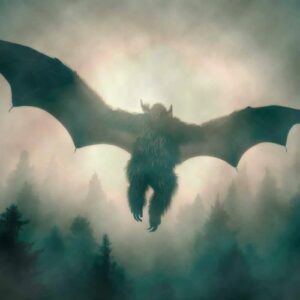
The Batsquatch isn’t your average forest legend. Witnesses describe it as a towering figure, standing close to nine feet tall, with the muscular build of an ape and the wingspan of a small airplane. Its body is covered in dark fur—often described as blue, gray, or black—and its eyes glow with an otherworldly light, red or yellow depending on the account. The face reportedly resembles something between a bat and a wolf, complete with fangs, pointed ears, and a snout. Its hands and feet are clawed, hinting at a potentially predatory nature.
First Sighting/Reporting
Although tales of strange creatures around Mount St. Helens go back decades, the Batsquatch first made headlines in 1994. Brian Canfield, an 18-year-old at the time, recounted a chilling story while driving near Lake Kapowsin, Washington. His truck suddenly stalled, and out of the silence came a creature unlike anything he’d ever seen—huge, winged, and staring at him with glowing eyes. Moments later, it flew off and his truck started again. The story was picked up by the Tacoma News Tribune and sparked widespread curiosity.
Other Names
Locals have given the creature several nicknames over the years. While “Batsquatch” remains the most popular, some refer to it as “Flying Bigfoot” or simply “Man-Bat.” Comparisons have also been drawn to other legendary beasts like the Mothman, Jersey Devil, and even the Indonesian Ahool. These parallels suggest a broader fascination with flying humanoids that straddle the line between myth and mystery.
Modus Operandi
Batsquatch sightings often come with strange side effects. Some claim their vehicles malfunction in its presence, or that electronics stop working without explanation. There’s even speculation that it feeds on livestock, with local farmers blaming missing animals on this elusive creature. Though most sightings come from the Pacific Northwest, there have been occasional reports as far away as Pennsylvania and California.
Pop Culture References
Over the years, the Batsquatch has taken on a life of its own in pop culture. It’s been featured in podcasts like REI Co-op’s Camp Monsters and made appearances in trading card games like MetaZoo: Cryptid Nation. It’s even become the face of a hazy IPA beer brewed by Rogue Ales. Artists and indie creators have embraced the legend, turning it into stickers, t-shirts, and collectible artwork that you can find online and at cryptid conventions.
Current Status
Despite all the stories and sightings, no physical evidence has ever confirmed the existence of the Batsquatch. No photos, no remains, no verified video footage. That hasn’t stopped believers, though. For many, the Batsquatch represents something more than just a creature—it symbolizes the unknown, a reminder that nature still holds secrets we haven’t uncovered.
Whether it’s a case of mistaken identity, an elaborate hoax, or something truly unexplained, the Batsquatch continues to inspire awe, fear, and curiosity. It might not have proven itself to science just yet, but in the hearts of cryptid lovers and folklore fans, it’s very much alive.




Source
Mythical Bestiary Wikia – Fandom. (2025, March 10). Batsquatch. Fandom. https://mythical-bestiary.fandom.com/wiki/Batsquatch
Creature Codex. (2017, September 9). Batsquatch. Tumblr. https://creaturecodex.tumblr.com
BLOCKFOREST. (2021, May 2). The Batsquatch. https://blockforest.com
ParaRational. (n.d.). Batsquatch the cryptid: Everything you need to know. https://pararational.com
ArcGIS StoryMaps. (2021, May 12). Batsquatch monitoring. https://storymaps.arcgis.com
Frequently Asked Questions
What is Batsquatch?
Batsquatch is a winged cryptid reportedly seen near Mount St. Helens after the 1980 volcanic eruption. It is described as a flying version of Bigfoot.
Is Batsquatch related to Bigfoot?
While inspired by Sasquatch lore, Batsquatch is considered a separate cryptid because of its bat-like wings and airborne abilities.
When was Batsquatch first reported?
The first major reports surfaced in 1980 following the eruption of Mount St. Helens in Washington State.
Does Batsquatch have glowing eyes?
Many witness descriptions mention glowing red or yellow eyes, which contribute to its ominous reputation.
Is there any proof that Batsquatch exists?
There is no verified scientific evidence supporting the existence of Batsquatch. The legend is based on eyewitness reports and local folklore.