

Bigfoot : The Elusive Giant of the American Forests
| Description | |
|---|---|
| Origin | United States of America |
| Classification | Cryptid |
| Demeanour | Neutral |
| Habitat | Forests |
| Status | Not Proved |
Mythlok Perspective
In Mythlok’s Perspective, Bigfoot represents the enduring mystery of the untamed wilderness. It is less about proving the existence of an unknown primate and more about humanity’s relationship with nature. Bigfoot stands at the boundary between civilization and the wild, embodying both fear and fascination. Cross-culturally, Bigfoot parallels the Himalayan Yeti and the Australian Yowie — all large, elusive humanoids said to inhabit remote landscapes. Yet unlike purely mythic beings, Bigfoot occupies a space between folklore and scientific debate. It reflects modern uncertainty rather than ancient cosmology, keeping alive the possibility that the natural world still holds secrets beyond human control.
Bigfoot
Introduction
Bigfoot—also known as Sasquatch—has long captivated the imagination of those drawn to the unknown. Often described as a towering, hairy creature wandering the forests of North America, this legendary being straddles the line between myth and mystery. Whether viewed as a surviving relic of prehistoric times, a clever hoax, or a spiritual symbol rooted in Indigenous tradition, Bigfoot continues to stir curiosity and debate like few other figures in American folklore.
Physical Attributes
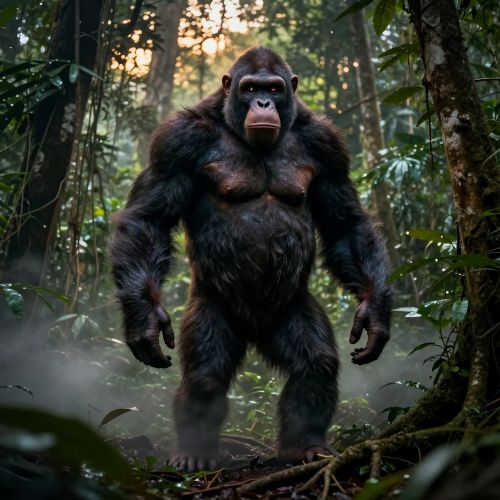
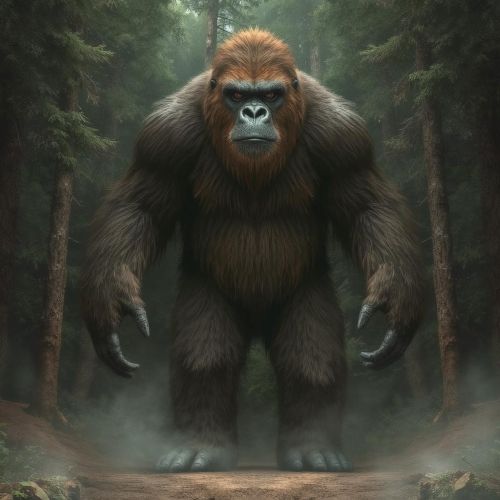
Eyewitnesses commonly describe Bigfoot as a massive, bipedal creature, standing anywhere from six to fifteen feet tall. It’s typically covered in thick, dark hair—ranging from deep brown to reddish tones—and said to walk upright like a human. One of the more distinctive clues left behind is its oversized footprints, some reportedly over two feet long, complete with dermal ridges that resemble human fingerprints. Witnesses also mention deep-set eyes, a heavy brow, and occasionally, an unpleasant musky odor that lingers in the air after an encounter. The creature’s movements are often described as fluid and silent, though eerie howls and whistles have been attributed to it as well.
First Sighting/Reporting
While Indigenous peoples of North America have told stories of wild, hairy beings in the woods for centuries, the legend as we know it today took off in 1958. That year, a Northern California newspaper ran a letter detailing giant footprints discovered by a group of loggers. The story sparked public fascination, and the name “Bigfoot” was born. Soon, similar tales emerged across the country, including accounts of miners in Washington State who claimed to have been attacked by mysterious ape-like beings in what became known as the Ape Canyon Incident. Over time, these stories blended, creating a consistent image of a shy but powerful forest dweller just beyond the reach of modern understanding.
Other Names
Though “Bigfoot” and “Sasquatch” are the most familiar names, the creature goes by many others depending on where you are. “Sasquatch” originates from the Sts’ailes First Nation’s word Sasq’ets, meaning “wild man.” In Florida, it’s called the “Skunk Ape” due to its strong odor, while Ohio locals know it as the “Grassman.” Other names reflect even deeper cultural roots. Among the Lakota, it’s referred to as “Chiye-Tanka,” or “Big Elder Brother,” and some Algonquin traditions link similar creatures to the Wendigo myth. These varied names reflect the widespread cultural imprint the creature has left, particularly among Indigenous communities that often regard it with a mixture of awe and reverence.
Modus Operandi
One reason Bigfoot has remained so elusive is its supposed behavior. Descriptions paint a picture of a creature that avoids confrontation, steering clear of human settlements and remaining hidden in remote, forested terrain. Some accounts suggest Bigfoot travels alone, while others hint at the existence of small, family-like groups. Its actions often mirror those of great apes—digging for food, foraging for small animals, or even using simple tools. Among Indigenous beliefs, Bigfoot is sometimes seen as more than a physical being—it’s a shapeshifter, able to blend into its surroundings by becoming trees, rocks, or animals to remain unseen.
Pop Culture References
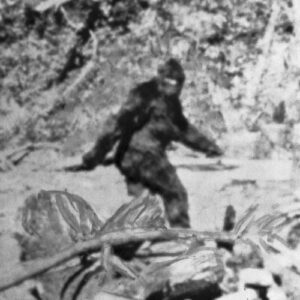
Bigfoot has made a smooth transition from folklore to pop culture icon. The 1967 Patterson-Gimlin film—a grainy reel showing a large figure striding across a creek—remains the most debated piece of alleged evidence. Though its authenticity is still hotly contested, it launched Bigfoot into the mainstream. From that point on, the creature found its way into countless movies, books, and television series. The lighthearted Harry and the Hendersons portrayed Bigfoot as a misunderstood gentle giant, while shows like Finding Bigfoot adopted a more investigative tone. Bigfoot also shows up in advertising, product packaging, and even as a team mascot—proof of just how deeply this creature has embedded itself in popular imagination.
Current Status
Despite decades of searches, expeditions, and supposed evidence, science remains unconvinced. Most hair and footprint samples have been traced back to known animals or revealed as fabrications. Still, public fascination hasn’t waned. Recent polls show that belief in Bigfoot is actually growing, especially among younger generations. Online communities regularly share sightings, audio recordings, and photographs, keeping the legend alive in the digital age. Some local governments have even embraced the myth, proposing official recognition or protective status for the creature—not out of scientific validation, but as a nod to its cultural significance.




Source
Tracking the Legend of Bigfoot | Arizona State Museum. (2025). https://statemuseum.arizona.edu/online-exhibit/curators-choice/tracking-legend-bigfoot
Robert Walls. (2022). Bigfoot (Sasquatch) legend – The Oregon Encyclopedia. https://www.oregonencyclopedia.org/articles/bigfoot_sasquatch_legend/
efelle creative. (2025). The Legend of Bigfoot – Washington Military Department. https://mil.wa.gov/the-legend-of-bigfoot
Becky Little. (2018). How the Bigfoot Legend Began – History.com. https://www.history.com/articles/bigfoot-legend-newspaper
Sasquatch | Bigfoot, Description, Sightings, & Facts | Britannica. (2025). https://www.britannica.com/topic/Sasquatch
Frequently Asked Questions
What is Bigfoot?
Bigfoot is a legendary ape-like creature said to inhabit forests in North America. It is also known as Sasquatch.
Is Bigfoot real?
There is no scientifically verified evidence confirming Bigfoot’s existence. Sightings and footprint casts remain controversial.
Where is Bigfoot most commonly seen?
Most sightings occur in the Pacific Northwest of the United States and Canada, particularly in forested regions of Washington, Oregon, and British Columbia.
What is the Patterson-Gimlin film?
The Patterson-Gimlin film is a 1967 video that allegedly shows a Bigfoot walking in Bluff Creek, California. It remains heavily debated among researchers and skeptics.
What does Bigfoot symbolize?
Bigfoot symbolizes humanity’s fascination with the unknown and the idea that wilderness may still contain undiscovered life.