


Pangu : Creator of Heaven and Earth in Chinese Mythology
At a glance
| Description | |
|---|---|
| Origin | Chinese Mythology |
| Classification | Gods |
| Family Members | N/A |
| Region | China |
| Associated With | Creation |
Mythlok Perspective
In Mythlok’s Perspective, Pangu stands apart from many creation figures because he does not simply command the universe into existence; his own body becomes part of the world he creates. This makes his mythology closer to traditions such as the Norse Ymir, whose body also forms the cosmos. Yet Pangu’s story places greater emphasis on the gradual separation of heaven and earth and the transformation of primordial chaos into an ordered natural world, reflecting a distinctly Chinese cosmological understanding of creation.
Pangu
Introduction
In Chinese mythology, Pangu is one of the most important figures associated with the creation of the cosmos. He is portrayed as a primordial being who emerged when the universe existed in a state of undifferentiated chaos. His story explains how heaven and earth came to be separated and how the ordered natural world emerged from the primordial state.
According to the best-known tradition, Pangu existed within a cosmic egg containing the forces of chaos. When the egg opened, the lighter and clearer yang rose upward to form heaven, while the heavier and more turbid yin settled downward to become earth. Pangu stood between the two realms, growing as they moved apart and ensuring that they did not collapse back into their original state.
The earliest known written accounts of Pangu are associated with Xu Zheng, a scholar of the Three Kingdoms period, in the Sanwu Liji. The surviving material was transmitted through later texts because the original work is no longer extant. This makes Pangu an especially interesting figure in Chinese mythology: although his creation story became enormously influential, the written evidence for the myth appears relatively late compared with some other ancient Chinese traditions.
Pangu’s story also developed within the cosmological environment of early medieval China, where ideas about yin and yang, transformation, and the relationship between heaven and earth were increasingly important. Rather than simply creating the universe through divine command, Pangu becomes part of the process itself. His eventual transformation into elements of the natural world presents creation as a continuous process in which life, matter, heaven, and earth remain interconnected.
Physical Traits
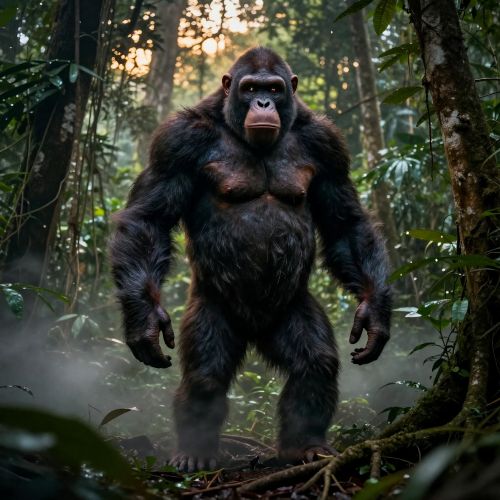
Pangu is generally imagined as a massive primordial giant, reflecting the enormous scale of the task he performs. His physical appearance is not completely standardized, however, because much of the familiar imagery comes from later artistic and folkloric traditions rather than from the earliest surviving descriptions.
In traditional and modern Chinese art, Pangu is frequently shown as a powerful, rugged figure with long hair or thick body hair. Some representations give him horns or other animal-like characteristics, emphasizing his primitive and ancient nature. He is also commonly portrayed carrying a large axe, which has become one of his most recognizable attributes in later visual representations.
His extraordinary size is central to the mythology. As heaven and earth move farther apart, Pangu grows along with the expanding space between them. Some versions describe him as becoming ten feet taller each day, continuing this growth over a period of 18,000 years. His increasing stature represents the immense scale and duration of cosmic creation.
Pangu’s physical form ultimately becomes inseparable from the world he helped establish. In later versions of the myth, different parts of his body are transformed into natural features. His breath becomes wind and clouds, his voice becomes thunder, and his eyes become the sun and moon. His blood becomes rivers, his flesh becomes the earth, and his bones contribute to mountains and minerals. His hair and other bodily elements are associated with vegetation, stars, and other features of the natural world. These transformations make Pangu more than a giant who creates the world. He becomes a mythological explanation for why the physical universe is composed of interconnected elements.
Family
Pangu has no established family genealogy in the principal creation traditions. Unlike deities who belong to extensive divine families, Pangu appears as a primordial figure whose existence begins before the ordered world itself. His story therefore does not depend on parents, a spouse, siblings, or descendants. This absence of genealogy is important to his role in Chinese mythology. Pangu does not inherit his position from an earlier generation of gods, nor does he create the world as part of a divine family struggle. Instead, he stands at the beginning of the cosmic process itself.
Some later folk traditions and modern retellings have attempted to connect Pangu with other major Chinese mythological figures, particularly Nüwa, who is associated with the creation and repair of humanity. However, Pangu and Nüwa do not form a standard couple or family in the classical Pangu creation account. Their stories belong to different strands of Chinese mythology that were sometimes brought together in later interpretations.
Likewise, the Dragon, Phoenix, Qilin, and Turtle should not be treated as Pangu’s literal relatives or a fixed group of assistants. These creatures have important symbolic roles in Chinese tradition and sometimes appear alongside Pangu in later artistic representations, but they are not established members of his family in the earliest creation narrative.
Other Names
The name Pangu is written in modern Mandarin romanization as Pangu, while older Western scholarship commonly used the spelling P’an-ku. The form Pan Gu is also frequently encountered in English-language writing.
The precise etymology of the name is uncertain. Interpretations such as “Ancient Coiled One” have been proposed, sometimes connecting the name with the image of Pangu curled inside the cosmic egg. However, this interpretation should not be treated as a firmly established literal translation. The meaning and origin of the name remain subjects of scholarly discussion.
Pangu is also described through titles and phrases emphasizing his role in cosmic creation, particularly his association with the separation of heaven and earth. These descriptive formulations help explain why he occupies such an important position in Chinese creation mythology.
Powers and Abilities
Pangu’s most important ability is his extraordinary physical strength and endurance, which allow him to maintain the separation between heaven and earth. His power is not usually presented as a collection of magical abilities in the manner of a warrior deity. Instead, his strength represents the immense natural forces involved in the formation of the cosmos.
His defining act is the separation of heaven and earth. In the primordial state, yin and yang are mixed together. As they separate, the lighter yang rises and becomes heaven while the heavier yin descends and forms earth. Pangu occupies the space between them, growing continuously so that the two realms remain apart.
This aspect of the myth connects Pangu with the Chinese cosmological principle of yin and yang, although the surviving Pangu traditions should not be reduced simply to an explanation of yin-yang philosophy. The story combines ideas about opposing forces, cosmic transformation, and the gradual establishment of order. Pangu’s greatest transformation occurs after his death. His body becomes part of the world he helped create. His breath, voice, eyes, blood, flesh, bones, hair, and other bodily elements are transformed into natural phenomena in various versions of the tradition.
The meaning is profound: Pangu does not merely make the world; he becomes part of it. Creation therefore involves transformation rather than the production of something entirely separate from the creator. The mountains, rivers, sky, celestial bodies, and living world can all be understood as extensions of the primordial being.
Modern Day Influences
The story of Pangu remains an important part of Chinese cultural heritage and continues to appear in literature, children’s books, educational material, painting, sculpture, theatre, television, film, and contemporary fantasy media. His recognizable image as a giant carrying an axe makes him particularly suited to visual interpretations of the creation of the world.
Pangu is also remembered through regional traditions and places associated with his worship, particularly in parts of southern China. Local Pangu temples and festivals demonstrate that his significance has not been limited to literary mythology. His traditions have been incorporated into different regional understandings of ancestry, landscape, and cosmic origins.
In contemporary culture, Pangu is often presented as a symbol of creation, transformation, endurance, and cosmic unity. His story also provides a particularly distinctive Chinese explanation of creation because the natural world is ultimately formed from the creator’s own body. Rather than remaining separate from nature, the creator becomes nature.
Pangu’s influence should not be understood as evidence that every modern environmental or philosophical idea derives directly from his mythology. However, the image of his body becoming mountains, rivers, celestial bodies, and vegetation continues to offer a powerful cultural metaphor for the interconnectedness of the natural world.
What makes Pangu enduring is therefore not simply the scale of his creation. His mythology presents the universe as something formed through separation, transformation, and continuity. Chaos becomes heaven and earth; the primordial being becomes nature; and creation continues through the transformation of one form into another. In Chinese mythology, Pangu ultimately represents the moment when an undivided cosmos becomes the ordered world inhabited by gods, humans, and nature.
Related Images


Source
Mythopedia. (2022). Pangu. https://mythopedia.com/topics/pangu/
Gods and Monsters. (2025). Pangu the Creator: Giant Who Split Heaven and Earth. https://godsandmonsters.info/pangu/
Roots of Civilizations. (2024). Exploring the Chinese Myth of Pangu and the Origins of the Universe. https://rootsofcivilizations.com/chinese-myth-of-pangu-and-universe/
EBSCO Research Starters. (2018). Pangu (deity). https://www.ebsco.com/research-starters/religion-and-philosophy/pangu-deity
Wikipedia. (2023). Pangu. https://en.wikipedia.org/wiki/Pangu
Storytelling DB. (2025). Pangu: The Creator God of Chinese Mythology. https://storytellingdb.com/pangu/
Ching, J. (1993). Chinese Religions. Macmillan Publishing.
Yang, L., An, D., & Turner, J. (2005). Handbook of Chinese Mythology. Oxford University Press.
Birrell, A. (1993). Chinese Mythology: An Introduction. Johns Hopkins University Press.
Wu, K. C. (1982). The Chinese Heritage. Crown Publishing Group.
Christie, A. (1968). Chinese Mythology. Hamlyn Publishing.
Lagerwey, J. (2010). China: A Religious State. University of Hong Kong Press.
Frequently Asked Questions
Who is Pangu in Chinese mythology?
Pangu is regarded as the first living being and the creator of the universe in Chinese mythology. According to legend, he emerged from a cosmic egg, separated heaven and earth, and shaped the natural world from his own body.
What is the meaning of the name “Pangu”?
The name Pangu (盘古) translates to “Ancient Coiled One” or “Primordial Antiquity,” referring to his curled position within the cosmic egg before creation and symbolizing the potential for life and transformation.
How did Pangu create the world?
Pangu split the chaotic void into heaven and earth using a mighty axe. As he grew for 18,000 years, he kept the sky and earth apart. Upon his death, his body transformed into natural elements—his eyes became the sun and moon, his breath the wind, and his blood the rivers.
Does Pangu have a family or descendants?
In most myths, Pangu is a solitary being with no parents or offspring. However, later folk traditions sometimes associate him symbolically with the goddess Nuwa, linking the cosmic creation to the birth of humankind.
How is Pangu remembered in modern Chinese culture?
Pangu remains a symbol of creation, balance, and transformation. His story is taught in schools, depicted in art and media, and honored in temples such as the Pangu King Temple in Guangdong. He continues to inspire philosophical thought and environmental awareness in contemporary China.



Football prediction software download
Pangus myth is simply brilliant – a cosmic giant splitting heaven and earth with an axe for 18,000 years? Talk about dedication, or maybe just extreme boredom! The way his very body became the world, with hair turning into stars and muscles into mountains, is both wonderfully poetic and slightly messy. Its a Taoist masterpiece, really, teaching balance and harmony while essentially throwing a cosmic party where everything gets recycled. And Pangu himself, being self-born and solitary, is quite the enigma – the ultimate cool cat of creation. Its a reminder that sometimes, the greatest origins stories involve someone just chilling in an egg before getting a bit ambitious. A truly inspiring, if slightly ax-heavy, tale!