


Ao Guang : The Chinese Dragon King of the East
Mythlok Perspective
Mythlok’s Perspective, Ao Guang is compelling not because he is simply a powerful Dragon King, but because his stories reveal the uneasy relationship between authority and power. Like Poseidon in Greek mythology, he commands a vast aquatic realm and represents nature’s unpredictable force. Yet Ao Guang is often less dominant than his title suggests, particularly when confronted by figures such as Sun Wukong. That contrast makes him a fascinating example of how myth can portray even supernatural rulers as vulnerable to greater forces.
Ao Guang
Introduction
Ao Guang is one of the most prominent Dragon Kings in Chinese mythology and is traditionally associated with the East Sea. He belongs to the group known as the Four Dragon Kings, supernatural rulers connected with the seas in the four cardinal directions. As the ruler of the Eastern Sea, Ao Guang occupies an important place in stories involving water, rain, dragons, immortals, and supernatural authority.
His most famous literary appearances are in the classical Chinese novels Journey to the West and Fengshen Yanyi (Investiture of the Gods). These works do not always present the Dragon Kings in exactly the same way, and their names, relationships, and positions can vary between traditions. In Journey to the West, Ao Guang is the Dragon King of the Eastern Sea and resides in a magnificent underwater Dragon Palace. His encounter with Sun Wukong, the Monkey King, becomes one of the best-known episodes associated with him.
Although he possesses considerable supernatural authority, Ao Guang is not always portrayed as an invincible or benevolent deity. Classical stories often depict him as a powerful ruler concerned with maintaining his status and protecting his domain, while his encounters with heroes such as Sun Wukong reveal a more complicated personality.
Physical Traits
Traditional Chinese mythology does not provide a single, standardized physical description of Ao Guang. As a Dragon King, however, he is associated with the supernatural dragon, one of the most important creatures in Chinese mythology. Chinese dragons are generally portrayed as long, serpentine beings with scales, horns or antler-like features, claws, whiskers, and elongated bodies.
Unlike the winged dragons commonly found in European mythology, Chinese dragons are traditionally capable of moving through the heavens without relying on physical wings. They are closely connected with clouds, rain, rivers, seas, and other forces of nature.
Ao Guang can also appear in human form in literary and artistic representations. In this guise, he is generally presented as a dignified ruler or nobleman, reflecting his position as sovereign of the Eastern Sea. His association with a Dragon Palace, dragon attendants, and supernatural treasures further emphasizes his royal status.
Modern illustrations often give Ao Guang elaborate scales, horns, robes, and aquatic features. These visual details help distinguish him as a Dragon King, although specific colours, dimensions, and other physical characteristics vary considerably between artistic interpretations rather than belonging to a fixed traditional description.
Family
Ao Guang belongs to the powerful lineage of the Dragon Kings, although the exact composition of this family differs between Chinese literary traditions. In Journey to the West, he is one of the Four Dragon Kings who rule the four seas. His brothers are Ao Qin, associated with the South Sea; Ao Run, associated with the West Sea; and Ao Shun, associated with the North Sea.
This arrangement should not be treated as universal. Fengshen Yanyi presents a different configuration of the Dragon Kings, demonstrating that their names and domains could vary across literary traditions.
Ao Guang is also associated with several dragon princes in Chinese mythology. Among the best known is Ao Bing, his son in Fengshen Yanyi. Ao Bing is particularly famous for his encounter with Nezha, which ends in his death and becomes an important episode in the story of Nezha’s supernatural rise.
Ao Guang’s family therefore extends beyond the Four Dragon Kings themselves, connecting him to a broader supernatural dragon lineage. Through these relationships, his stories intersect with some of the most important figures in Chinese mythology, including Nezha and Sun Wukong.
Other Names
Ao Guang is principally known as Ao Guang (敖广), particularly in Journey to the West, where he is identified as the Dragon King of the Eastern Sea, or Donghai Longwang (東海龍王). The written form of his name varies between classical traditions. In Fengshen Yanyi, his name appears as Ao Guang (敖光), using a different Chinese character for the second part of the name. Although the two forms are pronounced alike in Mandarin, they should not be treated as evidence that the name means “Brilliant Radiance” or “Blue Radiance.” Such translations are misleading because the characters themselves differ.
His most important title is therefore Dragon King of the Eastern Sea, which directly describes his supernatural position and domain. More broadly, he belongs to the group of beings known as Longwang, or Dragon Kings, who are associated with control over aquatic realms and weather. Some later religious and popular traditions have developed additional titles and descriptions for Dragon Kings, but these should be distinguished from the names and titles directly attested in classical literature.
Powers and Abilities
Ao Guang’s authority is closely connected with the sea, water, rain, and weather. As Dragon King of the Eastern Sea, he rules a vast supernatural aquatic realm and commands numerous beings who inhabit it. His Dragon Palace serves as the centre of his authority, populated by dragon relatives and aquatic attendants.
His association with water also places him within the broader Chinese tradition of dragon beings as controllers or bringers of rain. Dragon Kings could be approached in rituals connected with rainfall and water, reflecting the importance of these forces to agricultural societies. Ao Guang possesses supernatural abilities associated with his dragon nature and can be represented in both human and draconic forms. His supernatural status also gives him considerable physical strength and authority over his underwater domain.
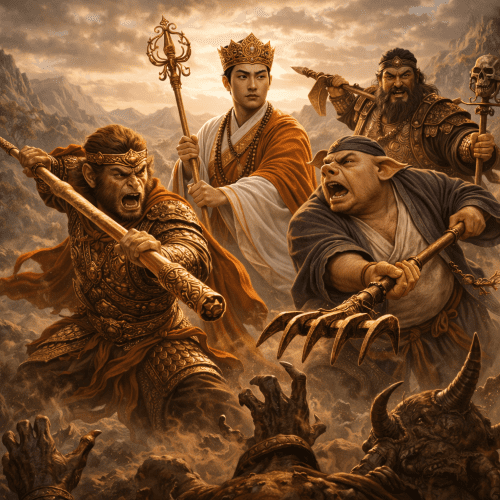
One of the most memorable aspects of his legend is his possession of extraordinary treasures. In Journey to the West, Sun Wukong visits Ao Guang’s Dragon Palace seeking a weapon powerful enough for him to wield. After trying several weapons, he ultimately obtains the Ruyi Jingu Bang, the magical golden-hooped staff that becomes his signature weapon.
Ao Guang’s power, however, does not make him all-powerful. In Journey to the West, his encounters with Sun Wukong demonstrate that even a Dragon King can be intimidated or outmaneuvered by a sufficiently powerful supernatural being. His character consequently combines immense authority with the political concerns and vulnerabilities of a ruler.
Modern Day Influence
Ao Guang continues to appear in modern interpretations of Chinese mythology, particularly in films, television series, animation, novels, comics, and video games. His connection with the Dragon Kings and his role in Journey to the West and Fengshen Yanyi have ensured that he remains recognizable to contemporary audiences.
His most enduring associations are with the sea, dragons, supernatural royalty, and control over water and weather. Modern adaptations frequently expand these characteristics, sometimes presenting him as a powerful elemental deity or a formidable antagonist. Such portrayals often combine traditional mythology with fantasy conventions, resulting in versions that differ considerably from the classical literary character.
Ao Guang’s wider cultural significance also reflects the enduring importance of dragons in Chinese culture. Dragon imagery has historically been associated with water, rainfall, power, authority, and auspicious forces. Dragon Kings similarly appear in religious and folk traditions connected with water and rain, although individual practices and beliefs vary across regions and historical periods.
His legacy is therefore larger than any single story. Through the Dragon King tradition, Ao Guang represents the mysterious power attributed to the seas and the forces of nature, while his appearances alongside figures such as Sun Wukong and Nezha connect him to some of China’s most enduring mythological narratives.
Related Images



Sources
Wikipedia. (n.d.). Ao Guang. Retrieved from https://en.wikipedia.org/wiki/Ao_Guang
Sheng, W. (2024, February 9). How the Dragon King emerged from the waves. Sixth Tone. Retrieved from https://www.sixthtone.com/news/1014617/how-the-dragon-king-emerged-from-the-waves
“Ao Guang.” (n.d.). The Dragon in Ancient China. Retrieved from https://www.worldhistory.org/article/1125/the-dragon-in-ancient-china/
Eberhart, W. (1968). The local cultures of South and East China. E. J. Brill.
Roberts, J. (2004). Chinese mythology A to Z. McFarland.
Wilson, J. K. (n.d.). Symbolism of Chinese dragons and phoenixes and how they’re connected. (Pressbook publication). Retrieved from https://pressbooks.pub/chin330/chapter/symbolism-of-chinese-dragons-and-phoenixes-and-how-theyre-connected/
Stenberg, J. (2022). “Dragon King in a contentious sea”: Sino-Japanese intercultural theatre in 1989. International Journal of Asian Studies, 19(1), 135-151. https://doi.org/10.1017/S147959142100019X
Frequently Asked Questions
Who is Ao Guang in Chinese mythology?
Ao Guang is the Dragon King of the Eastern Sea, ruling over ocean waters, weather, and storms while maintaining balance in the natural world.
What does Ao Guang represent?
He symbolizes the East, spring season, rain, and the element of wood, playing a key role in agricultural prosperity and cosmic harmony.
How is Ao Guang connected to Nezha’s story?
One of his most famous myths involves a confrontation with Nezha, where the child-god defeats Ao Guang’s son Ao Bing, leading to a major conflict between sea dragons and humans.
Does Ao Guang have family in mythology?
How is Ao Guang worshipped or represented today?
Ao Guang appears in temples, folk ceremonies, opera, novels, and modern media as a powerful sea god who can both bless and punish depending on human virtue.


