

Journey to the West : The Legendary Chinese Epic of Enlightenment
At a glance
| Attribute | Description |
|---|---|
| Mythology | Chinese Mythology |
| Language Written | Classical Chinese |
| Age | Circa 1600 CE |
| Author | Wu Cheng’en |
| Main Characters | Xuanzang, Sun Wukong, Zhu Bajie, Sha Wujing, White Dragon Horse |
Mythlok Perspective
In Mythlok’s View, Journey to the West is not merely a pilgrimage but a map of the human psyche. Each character reflects an internal force, from desire to discipline, shaping the path to enlightenment. Unlike purely heroic epics, it embraces imperfection as a necessary step toward transcendence. This aligns closely with the Indian Ramayana, where devotion drives the journey, and the Greek Odyssey, where trials test identity and endurance. Across cultures, the journey is never just physical, it is always inward.
Journey to the West
Introduction
Journey to the West stands as one of the most influential literary epics in Chinese culture, blending myth, spirituality, and adventure into a timeless narrative. Traditionally attributed to Wu Cheng’en, the novel emerged in the 16th century during the Ming dynasty and quickly became a defining work of East Asian storytelling.
At its core, the story reimagines the historical pilgrimage of Xuanzang, transforming a real journey into a grand mythological quest filled with gods, demons, and supernatural trials. What makes Journey to the West enduring is not just its narrative excitement, but its deeper philosophical layers. It reflects the harmony between Buddhism, Daoism, and Confucianism while exploring the human struggle for enlightenment.
Historical Background
The roots of Journey to the West lie in the real-life travels of Xuanzang, who journeyed from China to India in the 7th century to collect sacred Buddhist scriptures. Defying imperial restrictions, he crossed deserts, mountains, and hostile territories before returning with hundreds of texts that would reshape Chinese Buddhism.
Over centuries, his journey evolved into folklore. By the Song dynasty, storytellers had already begun embellishing his travels with supernatural elements. These oral traditions were eventually compiled and refined during the Ming dynasty into the novel we recognize today.
Although commonly credited to Wu Cheng’en, the authorship remains debated due to the story’s deep roots in earlier folk narratives. The earliest known printed edition appeared around 1592, marking the transition of the tale from oral tradition to literary masterpiece.
The novel reflects the intellectual and cultural climate of its time, incorporating Buddhist teachings, Daoist mysticism, and Confucian ethics. It also subtly critiques social structures, particularly bureaucracy and moral decay, making it both a spiritual and social commentary.
Synopsis & Themes
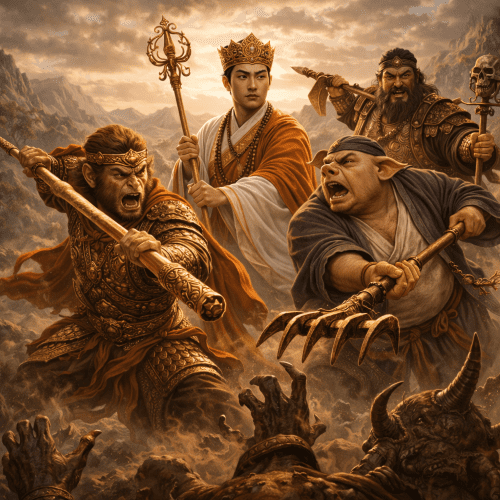
The story follows the monk Xuanzang, often referred to as Tripitaka, who is tasked with retrieving sacred scriptures from India. He is joined by three extraordinary disciples: Sun Wukong, Zhu Bajie, and Sha Wujing, along with a transformed dragon who serves as his steed.
Their journey is marked by 81 trials, each representing a spiritual or moral challenge. These encounters range from battling shape-shifting demons to resisting illusions and temptations. Many obstacles are not random but orchestrated tests meant to refine the pilgrims’ character and faith.
At a deeper level, Journey to the West is an allegory of self-cultivation. Each character embodies a facet of human nature. The journey symbolizes the path toward enlightenment, where discipline, cooperation, and perseverance are essential.
The themes extend beyond spirituality. The narrative explores the tension between chaos and order, particularly through Sun Wukong’s rebellious nature and eventual transformation into a disciplined protector. It also emphasizes the coexistence of the Three Teachings, presenting a unified vision of moral and spiritual growth.
Another recurring idea is illusion versus reality. Many enemies disguise themselves as harmless figures, testing the group’s awareness. This reflects a broader philosophical idea that enlightenment requires seeing beyond appearances.
Key Characters
The richness of Journey to the West lies in its unforgettable characters, each representing a distinct human trait.
Sun Wukong, the Monkey King, is perhaps the most iconic figure. Born from stone, he possesses immense strength, magical abilities, and a rebellious spirit. His journey from defiance to discipline mirrors the taming of the human mind.
Zhu Bajie represents indulgence and desire. Once a celestial marshal, he falls due to his excesses and retains his flaws throughout the journey. Despite this, he contributes to the group, showing that imperfection does not exclude growth.
Sha Wujing embodies patience and reliability. As a quiet and steadfast companion, he contrasts sharply with Wukong and Bajie, symbolizing endurance and humility. At the center is Xuanzang himself, whose compassion and faith guide the group. Though physically weak, his moral strength binds the pilgrims together. The White Dragon Horse, originally a dragon prince, serves as a reminder of transformation and redemption, reinforcing the story’s central theme of spiritual evolution.
Cultural & Religious Significance
Journey to the West is more than a novel; it is a cultural bridge that unites multiple philosophical traditions. It reflects the deep integration of Buddhism, Daoism, and Confucianism within Chinese society, presenting them not as competing ideologies but as complementary paths.
From a Buddhist perspective, the journey represents the path to enlightenment, where suffering and trials are necessary for spiritual growth. Daoist elements appear through themes of immortality, transformation, and harmony with nature. Confucian values are evident in the emphasis on loyalty, hierarchy, and moral responsibility.
The story has also played a major role in shaping Chinese performing arts, including opera, puppetry, and festivals. Its characters, especially Sun Wukong, have become cultural icons, symbolizing rebellion, intelligence, and resilience.
Globally, the narrative has influenced literature, philosophy, and even modern interpretations of hero journeys. It serves as a testament to the power of storytelling in conveying complex spiritual ideas through engaging narratives.
Modern Adaptations
The legacy of Journey to the West continues to thrive in modern media. The story has been adapted into countless films, television series, and animated works across Asia and beyond. One of the most influential reinterpretations is the Japanese franchise Dragon Ball, where the character Goku is inspired by Sun Wukong. This adaptation introduced elements of the original story to a global audience, blending mythology with modern storytelling.
In China, the 1986 television series remains a cultural landmark, while recent films and streaming adaptations have reimagined the tale with advanced visual effects. Video games like Black Myth: Wukong have further expanded its reach, bringing the mythological world into interactive storytelling.
These adaptations demonstrate the story’s flexibility. Whether retold as comedy, action, or philosophical drama, its core themes remain relevant, resonating with audiences across generations.



Source
Waley, A. (1942). Monkey: Folk Novel of China. George Allen & Unwin.
Plaks, A. H. (1987). Four Masterworks of the Ming Novel. Princeton University Press.
Dudbridge, A. (1970). The Hsi-yu chi: A Study of Antecedents to the Sixteenth-Century Chinese Novel. Cambridge University Press.
Yu, A. C. (2012). Journey to the West (Vols. 1–4). University of Chicago Press.
BBC. (1978–1980). Monkey [Television series]. BBC Worldwide. https://www.bbc.co.uk/programmes/b006m8g1
GameScience. (2024). Black Myth: Wukong [Video game]. Hero Games.
Brokaw, C. J. (2009). The cult of Wu: Folk pilgrimage in the Ming-Journey to the West nexus. Journal of Chinese Religions, 37(1), 1–32. https://doi.org/10.1179/073776009X12454725437385
Frequently Asked Questions
What is Journey to the West about?
It follows Xuanzang and his disciples on a spiritual quest to India, overcoming trials to obtain sacred Buddhist scriptures.
Who wrote Journey to the West?
It is traditionally attributed to Wu Cheng’en, a Ming dynasty writer, though its origins include earlier folk tales.
Who is the Monkey King?
Sun Wukong is a powerful trickster figure with magical abilities, representing the untamed human mind.
Is Journey to the West based on a true story?
Yes, it is inspired by the real pilgrimage of the monk Xuanzang in the 7th century.
Why is Journey to the West important?
It blends philosophy, religion, and storytelling, shaping Chinese culture and influencing global literature and media.