


Zhu Bajie : The Chinese Pig Warrior of Journey to the West
At a glance
| Description | |
|---|---|
| Origin | Chinese Mythology |
| Classification | Hybrids |
| Family Members | Gao Cuilan (Wife) |
| Region | China |
| Associated With | Gluttony, Laziness, Lust |
Mythlok Perspective
In Mythlok’s Perspective, Zhu Bajie stands apart from heroes who overcome their flaws before earning greatness. Like the Hindu god Ganesha, whose elephant form carries associations with earthly appetites and divine wisdom, Zhu Bajie combines the comic with the profound. His gluttony, laziness and lust make him deeply human, while his loyalty and perseverance reveal a quieter form of heroism. His journey suggests that redemption is not about becoming perfect, but learning to keep moving despite imperfection.
Zhu Bajie
Introduction
Zhu Bajie, also known as Pigsy in many English translations, is one of the most memorable characters in Chinese mythology and literature. He is best known from Journey to the West, the 16th-century Chinese novel traditionally attributed to Wu Cheng’en. Alongside Sun Wukong and Sha Wujing, Zhu Bajie becomes one of the monk Tang Sanzang’s principal disciples during his pilgrimage to India in search of Buddhist scriptures.
Zhu Bajie was not originally a monster. Before his fall, he was Marshal Tianpeng, a powerful celestial military commander associated with the Heavenly River. His position in Heaven ended after he became drunk at a celestial banquet and behaved improperly toward Chang’e, the goddess associated with the Moon. As punishment, he was banished from Heaven and sent toward reincarnation.
His attempt to be reborn as a human went disastrously wrong when he entered the womb of a sow. He emerged as a pig-like monster and eventually became known as Zhu Ganglie. Living in the mortal world, he developed an appetite for food, wealth and pleasure, while his behaviour toward women repeatedly caused trouble.
His fate changed when the Bodhisattva Guanyin encountered him and directed him to wait for the scripture pilgrim. When Tang Sanzang eventually arrived, Zhu Bajie joined the pilgrimage and received the name Zhu Bajie, referring to the Buddhist Eight Precepts or prohibitions. His new identity did not erase his old habits, however. He remained greedy, lazy, easily distracted and lustful, yet he also proved courageous, loyal and capable of great physical strength.
This combination makes Zhu Bajie unusual among the heroes of Journey to the West. He does not represent perfect virtue. Instead, his journey suggests that spiritual progress can belong even to someone who continually struggles with his own desires.
Physical Traits
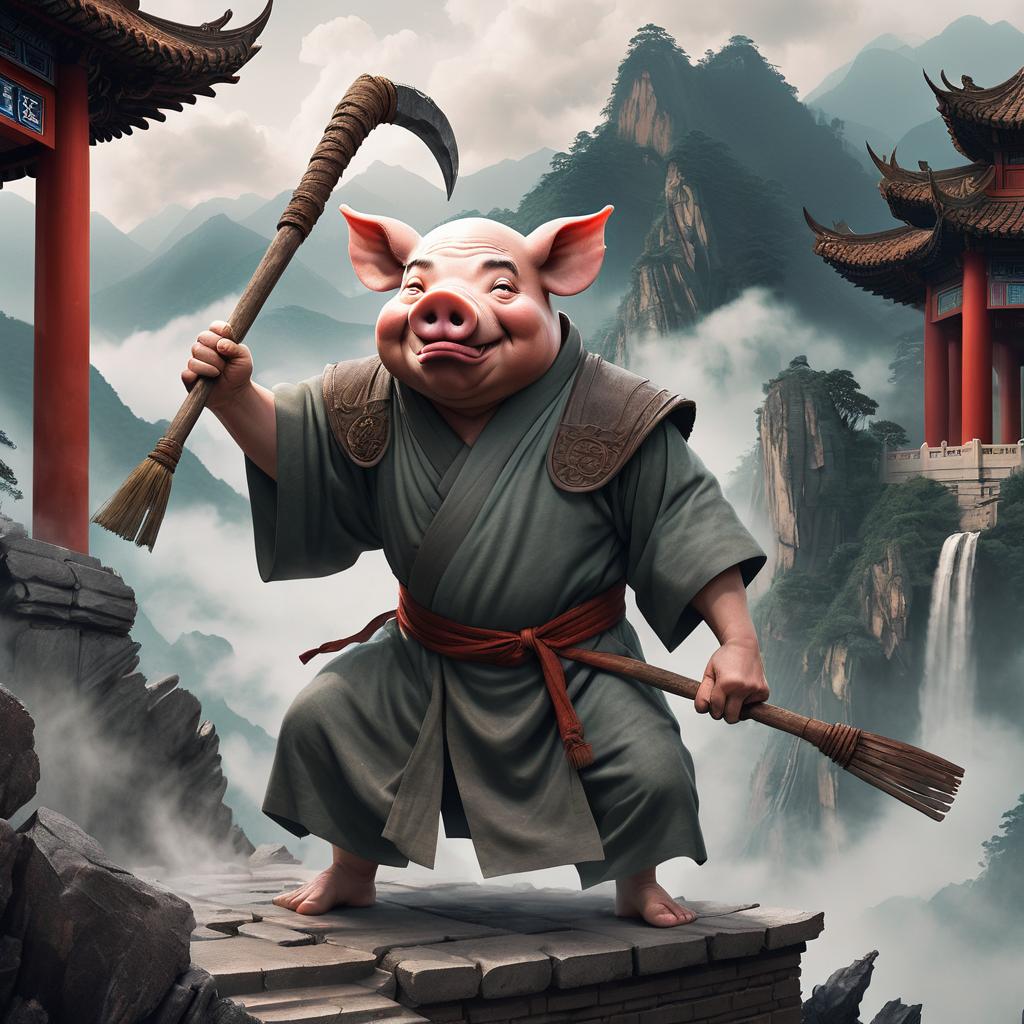
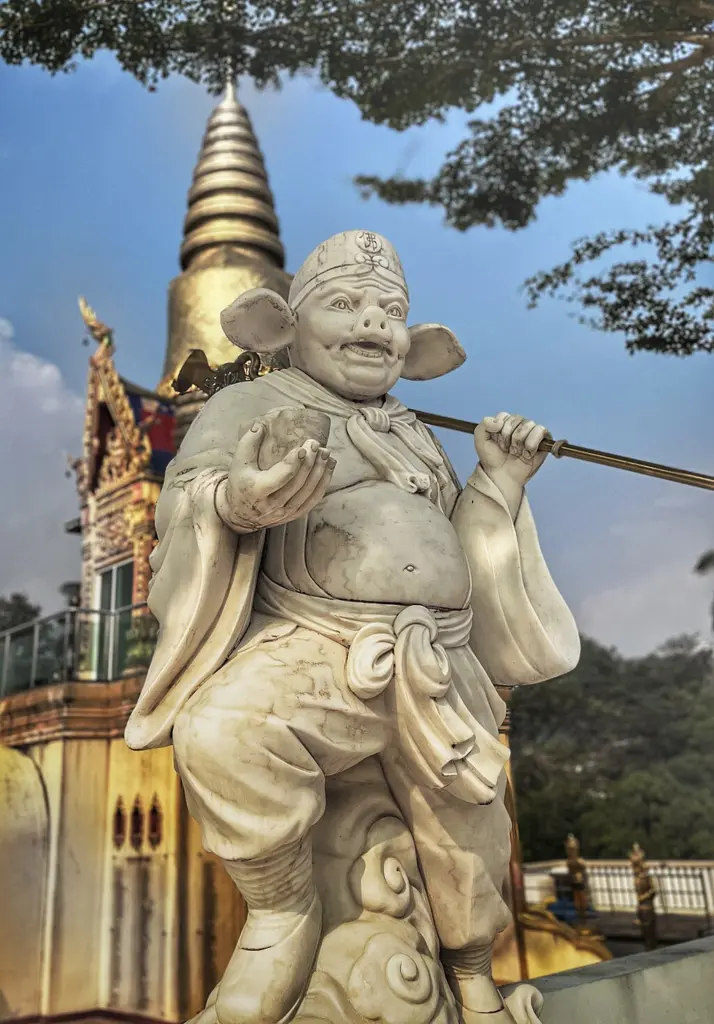
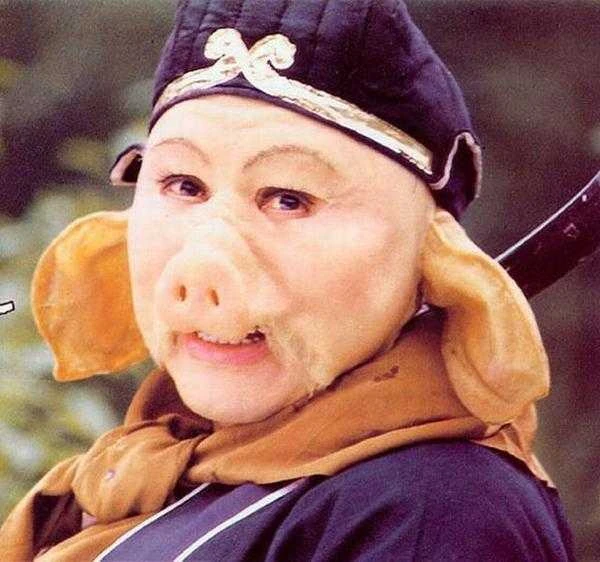
Zhu Bajie is immediately recognizable because of his distinctive pig-like appearance. In Journey to the West, he has a monstrous body with a pig’s face, large ears, a long snout, protruding teeth and coarse bristles. His enormous physical frame reflects his strength, while his animal features constantly remind the reader of his fall from celestial status.
Later paintings, opera performances, television series and films have developed this appearance in different ways. Some portray Zhu Bajie as a frightening boar-like creature, while others give him a softer, more humorous appearance. His rotund belly has become particularly associated with his enormous appetite and love of food.
Zhu Bajie’s appearance also creates one of the novel’s recurring comic contrasts. Although he looks unmistakably monstrous, he frequently behaves as though he were an attractive and sophisticated man, especially when women are involved. His confidence in his own desirability often clashes with how others see him.
His most recognizable possession is his nine-toothed rake, known as the jiǔchǐdīngpá. Despite its agricultural appearance, it is a formidable celestial weapon. The novel gives it an extraordinary weight of 5,048 jin and describes its construction using divine materials. The rake is therefore not merely a farming implement but an emblem of Zhu Bajie’s former celestial identity and his enormous physical power.
Family
Zhu Bajie’s family history is unusual because much of his story concerns separation from the celestial world and his attempts to establish himself in the mortal realm. Before his punishment, he belonged to the heavenly order as Marshal Tianpeng rather than living within an ordinary human family. After his disastrous reincarnation, Zhu Bajie became a pig monster and eventually settled around Mount Fuling. There he became involved with several relationships, including his association with the mistress of Yunzhan Cave. His later attempt to enter human society brought him to the Gao household.
At Gao Village, Zhu Bajie took human form and became involved with Gao Cuilan, the third daughter of the local family. He married into the household after demonstrating his usefulness through physical labour, but his monstrous nature eventually became known. His treatment of Gao Cuilan reveals the darker side of his character, particularly his possessiveness and uncontrolled desire.
His most important relationships, however, are formed during the pilgrimage. Tang Sanzang becomes his religious master, while Sun Wukong becomes his frequent rival and companion. Sha Wujing provides a calmer presence within the group. Their arguments, cooperation and occasional frustrations give the pilgrimage party a remarkably human dynamic.
Zhu Bajie is often the member who complains about hunger, danger or hard work, yet he repeatedly returns to the struggle when his companions need him. His relationship with the other disciples therefore becomes an important part of his redemption.
Other Names
Zhu Bajie’s different names reflect the successive stages of his existence. His original celestial title is Marshal Tianpeng (Tiānpéng Yuánshuài), identifying him as a high-ranking commander in Heaven. After his fall and reincarnation, he becomes known as Zhu Ganglie (Zhū Gāngliè), a name commonly translated as “strong-maned pig,” emphasizing his fierce and bestial appearance. When Guanyin directs him toward the Buddhist pilgrimage, she gives him the name Zhu Wuneng (Zhū Wùnéng). The name is commonly translated in ways such as “Pig Awakened to Ability” or “Pig Awakening to Power,” although English renderings vary.
Tang Sanzang later gives him the name Zhu Bajie (Zhū Bājiè). The name refers to the Eight Precepts, Buddhist rules of restraint associated with the religious life. It is an especially fitting name because Zhu Bajie’s greatest struggle is not a lack of physical ability but his difficulty controlling his appetites and impulses. In English-language adaptations, he is most commonly called Pigsy or simply Pig. Other East Asian traditions have their own forms of his name, including Cho Hakkai in Japanese and Jeo Palgye in Korean.
Powers and Abilities
Zhu Bajie’s abilities reflect his origins as a celestial marshal. He possesses tremendous physical strength and is a highly capable warrior when circumstances demand it. His nine-toothed rake is his signature weapon, and he can wield it with enough force to fight powerful demons and supernatural opponents.
One of his most distinctive abilities is his mastery of 36 transformations. This is fewer than Sun Wukong’s famous 72 transformations, creating a recurring contrast between the two characters. Zhu Bajie’s transformations nevertheless give him considerable supernatural versatility.
He can also travel through the air using cloud-riding techniques, although he is considerably slower than Sun Wukong. His abilities are particularly impressive around water. His celestial background and experience associated with the Heavenly River make him a formidable aquatic fighter, and he is capable of battling effectively in environments where other members of the pilgrimage party are less comfortable.
Zhu Bajie’s supernatural nature also gives him considerable endurance. Yet his greatest limitation is rarely physical. His appetite, laziness, fear and sexual desire repeatedly interfere with his judgement. He sometimes avoids difficult work, complains about the pilgrimage and looks for easier alternatives when danger appears.
These weaknesses are central to his character rather than flaws accidentally added by later adaptations. Zhu Bajie is deliberately written as an imperfect companion. Unlike the disciplined Buddhist monk or the exceptionally powerful Sun Wukong, he resembles an ordinary person struggling to control impulses that continually compete with higher ideals. That tension gives his abilities their meaning. Zhu Bajie already possesses extraordinary power, but possessing power is not the same as possessing self-control. His pilgrimage is therefore as much about mastering himself as defeating external enemies.
Modern Day Influences
Zhu Bajie’s popularity has continued far beyond the pages of Journey to the West. He has become one of the novel’s most recognizable characters and appears regularly in Chinese opera, theatre, television, cinema, animation, comics and video games. Television adaptations have played an especially important role in shaping the modern image of Zhu Bajie. The celebrated 1986 Chinese television adaptation of Journey to the West helped establish a widely recognizable portrayal of the character, balancing his comic appetite and laziness with moments of courage and loyalty.
His influence has also extended across East Asian popular culture. The Japanese manga and anime Saiyuki, for example, reinterprets the pilgrimage characters through its own setting and characterization, with Cho Hakkai drawing from Zhu Bajie. Similar reinterpretations appear throughout Asian animation, comics and fantasy entertainment.
Modern video games have likewise returned to Zhu Bajie as a source of inspiration. His appearance in Black Myth: Wukong introduces him to a new international audience while drawing heavily on the mythology and imagery surrounding Journey to the West. His character has also appeared in numerous other games and adaptations that reinterpret the original pilgrimage for contemporary audiences.
What makes Zhu Bajie particularly durable is the fact that his appeal does not depend on being heroic in the conventional sense. He is selfish when he wants to be, easily tempted and frequently reluctant to face danger. Yet he is not without courage or loyalty. When his companions genuinely need him, he can fight with extraordinary determination. Zhu Bajie therefore occupies an unusual position in Chinese mythology. His story is not simply one of a fallen celestial being becoming a hero. It is a story about an imperfect individual learning, however inconsistently, to live beyond his appetites.
His redemption is never presented as effortless. He remains recognizably flawed throughout the pilgrimage, which makes his eventual spiritual achievement more meaningful. In the world of Journey to the West, the road toward enlightenment does not require someone to begin as a perfect person. Zhu Bajie demonstrates that even a gluttonous, lazy and lustful pig demon can continue walking the path, contribute to the journey and ultimately find a place within the sacred order.
Related Images




Source
Brose, B. (2018). The Pig and the Prostitute: The Cult of Zhu Bajie in Modern Taiwan. Journal of Chinese Religions, 46(2), 167–196.
Wu, C. (Trans.). (1592/2020). Journey to the West. Beijing: Foreign Languages Press.
Wikipedia. (2025). Zhu Bajie. Retrieved from https://en.wikipedia.org/wiki/Zhu_Bajie
YouWeiTrade. (2024). Zhu Bajie’s Story. Retrieved from https://youweitrade.com/blogs/blog/zhubajies-story
The World of Chinese. (2019). The Many Faces of Zhu Bajie. Retrieved from https://www.theworldofchinese.com/2019/02/the-many-faces-of-zhu-bajie/
Journey to the West Wiki. (2024). Zhu Bajie Character Profile. Retrieved from https://journey-to-the-west-xiyouji.fandom.com/wiki/Zhu_Bajie
Myth in Media Wiki. (2007). Zhu Bajie. Retrieved from https://myths-in-media.fandom.com/wiki/Zhu_bajie
Amino Apps. (2023). Zhu Bajie Profile: Fate & Nasuverse Wiki. Retrieved from https://aminoapps.com/c/fatenasuverse/page/item/zhu-bajie/0koq_vnfZIjl5vB10xDzEDn5vlqwz5Vglz
Wu, C. (1993). Journey to the West (A. Yu, Trans.). University of Chicago Press.
Idema, W. L. (2012). Chinese Vernacular Fiction: The Journey to the West. Harvard University Press.
Yang, L. (2005). Handbook of Chinese Mythology. Oxford University Press.
Teo, S. (2009). Chinese Mythology in Popular Culture. Routledge.
Wang, D. (2010). The Monster That Is Zhu Bajie: Comic Relief and Moral Ambiguity in Journey to the West. Journal of Chinese Literature and Culture, 2(1), 45–67
Frequently Asked Questions
Who is Zhu Bajie in Journey to the West?
Zhu Bajie is one of Tang Sanzang’s disciples, a pig-like warrior who provides strength, humor, and occasional trouble on the pilgrimage.
What was Zhu Bajie before joining the pilgrimage?
He was once a Marshal of Heaven but was banished to Earth for misbehavior, transforming into a pig demon before earning a chance at redemption.
What does Zhu Bajie represent?
He embodies human weaknesses such as laziness, gluttony, and lust — yet also loyalty and bravery when it truly matters.
What weapon does Zhu Bajie use?
He wields the Nine-Toothed Rake, a powerful farming tool turned mystical weapon capable of taking down demons and enemies.
Why is Zhu Bajie such a popular character?
His humorous personality, relatable flaws, and heartfelt growth make him one of the most beloved characters in the entire legend.


