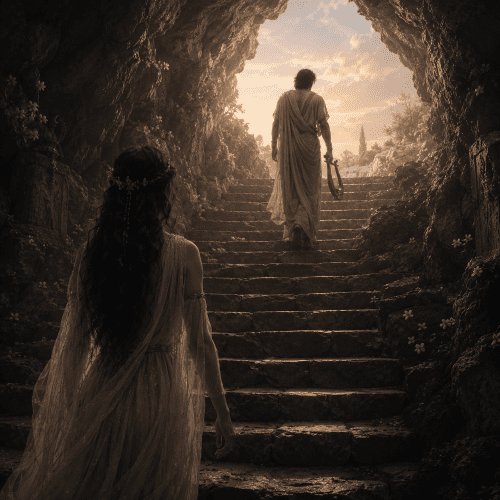
Eros and Psyche : The Legendary Love That Conquered the Gods
| Description | |
|---|---|
| Origin | Greek Mythology |
| Story Title | Eros and Psyche |
| Main Characters | Eros, Psyche |
| Type of Ending | Happy |
| Symbolism | Love, Trust, Soul’s transformation |
Mythlok Perspective
In Mythlok’s Perspective, the story of Eros and Psyche reflects the universal belief that love transforms the human soul through hardship. Psyche’s trials represent the process of growth that turns admiration into true devotion. Similar themes appear in other traditions. The Indian legend of Savitri and Satyavan shows a woman overcoming death itself through love and determination, while the Japanese tale of Izanagi and Izanami explores the tragic consequences of breaking sacred boundaries. Across cultures, myths repeatedly portray love as both a challenge and a path to spiritual transformation.
Eros and Psyche
Introduction
The myth of Eros and Psyche is one of the most enduring love stories preserved from the ancient Mediterranean world. Although rooted in Greek mythic tradition, the complete narrative survives in the Roman writer Apuleius’s second-century novel Metamorphoses (also known as The Golden Ass). Within that work, the story appears as a tale told by an old woman, yet it quickly transcended its literary setting and became one of the most influential myths about love and the human soul.
At its heart, the story describes the union between Eros, the god of love, and Psyche, a mortal princess whose beauty rivals the gods. Their relationship unfolds through secrecy, betrayal, suffering, and redemption. Psyche’s trials transform her from a mortal admired for her beauty into an immortal figure who embodies the soul’s spiritual growth.
What makes the myth of Eros and Psyche remarkable is its emotional structure. Unlike many ancient myths centered on heroic battles or divine wars, this narrative resembles a fairy tale. It focuses on trust between lovers, the dangers of jealousy, and the painful but necessary journey toward maturity. Over centuries the myth has been interpreted as a philosophical allegory, a psychological metaphor, and a timeless romance about love that survives even divine opposition.
Characters Involved
The story of Eros and Psyche revolves around a small group of figures whose relationships shape the entire narrative.
Psyche is the central character. She is a mortal princess famed for her extraordinary beauty. Her name comes from the Greek word psyche, meaning “soul” or “breath of life.” According to the myth, people began admiring her beauty so intensely that they neglected the worship of Aphrodite. This unintended rivalry with a goddess becomes the cause of Psyche’s suffering. Despite her innocence, Psyche must endure abandonment, humiliation, and nearly impossible challenges before achieving divine status.
Eros, known as Cupid in Roman tradition, is the god of desire and romantic attraction. He is usually depicted as a winged youth armed with arrows that can cause love or indifference. In the myth, Aphrodite commands him to make Psyche fall in love with a monstrous creature. Instead, Eros accidentally wounds himself with one of his arrows and falls deeply in love with her. His secret relationship with Psyche forms the emotional core of the story.
Aphrodite, the goddess of beauty and love, serves as the story’s antagonist. Her jealousy arises when humans begin praising Psyche as more beautiful than the goddess herself. Determined to punish the mortal girl, Aphrodite imposes a series of impossible tasks designed to break Psyche’s spirit.
Other figures also appear briefly. Psyche’s jealous sisters manipulate her into doubting her mysterious husband. Natural forces and divine creatures, including ants, reeds, and an eagle, assist Psyche during her trials. Finally, Zeus, king of the gods, resolves the conflict by granting Psyche immortality and approving her marriage to Eros.
Story Summary
The myth of Eros and Psyche begins with Psyche’s extraordinary beauty attracting widespread admiration. People begin traveling from distant regions simply to see her, and some even compare her to Aphrodite herself. This devotion angers the goddess, who believes her divine honor has been insulted.
Aphrodite orders her son Eros to make Psyche fall in love with a hideous monster. However, when Eros approaches Psyche, he accidentally scratches himself with his own arrow and becomes hopelessly enamored with her. Meanwhile, Psyche’s father consults the Oracle of Apollo, seeking guidance about his daughter’s strange fate. The oracle declares that Psyche must be left on a mountainside to marry a terrifying winged being. Obeying the prophecy, her family abandons her there. Instead of a monster, however, the west wind Zephyrus carries Psyche gently to a magnificent palace.
In the palace Psyche is cared for by invisible servants, and each night a mysterious husband visits her in darkness. He warns her never to look upon his face. Psyche lives happily until her sisters visit and sow doubt in her mind, convincing her that her unseen husband must be a monster. One night Psyche lights an oil lamp to see him. She discovers that her husband is none other than Eros, the god of love himself. In her excitement she accidentally spills hot oil onto him. Awakened and hurt by her lack of trust, Eros flies away.
Heartbroken, Psyche searches for him and eventually falls into the hands of Aphrodite, who forces her to complete several nearly impossible tasks. These include sorting an enormous pile of mixed grains, collecting dangerous golden wool from aggressive sheep, fetching sacred water from a treacherous cliff, and traveling to the Underworld to obtain a box of beauty from Persephone.
With help from nature and divine guidance, Psyche succeeds in each challenge. Yet curiosity once again leads to trouble when she opens Persephone’s box, releasing a sleep that causes her to collapse into a deathlike state. Eros eventually finds Psyche and revives her. He then appeals to Zeus, who settles the conflict by granting Psyche immortality. The gods celebrate their marriage on Mount Olympus, and the couple later have a daughter named Voluptas, the personification of pleasure.
Epics & Poems
The most complete version of Eros and Psyche appears in Apuleius’s Metamorphoses, written in the second century CE. This Roman novel includes the myth as a narrative embedded within the main story, yet the tale became so popular that it eventually stood on its own as a literary classic.
During the Renaissance and Romantic periods, writers rediscovered the myth and adapted it into poetic works. In the nineteenth century, Robert Bridges composed a long narrative poem titled Eros and Psyche, expanding the myth into a structured epic exploring the psychological and emotional aspects of the characters.
Another influential reinterpretation appeared in C. S. Lewis’s novel Till We Have Faces (1956). Instead of retelling the story from Psyche’s perspective, Lewis narrated it through the voice of Psyche’s jealous sister, turning the myth into a philosophical reflection on faith, jealousy, and divine mystery. These literary adaptations demonstrate how the myth continues to evolve, shifting from ancient allegory to modern psychological storytelling.
Symbolism
The myth of Eros and Psyche is often interpreted as an allegory of the soul’s development. Psyche represents the human soul striving for growth and understanding. Her journey through suffering and trials mirrors the idea that spiritual maturity requires perseverance and self-discovery. Each challenge imposed by Aphrodite symbolizes obstacles that test resilience and faith.
Eros represents the transformative power of love. His relationship with Psyche shows that love can elevate human existence beyond its mortal limitations. The prohibition against seeing Eros symbolizes trust within relationships. Psyche’s decision to look at him reflects the tension between curiosity and faith, illustrating how doubt can disrupt even the strongest bond. Finally, Psyche’s transformation into a goddess symbolizes spiritual awakening. By enduring hardship and learning from her mistakes, she achieves immortality and unity with divine love.
Cultural Variations
Although the surviving narrative comes from Roman literature, the myth of Eros and Psyche reflects earlier Greek storytelling traditions. Its themes resemble folktales found across Europe and beyond. Many scholars note similarities between this myth and the later fairy tale Beauty and the Beast, where a woman learns to love a mysterious partner despite fear and uncertainty. Similar motifs appear in Asian, African, and Middle Eastern folklore involving hidden husbands or supernatural lovers.
In medieval Europe the story was sometimes interpreted through a Christian lens. Psyche’s suffering was viewed as a symbol of the human soul striving toward divine salvation. Across cultures, the myth resonates because it explores universal themes: jealousy, trust, temptation, and the enduring power of love.
Associated Practices
Across cultures, the Sampo finds echoes in mythic objects that promise endless sustenance or cosmic stability. The Greek cornucopia embodies abundance without labor, while Norse tradition offers the Grotti mill, which also grinds wealth until misuse leads to catastrophe. The Irish Dagda’s cauldron feeds all without depletion, and Indo-Iranian myths speak of world pillars sustaining heaven and earth. These parallels suggest a shared human anxiety around resources, balance, and the consequences of excess. The Sampo stands apart, however, in that its final state is fragmentation rather than preservation.
Modern Influence
While the myth of Eros and Psyche was not tied to a specific festival in ancient religion, its imagery influenced several cultural traditions. In Roman art, the couple frequently appeared in wedding decorations and household frescoes, symbolizing harmony between lovers and the triumph of affection over hardship. Sculptures and reliefs often depicted Psyche with butterfly wings, emphasizing the meaning of her name and the soul’s transformation.
Some scholars also connect Psyche’s descent into the Underworld with symbolic themes found in mystery religions, such as the Eleusinian Mysteries, which explored ideas of death, rebirth, and spiritual renewal. In modern times, the myth occasionally appears in symbolic wedding ceremonies and romantic literature as a representation of enduring commitment.
Modern Influence
The story of Eros and Psyche continues to influence modern culture across multiple fields. In art history, one of the most famous depictions is Antonio Canova’s sculpture “Psyche Revived by Cupid’s Kiss” (1793), which captures the emotional moment when Eros awakens Psyche from enchanted sleep. Painters such as John William Waterhouse also reimagined the myth in dramatic Romantic style.
Psychology has drawn heavily from the myth as well. The term psyche became central to discussions about the human mind, and thinkers like Carl Jung viewed the story as a symbolic narrative about the integration of emotion, desire, and consciousness.
Popular culture continues to adapt the myth’s themes. Modern novels, webcomics, and films often echo the structure of a secret lover, betrayal, and eventual reunion. Even contemporary romance stories frequently mirror the emotional arc first expressed in the myth of Eros and Psyche.




Sources
Greek Myths & Greek Mythology. (2025, May 27). The myth of Eros and Psyche. https://www.greekmyths-greekmythology.com/eros-psyche-myth/
Lectures Bureau. (n.d.). The myth of Eros and Psyche. https://www.lecturesbureau.gr/1/%CF%84he-myth-of-eros-and-psyche-1519/?lang=en
Greek Reporter. (2025, June 27). Eros and Psyche: The greatest love story in Greek mythology. https://greekreporter.com/2025/06/27/eros-cupid-psyche-love-story-greek-mythology/
Greek Mythology. (n.d.). Eros and Psyche. https://www.greekmythology.com/Myths/The_Myths/Eros_and_Psyche/eros_and_psyche.html
Apuleius. (2008). The golden ass (P. G. Walsh, Trans.). Oxford University Press. (Original work published ca. 170 CE)
Bridges, R. (1885). Eros and Psyche: A poem. George Bell and Sons.
Lewis, C. S. (1956). Till we have faces: A myth retold. Geoffrey Bles.
Neumann, E. (1956). Amor and Psyche: The psychic development of the feminine. Journal of Analytical Psychology, 1(3), 156-172.
Frequently Asked Questions
Who were Eros and Psyche in Greek mythology?
Eros was the god of love, while Psyche was a mortal princess whose beauty rivaled the gods. Their story tells how Psyche overcame divine trials to eventually marry Eros and become immortal.
What is the main message of the myth of Eros and Psyche?
The myth explores themes of trust, perseverance, and transformation. It symbolizes how love and personal growth can elevate the human soul.
Where is the story of Eros and Psyche found?
The most complete version appears in the Roman novel Metamorphoses by Apuleius, written in the second century CE.
What tasks did Psyche have to complete?
Aphrodite forced Psyche to complete several impossible tasks, including sorting seeds, collecting golden wool, fetching water from a dangerous river, and retrieving a box from the Underworld.
Did Eros and Psyche have children?
Yes. After Psyche became immortal and married Eros, they had a daughter named Voluptas, who represented pleasure.