

Prophecy of the Clutched Blood Clot : The Birth Omen of Genghis Khan
| Description | |
|---|---|
| Origin | Mongolian Mythology |
| Delivered By | Self-evident omen |
| Type | Positive |
| Outcome | Temüjin becomes Genghis Khan |
| Source Texts | The Secret History of the Mongols (13th c.); Rashid al-Din’s Compendium of Chronicles (14th c.) |
Mythlok Perspective
In Mythlok’s View, the Clutched Blood Clot is less about a physical phenomenon and more about how societies construct inevitability around power. It transforms violence into destiny and leadership into divine order, reflecting a worldview where survival depends on dominance. This motif closely parallels the Roman wolf-nurtured founders and the divine births of East Asian rulers. While the Mongolian version emphasizes conquest and bloodshed, others highlight protection or divine purity. Together, they reveal a universal archetype: the marked child whose life is framed as preordained, shaping how history is understood across cultures.
Prophecy of Divine Mandate
Introduction
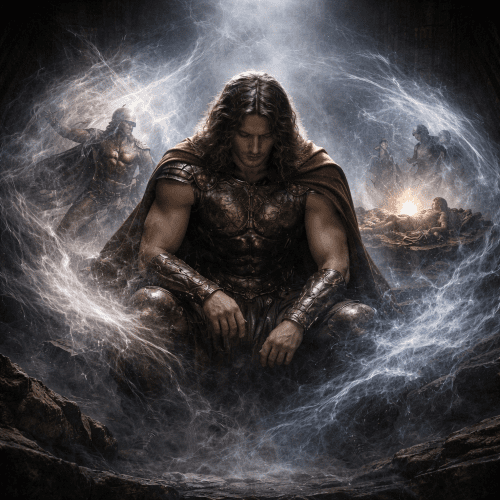
Across cultures, unusual birth signs often signal extraordinary destinies. In Mongolian tradition, one of the most striking of these is the Clutched Blood Clot, an omen believed to mark a child for greatness in war and leadership. This belief is most famously tied to Genghis Khan, born Temüjin, whose rise from hardship to global dominance reshaped history.
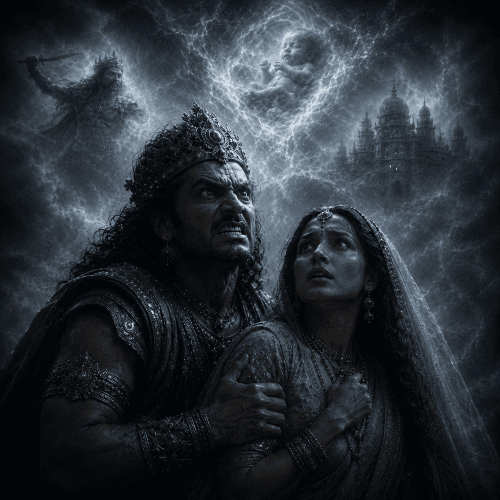
According to legend, Temüjin entered the world gripping a clot of blood in his fist. Rather than being viewed as a medical anomaly, this sign was interpreted as a powerful message from the heavens. It suggested a life bound to conflict, strength, and destiny. In the worldview of the Mongolian steppes, where survival depended on dominance and resilience, such an omen was not feared. It was revered. This narrative goes beyond folklore. It functioned as a foundational myth that justified authority, unified tribes, and framed conquest as destiny rather than ambition.
Source Texts
The most important record of the Clutched Blood Clot appears in The Secret History of the Mongols, written shortly after Genghis Khan’s death in 1227. This text is both a historical account and a mythic narrative, carefully crafted to present Temüjin as a figure chosen by higher powers.
It describes his birth near the Onon River around 1162, noting that he emerged holding a blood clot “the size of a knucklebone die” in his right hand. This detail is not incidental. It is presented as a defining sign, marking him from the very beginning as someone set apart from ordinary men.
Later sources reinforce this imagery. The Persian historian Rashid al-Din, in his Compendium of Chronicles, recounts a similar version of the birth, describing the clot as a sign of future dominance. These accounts blend genealogy, myth, and political messaging, linking Temüjin to divine ancestry and cosmic purpose. Together, these texts do not merely document an event. They construct a narrative of inevitability, where empire is not achieved but foretold.
The Prophecy
In Mongolian belief, a child born clutching a blood clot was destined for a life of power, particularly through warfare. The symbolism is direct and uncompromising. Blood represents both life and violence, and holding it at birth suggests mastery over both.
For Temüjin, this sign implied more than personal success. It indicated that he would become a unifier and conqueror, someone who would reshape the fragmented tribes of the steppe into a single force. The omen also connected him to Tengri, the eternal sky god, reinforcing the idea that his actions were aligned with divine will.
Shamans interpreted such signs not as abnormalities but as confirmations of cosmic order. The clot symbolized predation, strength, and inevitability. It suggested that Temüjin would not merely survive the harsh realities of steppe life but dominate them.
Characters Involved
At the center of this story is Temüjin himself, later known as Genghis Khan. His birth omen shaped how others perceived him and how his story was later told. His father, Yesügei, was a tribal leader who recognized the significance of the sign and named his son after a defeated enemy, reinforcing the idea of inherited strength. His mother, Hö’elün, played an equally crucial role. After Yesügei’s death, she raised her children in extreme hardship, ensuring their survival in a hostile environment.
Ancestral figures also deepen the mythic context. The legendary ancestress Alan Gua, said to have conceived through a divine light, connects Temüjin’s lineage to supernatural origins. This lineage aligns with the Mongol belief in a heavenly wolf ancestor, further strengthening the narrative that his birth was not accidental but ordained.
Outcome
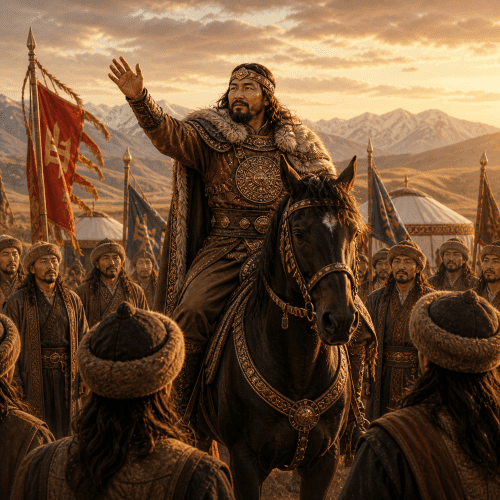
The prophecy of the Clutched Blood Clot appears fulfilled in the life of Genghis Khan. By 1206, he had united the Mongol tribes, earning the title “Khan of Khans.” From there, his campaigns expanded across Asia and into Europe, creating the largest contiguous land empire in history.
His rise was not straightforward. He endured betrayal, enslavement, and near starvation. Yet each challenge seemed to reinforce the idea that he was destined to overcome. The symbolism of the blood clot became a retrospective explanation for his relentless drive and success. Even after his death in 1227, the empire continued to expand under his successors. The prophecy extended beyond a single life, becoming a legacy that shaped generations.
Cultural Significance
For Mongolian culture, the Clutched Blood Clot represents more than a historical anecdote. It embodies the belief that leadership is divinely sanctioned and that strength is a necessary virtue. The story reinforced the legitimacy of Genghis Khan’s rule, providing a spiritual framework for his authority. It also reflected the realities of steppe life, where survival depended on power, loyalty, and adaptability.
Today, the legend remains central to Mongolian identity. Statues, literature, and national narratives continue to portray Genghis Khan as a figure chosen by the heavens. The birth omen serves as a reminder of a time when destiny and survival were inseparable.
Comparative Parallels
The Clutched Blood Clot fits into a broader global pattern of birth omens associated with great leaders. In Roman tradition, Romulus and Remus were nurtured by a she-wolf, symbolizing their destined greatness. In Japanese lore, Emperor Ōjin was born with divine attributes, marking him as extraordinary.
Similarly, stories about Alexander the Great often include supernatural signs at birth, reinforcing his image as a world conqueror. These parallels reveal a shared human tendency to frame powerful leaders as chosen from the moment of birth. Such narratives transform historical figures into symbols, making their authority feel inevitable rather than earned.
Modern Influence
In modern times, the legend of the Clutched Blood Clot continues to inspire storytelling and cultural expression. It appears in historical novels, films, and digital media, often dramatized as a defining moment that foreshadows empire.
Writers like Conn Iggulden incorporate the omen into narratives that blend history with myth, making it accessible to global audiences. In Mongolia, the story remains a source of national pride, shaping how history is remembered and taught.
Scholars also examine the motif as an example of how myth and history intertwine. From a modern perspective, the blood clot could be seen as a rare medical occurrence, but its interpretation reveals far more about cultural values than biology.


Sources
Kaustubha Reflections. (2025, June 16). The birth of Genghis Khan: Destiny and omen explored. https://kaustubhareflections.com/2025/06/16/the-birth-of-genghis-khan-destiny-and-omen-explored/
Explore the Archive. (2019, July 24). 8 facts about Genghis Khan that may surprise you. https://explorethearchive.com/genghis-khan
Academia.edu. (2022, June 26). Blood brothers – an Irish saint and a Mongolian conqueror. https://www.academia.edu/82252975/Blood_brothers_an_Irish_saint_and_a_Mongolian_conqueror
Sciedu Press. (2024, July 9). Symbolics of ‘The White Cloud of Genghis Khan’. https://www.sciedupress.com/journal/index.php/wjel/article/viewFile/26197/16219
de Rachewiltz, I. (2004). The secret history of the Mongols: A Mongolian epic chronicle of the thirteenth century (Vol. 1). Brill.
Onon, U. (2001). The secret history of the Mongols: The life and times of Chinggis Khan. RoutledgeCurzon.
Man, J. (2014). The Mongol Empire: Genghis Khan, his heirs and the founding of modern China. St. Martin’s Press.
Yardimli, A. (2022). Blood clot motifs in Eurasian birth legends: Mongolian and Celtic parallels. Journal of Folklore Studies, 15(2), 45-62. https://www.academia.edu/82252975/Blood_brothers_an_Irish_saint_and_a_Mongolian_conqueror
Frequently Asked Questions
What is the Clutched Blood Clot omen?
It is a Mongolian birth sign where a child is born holding a blood clot, believed to predict a future of power and conquest.
Who was born with the Clutched Blood Clot?
The omen is most famously linked to Genghis Khan, born Temüjin, who later built a vast empire.
What does the blood clot symbolize?
It represents destiny, strength, and a life tied to warfare and leadership in Mongolian belief.
Which text records this omen?
It is described in The Secret History of the Mongols, a key 13th-century chronicle.
Is the Clutched Blood Clot historically verified?
It is recorded in historical texts but is widely considered symbolic rather than medically confirmed.