

Kojiki : Japan’s Ancient Record of Gods, Emperors, and Origins
Listen
At a glance
| Attribute | Description |
|---|---|
| Mythology | Japanese Mythology |
| Language Written | Classical Japanese with Chinese characters |
| Age | Circa 712 CE |
| Author | Ō no Yasumaro |
| Main Characters | Izanagi, Izanami, Amaterasu, Susanoo, Ōkuninushi, Emperor Jimmu |
Mythlok Perspective
From the Mythlok perspective, the Kojiki is less a chronicle of rulers and more a map of elemental order. Its myths emphasise balance over conquest, where creation emerges through purification, withdrawal, and return rather than domination. Authority flows horizontally through land, lineage, and ritual, not sheer power. Comparable patterns surface elsewhere. Like Hesiod’s Theogony, the Kojiki frames order as fragile and cyclical. It also mirrors early Vedic cosmology, where harmony is sustained through ritual alignment rather than heroic supremacy. Across cultures, origins endure not by force, but by balance carefully maintained.
Kojiki
Introduction
Kojiki, translated as Records of Ancient Matters, stands as the oldest surviving literary work of Japan and one of the most influential texts in East Asian cultural history. Completed in 712 CE and presented to Empress Genmei, it occupies a unique space between myth, memory, and political narrative. Rather than functioning as a neutral chronicle, the Kojiki weaves divine creation stories, ancestral genealogies, ritual poetry, and early imperial history into a single worldview. Its purpose was not simply to record the past, but to explain why Japan existed as it did, who ruled it, and how the sacred and human realms were meant to remain intertwined.
Spanning three volumes, the text moves from cosmic beginnings and the age of the gods to the semi-divine founders of imperial rule and finally to historically recognisable emperors. Songs, oral formulas, and symbolic episodes preserve a worldview that predates Buddhism and Confucian statecraft, offering rare insight into Japan before continental philosophies reshaped its institutions. Even today, the Kojiki remains essential for understanding Shinto belief, imperial ideology, and the cultural logic that underpins Japanese identity.
Historical Background
The Kojiki was compiled by the court official Ō no Yasumaro under the order of Empress Genmei, though the original directive came decades earlier from Emperor Tenmu, who reigned from 673 to 686 CE. Tenmu sought to correct inconsistencies in clan genealogies and mythic histories that had accumulated through oral transmission. These inconsistencies were not merely academic; they threatened the legitimacy of imperial authority during a time when Japan was consolidating power under a centralised court.
To preserve these traditions, the court entrusted Hieda no Are, renowned for exceptional memory, with memorising imperial genealogies, myths, songs, and regional traditions. After Tenmu’s death, the project remained dormant until Empress Genmei ordered Yasumaro to commit these oral materials to writing. The resulting text was composed using Classical Chinese characters arranged phonetically to capture spoken Japanese, making it the earliest surviving example of written Japanese expression.
The Kojiki emerged during the early Nara period, when Japan was adopting Chinese administrative models while simultaneously asserting its own sacred origins. Unlike the Nihon Shoki, completed eight years later for diplomatic presentation to foreign courts, the Kojiki was inward-facing. It spoke to the Japanese elite themselves, reinforcing the divine descent of the imperial line and integrating powerful clans into a shared sacred genealogy.
Synopsis & Themes
The Kojiki is divided into three volumes that trace a gradual movement from divine time to human history. The opening volume begins in primordial chaos, where abstract heavenly deities emerge spontaneously before giving way to more anthropomorphic kami. The narrative then centres on Izanagi and Izanami, whose creative acts bring forth the Japanese islands and countless gods. Creation is not depicted as orderly or painless; death, decay, and ritual pollution are present from the beginning, establishing a worldview where balance must be constantly restored through purification.
Following Izanami’s death and Izanagi’s descent into the underworld, the birth of Amaterasu, Tsukuyomi, and Susanoo introduces cosmic order, time, and elemental force. Conflicts among these siblings, particularly Susanoo’s violence and Amaterasu’s withdrawal into the Heavenly Rock Cave, explain natural phenomena while reflecting social anxieties around disorder and authority.
The middle volume transitions toward the human realm, recounting the descent of Amaterasu’s grandson Ninigi and the eventual rise of Emperor Jimmu. Myth and history blur as divine ancestry legitimises territorial expansion and political rule. The final volume, covering later emperors, becomes increasingly restrained, with fewer divine interventions and more genealogical recording.
Across all three volumes, recurring themes dominate: purity and pollution, harmony disrupted and restored, lineage as sacred continuity, and the inseparability of land, ruler, and ritual. The embedded songs add emotional depth, preserving the rhythm and sensibility of oral tradition within a written form.
Key Characters
The Kojiki’s narrative is shaped by figures who function simultaneously as cosmic forces, ancestors, and cultural symbols. Izanagi and Izanami embody creation itself, their union producing both life and inevitable death. Izanami’s transformation into a being of decay introduces mortality as an intrinsic part of existence rather than a moral failure.
Amaterasu, the sun goddess, stands at the centre of the text’s ideological structure. Her authority establishes order in heaven, and her lineage provides the sacred foundation of imperial rule. Her withdrawal into darkness and eventual return express the fragility of balance and the communal responsibility required to restore it.
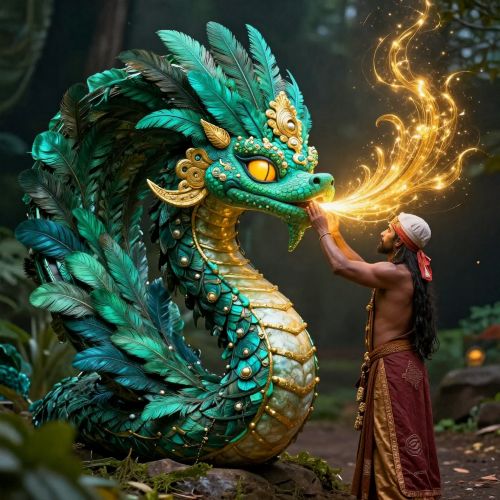
Susanoo represents uncontrolled force and emotional excess, yet his exile leads to heroic transformation. His slaying of the multi-headed serpent Yamata-no-Orochi introduces themes of redemption and the taming of chaos. Ōkuninushi, a descendant of Susanoo, governs the earthly realm through endurance and negotiation rather than brute force, ultimately yielding authority to the heavenly lineage.
Ninigi’s descent to earth formalises the transfer of divine rule into mortal governance, while Emperor Jimmu bridges mythic time and recorded history. Together, these figures form a continuum rather than a hierarchy, reflecting a worldview where gods, humans, and nature remain interdependent.
Cultural & Religious Significance
The Kojiki is foundational to Shinto, not as a rigid doctrine but as a narrative framework through which ritual, landscape, and ancestry gain meaning. Its portrayal of kami as present within mountains, rivers, ancestors, and imperial authority shaped shrine practices and purification rites that continue today. The text provided a unifying mythic structure that integrated diverse clans into a single sacred history, reinforcing the Yamato court’s legitimacy.
During the Edo period, scholars such as Motoori Norinaga elevated the Kojiki as a repository of authentic Japanese spirit, arguing that it preserved emotional sincerity untouched by foreign philosophy. His extensive commentary reshaped Shinto thought and later influenced modern nationalism. In the Meiji era, the Kojiki was mobilised to support state ideology centred on imperial divinity. After the Second World War, its political role diminished, but its cultural and religious value remained intact.
Today, the Kojiki is studied as literature, ritual memory, and symbolic history. It informs shrine festivals, seasonal observances, and ethical ideas about harmony with the natural world. Linguistically, it remains indispensable for understanding early Japanese language and poetic expression.
Modern Adaptations
In the modern era, the Kojiki continues to evolve through reinterpretation rather than repetition. Scholars debate its historical reliability, some viewing it as a constructed political document, others emphasising its literary and symbolic depth. Multiple translations, from early European efforts to contemporary academic editions, have expanded its global readership.
Popular culture has embraced its figures and themes, reimagining kami in novels, animation, games, and visual art. Stories of Amaterasu, Susanoo, and Ōkuninushi appear in modern fantasy settings, while ecological readings highlight the text’s emphasis on balance between humanity and the natural world. Digital archives, illustrated editions, and educational adaptations have made the Kojiki accessible to younger audiences, ensuring its continued relevance in a rapidly changing cultural landscape.



Source
Bock, F. (1972). Engi-shiki: Procedures of the Engi Era (Books I-X) with Engi-shiki Norito. Monumenta Nipponica.
Grapard, A. G. (1992). The protocol of the gods: A study of the Kasuga cult in Japanese history. University of California Press.
Hall, R. A. (2007). Kojiki and Nihon Shoki: The milestones of Japanese history. iUniverse.
Motoori, N. (1798). Kojiki-den (44 volumes). (Original commentary on Kojiki).
Philippi, D. L. (Trans.). (1968). Kojiki. University of Tokyo Press. ()
Tsunoda, R., & Goodrich, L. C. (1958). Japan in the Chinese dynastic histories. Pinyin Books.
Ueda, A. (2020). The Kojiki: A translation with commentary. Tuttle Publishing.
Miyake, M. (2024, December 5). The Power of Myth: How Kojiki Influences Japanese Culture Today. Japanese Mythology. Retrieved from https://japanesemythology.org
Wikipedia contributors. (2025). Kojiki. In Wikipedia. Retrieved from https://en.wikipedia.org/wiki/Kojiki
Encyclopaedia Britannica. (2025). Kojiki. In Britannica. Retrieved from https://www.britannica.com/topic/Kojiki
Frequently Asked Questions
What is the Kojiki and why is it important in Japan?
The Kojiki is Japan’s oldest surviving chronicle, preserving creation myths, imperial genealogy, and early Shinto beliefs that shaped Japanese identity.
Who commissioned the Kojiki and for what purpose?
It was commissioned by Emperor Tenmu and completed under Empress Genmei to legitimise imperial rule and unify mythic traditions.
How is the Kojiki different from the Nihon Shoki?
The Kojiki is inward-facing and mythic in tone, while the Nihon Shoki was written for foreign audiences and follows a more formal historical style.
Is the Kojiki considered history or mythology?
It is a blend of both, combining mythological narratives with early historical records and political ideology.
Does the Kojiki still influence modern Japanese culture?
Yes, its themes, gods, and worldview continue to shape Shinto practices, literature, popular media, and cultural identity.