

Chanson de Roland : A Medieval Epic of Honor and Betrayal
At a glance
| Attribute | Description |
|---|---|
| Mythology | Basque Mythology |
| Language Written | Old French |
| Age | Circa 1100 CE |
| Author | Anonymous (possibly Turold) |
| Main Characters | Roland, Oliver, Ganelon, Charlemagne |
Mythlok Perspective
In Mythlok’s Perspective, the Chanson de Roland is less a historical account and more a medieval myth of identity and sacrifice. Roland’s death transforms a failed military retreat into a sacred legend about honor, loyalty, and divine purpose. The poem reveals how cultures reshape history to reflect the fears and ideals of their own era. Its rewriting of Basque fighters into cosmic enemies also demonstrates how epics can erase local realities in favor of broader ideological narratives. Similar transformations can be seen in works like the Iliad from Greece and the Mahabharata from India, where historical conflicts evolved into moral and spiritual epics. Across cultures, these stories survive because they speak not only about war, but about how civilizations choose to remember themselves.
Chanson de Roland
Introduction
The The Song of Roland, better known by its original title Chanson de Roland, is one of the most influential works of medieval European literature. Written in Old French during the late 11th century, the poem transformed a relatively small historical ambush in the Pyrenees into a sweeping tale of heroism, sacrifice, and faith. It became the defining example of the chanson de geste, a genre of epic poetry celebrating legendary deeds and noble warriors.
Although the poem is often associated with French national identity, its roots lie in the rugged borderlands between the Frankish Empire and the Basque territories. The story draws inspiration from the real Battle of Roncevaux Pass in 778 CE, where Charlemagne’s rearguard was attacked while crossing the Pyrenees. Over centuries, oral storytelling reshaped the event into a dramatic conflict between Christians and Muslim forces, reflecting the political and religious atmosphere of medieval Europe.
Today, the Chanson de Roland remains important not only as literature but also as a historical window into medieval values. It reveals how societies transformed local conflicts into grand cultural myths that reinforced ideas of loyalty, kingship, and divine destiny.
Historical Background
The historical event behind the Chanson de Roland took place on August 15, 778 CE, during the reign of Charlemagne. After campaigning in the Iberian Peninsula, Charlemagne’s army began its return journey through the Pyrenees Mountains. As the Frankish forces moved through the narrow passes near Roncevaux, their rearguard was ambushed by Basque fighters familiar with the difficult terrain.
Contemporary historical sources, including the writings of Einhard, identified the attackers as Basques rather than Muslim armies. The attack was likely retaliation for Frankish destruction in the region, including the sacking of Pamplona. Among those killed was Roland, believed to have been a Breton military commander serving under Charlemagne.
By the time the Chanson de Roland was composed around the late 11th century, the original event had changed dramatically in collective memory. The Basque ambushers were rewritten as Saracen warriors, turning a regional political conflict into a religious struggle between Christianity and Islam. This transformation reflected the mindset of medieval Europe during the era of the Crusades, when stories of holy warfare carried enormous cultural and political significance.
The poem’s authorship remains uncertain. The surviving Oxford manuscript ends with the name “Turoldus,” though historians continue debating whether this refers to the poet, a scribe, or a performer. Regardless of its creator, the poem became one of medieval Europe’s most celebrated literary works and circulated widely across France and neighboring regions.
Synopsis & Themes
The Chanson de Roland follows Charlemagne’s campaign in Spain after years of warfare against Muslim rulers. The Saracen king Marsile pretends to seek peace in order to deceive the Franks and weaken their forces. Roland recommends his stepfather Ganelon as an envoy to negotiate with Marsile, but Ganelon views this appointment as a personal insult and secretly conspires against Roland.
As Charlemagne’s army withdraws through the Pyrenees, Roland commands the rear guard alongside his close companion Olivier and Archbishop Turpin. Ganelon’s betrayal leaves them vulnerable to a massive ambush at Roncevaux Pass. Despite being heavily outnumbered, Roland refuses Olivier’s advice to blow the oliphant horn and summon Charlemagne’s army for help. Roland believes calling for aid would dishonor his reputation as a warrior.
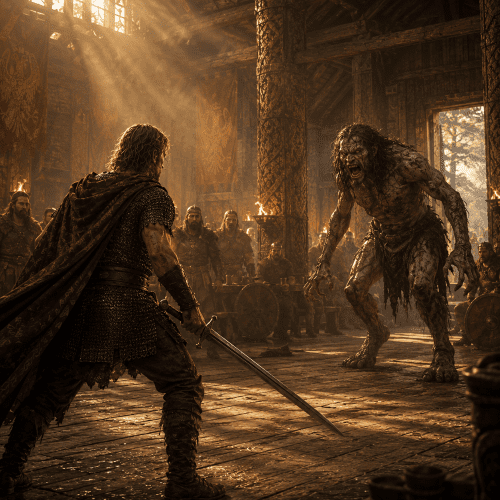
The battle becomes a brutal last stand. Roland and his companions fight courageously, but the Frankish rearguard is eventually destroyed. Only when defeat becomes unavoidable does Roland finally sound the horn with such force that it bursts his temples. Charlemagne hears the call and returns too late to save his warriors. Roland dies beneath a pine tree, offering his glove to God in a scene filled with religious symbolism.
Several major themes define the poem. Honor and loyalty stand at the center of the narrative, particularly through Roland’s devotion to Charlemagne. The poem also examines the dangers of pride, as Roland’s refusal to seek help contributes directly to the tragedy. In contrast, Olivier represents wisdom and restraint, creating one of medieval literature’s most memorable character contrasts.
Religion is another dominant theme. The poem portrays warfare as a sacred duty and frames Roland’s death as martyrdom rather than simple military defeat. This spiritual framing helped transform the story into a symbol of Christian heroism for medieval audiences.
Key Characters
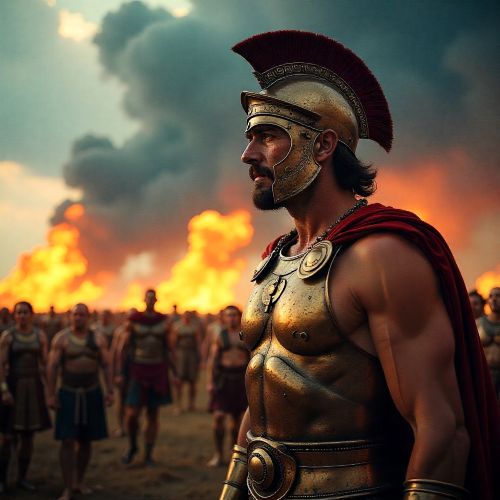
Roland stands at the heart of the Chanson de Roland as the embodiment of medieval heroism. Fearless in battle and unwavering in his loyalty to Charlemagne, he represents the ideals of chivalry and knightly honor that defined the epic tradition. Yet the poem also presents Roland as tragically flawed, as his pride prevents him from calling for help before it is too late. His close companion Olivier serves as a contrast to this recklessness, offering wisdom and strategic caution throughout the battle. Together, the two warriors symbolize the tension between courage and prudence that runs through the story.
Charlemagne is portrayed not merely as a king but as a near-sacred ruler chosen to defend Christian order. The poem transforms the historical emperor into a mythic figure whose authority carries divine significance. His grief over Roland’s death and his determination to punish betrayal reinforce the moral framework of the narrative. Beside the emperor stands Turpin, the warrior-archbishop who fights alongside the knights. Turpin reflects the medieval belief that religious devotion and warfare could unite in the service of Christianity.
The poem’s central antagonist is Ganelon, Roland’s resentful stepfather whose betrayal leads directly to the destruction of the Frankish rear guard. Driven by personal vengeance, Ganelon became one of the most famous symbols of treachery in medieval literature. His actions not only trigger the tragedy at Roncevaux Pass but also set the stage for the poem’s exploration of justice, loyalty, and feudal duty. Through these characters, the Chanson de Roland creates a powerful moral drama that shaped medieval ideas of heroism and betrayal for centuries.
Cultural & Religious Significance
The Chanson de Roland became far more than a heroic poem. It evolved into a cultural symbol that shaped medieval ideas about kingship, warfare, and national identity. In France, the story was eventually viewed as a foundational national epic, especially during the 19th century when European nations increasingly used medieval legends to build patriotic narratives.
Religiously, the poem played a major role in promoting the concept of holy warfare. By transforming a regional ambush into a cosmic battle between Christians and non-Christians, the poem reinforced the ideology that later supported the Crusades. Medieval audiences saw Roland not simply as a knight but as a defender of divine truth.
The poem also demonstrates how history can be reshaped through storytelling. The real attackers at Roncevaux were almost certainly Basque fighters defending their territory from Frankish influence. Yet centuries of retelling replaced this regional conflict with a religious narrative better suited to medieval political and spiritual concerns.
For historians and literary scholars, this transformation makes the Chanson de Roland especially valuable. It reveals how medieval societies used epic poetry to preserve memory, justify power, and create heroic models for future generations.
Modern Adaptations
The influence of the Chanson de Roland extends far beyond the Middle Ages. The poem has been translated into numerous languages and adapted into novels, theater productions, operas, and academic studies. Modern readers continue to revisit the story because of its powerful themes of sacrifice, loyalty, and identity.
Contemporary scholarship has also challenged older interpretations of the poem. Historians now place greater emphasis on the Basque origins of the Roncevaux ambush and examine how medieval writers altered historical events for ideological purposes. This has encouraged fresh discussions about propaganda, religious conflict, and the construction of national myths.
In literature and popular culture, Roland remains an enduring archetype of the tragic hero. His story continues to inspire reinterpretations that explore the balance between courage and pride, faith and violence, memory and history.


Source
Anonymous. (n.d.). The Song of Roland. In Wikipedia. Retrieved from https://en.wikipedia.org/wiki/Song_of_Roland.
LitCharts. (2024). The Song of Roland study guide. Retrieved from https://www.litcharts.com/lit/the-song-of-roland.
Custom‑Writing. (2023). Themes in The Song of Roland. Retrieved from https://custom-writing.org/blog/the-song-of-roland-themes.
Gillingham, J. (2008). The Chanson de Roland. In The Cambridge Companion to Medieval French Literature. Cambridge University Press..
McGoldrick, B. (2020). The Song of Roland and its relationship to the Crusades. University of San Diego HIST103 Course Site. Retrieved from https://sites.sandiego.edu/hist103/2020/10/08/mcgoldrick-the-song-of-roland/.
Historical Perspective and the Song of Roland. (n.d.). Indiana University ScholarWorks. Retrieved from https://scholarworks.iu.edu/journals/index.php/psource/article/download/13710/24299/40990.
SuperSummary. (2026). The Song of Roland themes. Retrieved from https://www.supersummary.com/the-song-of-roland/themes/.
Student‑Notes. (2025). The Song of Roland: History, Legend, and Medieval Epic. Retrieved from https://www.student-notes.net/the-song-of-roland-history-legend-and-medieval-epic/.
Frequently Asked Questions
What is the Chanson de Roland about?
The Chanson de Roland tells the story of Roland’s heroic last stand at Roncevaux Pass during Charlemagne’s campaign in Spain.
Was Roland a real historical figure?
Yes. Roland was likely based on a Frankish commander who died during the 778 CE ambush at Roncevaux Pass.
Who attacked Charlemagne’s army at Roncevaux Pass?
Historical records identify the attackers as Basque fighters, though the poem later portrayed them as Saracens.
Why is the Chanson de Roland important?
It is considered the greatest medieval French epic and helped shape European ideas of chivalry, loyalty, and holy war.
What themes are explored in the Song of Roland?
The poem explores honor, betrayal, sacrifice, religious conflict, and the consequences of pride.