


Prophecy of the Gods’ Destruction : How Völuspá Foretold Ragnarök
| Description | |
|---|---|
| Origin | Norse Mythology |
| Delivered By | Völva |
| Type | Neutral (Doom and renewal) |
| Outcome | Ragnarök |
| Source Texts | Poetic Edda |
Mythlok Perspective
In Mythlok Perspective, Völuspá’s vision of Ragnarök can be compared with the Hindu concept of Pralaya, where the destruction of the existing cosmos precedes its renewal. Both traditions therefore treat cosmic destruction as part of a larger process rather than absolute extinction. The difference is in their conception of time: Völuspá moves toward a foretold Ragnarök, while Pralaya belongs to recurring cycles of cosmic dissolution and creation.
Prophecy of the Gods’ Destruction
Introduction
Völuspá, meaning “Prophecy of the Seeress,” is one of the most important poems preserved in the Poetic Edda and one of the richest sources for understanding Norse mythology. Rather than focusing on a single god or heroic episode, Völuspá presents an enormous vision of the cosmos, moving from its mysterious beginnings through the rise of the gods, the creation of humanity, the collapse of the divine order, Ragnarök, and the emergence of a renewed world.
The poem is spoken by a völva, or seeress, who addresses Óðinn and reveals knowledge of events that have already happened as well as those yet to come. Her account is not presented as a straightforward history. It moves between memory, prophecy, symbolism, and glimpses of the future, creating a deliberately mysterious picture of time and fate.
Völuspá is especially important because the gods themselves are not outside destiny. Óðinn can seek knowledge, Thor can fight monstrous enemies, and the gods can prepare for Ragnarök, but none can ultimately escape what has been foretold. Yet the poem does not end with complete annihilation. After the destruction of the old world, a renewed earth emerges.
The exact origins of Völuspá remain debated. The poem probably preserves older Scandinavian traditions, but the surviving manuscripts were written in Christian medieval Iceland. Scholars therefore continue to examine how pre-Christian beliefs, oral tradition, literary composition, and possible Christian influence shaped the version that survives today.
Source Texts
Völuspá survives in two principal medieval manuscripts. The best-known is the Codex Regius of the Poetic Edda, generally dated to around 1270. A second version appears in Hauksbók, dating from the early fourteenth century. The two versions are similar but are not identical, and differences between them matter when scholars reconstruct the poem.
Snorri Sturluson’s Prose Edda, written in the early thirteenth century, provides another important witness. Snorri quotes or paraphrases passages from Völuspá while explaining Norse mythology and poetic traditions. His work is valuable, but it should not be treated as a completely independent record of Viking Age religion because Snorri was writing in a Christian Iceland several centuries after the period traditionally associated with the myths.
Völuspá belongs to the tradition of Eddic poetry and is written primarily in fornyrðislag, an Old Norse alliterative verse form. Its highly compressed language leaves considerable room for interpretation. Even individual lines can have competing readings, particularly where manuscripts differ or where the original meaning is uncertain.
This complicated transmission is important. Völuspá should not be treated as a manuscript written during the Viking Age. What survives is a medieval written record of traditions that may be considerably older.
The Prophecy
The prophecy begins with the seeress calling on her audience to listen. She claims knowledge of the ancient history of the world and addresses Óðinn directly. Her vision reaches back to the primordial state before the ordered cosmos existed and describes the shaping of the world by the gods.
The poem recalls Ymir and the creation of the ordered universe, although some details differ from the more systematic account later presented by Snorri. It then describes the organization of time and the establishment of the divine world. The gods create places of assembly, fashion objects, and experience an early period of prosperity.
Humanity enters the story through Ask and Embla, the first human pair. The gods give them qualities that transform them from lifeless forms into living beings. Völuspá therefore connects the emergence of humanity directly to the wider ordering of the cosmos.
The poem also introduces the Norns and Yggdrasill, the great cosmic tree. The Norns are associated with determining or shaping destiny, reinforcing one of Völuspá’s central ideas: even gods live within a universe where fate cannot simply be overturned.
Conflict eventually enters the divine world. The war between the Æsir and Vanir represents a major rupture in the early order of the cosmos. Gullveig, a mysterious figure associated with repeated burning and magic, appears before the conflict. The poem then moves through further signs of instability, eventually turning toward the death of Baldr.
Baldr’s death becomes one of the great turning points in the prophecy. His death is followed by Loki’s punishment and an increasingly ominous sequence of events. The natural and social order begins to break apart. The poem describes violence between kin, the collapse of moral bonds, and a world moving toward catastrophe.
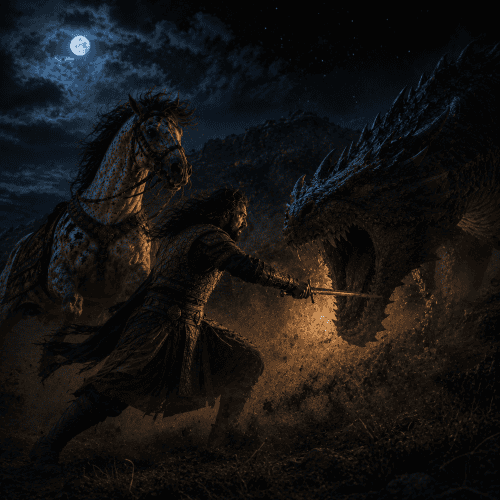
Ragnarök finally arrives. Fenrir breaks free, the Midgard Serpent rises from the sea, and the gods face their enemies in the final conflict. Heimdallr sounds the Gjallarhorn, announcing the approaching disaster. Óðinn is killed by Fenrir, while Víðarr avenges him. Thor kills the Midgard Serpent but dies from its venom. Freyr falls to Surtr, and the world is consumed by fire.
Yet Völuspá continues beyond this destruction. The earth rises from the sea, becoming green and fertile again. Baldr and Höðr return, and surviving gods gather in the renewed world. The prophecy therefore presents Ragnarök as both an ending and a transformation.
Characters Involved
The völva is the central voice of Völuspá. She is not simply a narrator describing events from a distance. Her prophetic authority allows her to move across time, revealing memories of the distant past and visions of the future. Óðinn is both the principal listener and one of the central figures in the prophecy. His search for knowledge is especially significant because Völuspá makes clear that knowledge of fate does not necessarily provide the power to change it.
Thor appears as one of the great defenders of the divine order. His final confrontation with the Midgard Serpent demonstrates both his strength and the unavoidable cost of Ragnarök. He succeeds in killing his enemy but dies from the serpent’s poison. Fenrir, the monstrous wolf, represents one of the forces destined to break the gods’ order. His role becomes decisive when he kills Óðinn during Ragnarök.
Loki occupies a complicated position within the prophecy. His actions are closely connected with Baldr’s death and the final catastrophe, although Völuspá does not reduce him to a simple embodiment of evil. Baldr and Höðr are central to the poem’s movement toward Ragnarök and renewal. Baldr’s death marks a major stage in the collapse of the old order, while both figures appear again in the renewed world. The Norns, especially Urðr, Verðandi, and Skuld, are associated with destiny beneath Yggdrasill. Their presence reinforces the poem’s concern with time, memory, and fate.
Outcome
Ragnarök destroys much of the existing cosmic order. Gods die, monstrous beings are released, fire consumes the world, and the earth disappears beneath the sea. It is one of the most dramatic examples of divine mortality in ancient mythology because even the most powerful gods cannot avoid their destined deaths. But destruction is not the final state described by Völuspá.
The earth rises again, green and fertile. Some gods survive, while Baldr and Höðr return. The surviving divine figures gather once more, suggesting that the new world retains a connection with what came before it. Humanity also survives through Líf and Lífþrasir, who hide during the destruction and emerge to repopulate the renewed world. The new creation therefore preserves continuity even after the old cosmic structure has collapsed.
The ending is not entirely peaceful, however. The appearance of Níðhǫggr near the conclusion leaves the poem with an unsettling image. Völuspá therefore avoids giving readers a perfectly clean ending. Renewal exists, but the poem leaves open the possibility that darkness and instability have not disappeared forever.
Cultural Significance
Völuspá is culturally significant because it brings together many of the central ideas of Norse mythology in a single poetic vision. Creation, humanity, divine conflict, fate, death, Ragnarök, and renewal are not isolated stories. They form parts of a larger understanding of how the cosmos works.
One of the poem’s most distinctive ideas is that power does not guarantee survival. The gods possess enormous abilities, but destiny remains stronger than individual strength. Óðinn cannot outwit Fenrir forever, and Thor cannot survive his victory over the Midgard Serpent. The poem is also important for understanding the transmission of Norse tradition. Its surviving manuscripts were produced in medieval Iceland after the conversion to Christianity. This has led to a long-running debate over whether certain aspects of Völuspá reflect Christian apocalyptic ideas.
The similarities are real enough to deserve attention, particularly in descriptions of cosmic destruction and the renewal of the world. However, scholars disagree about their significance. Some interpretations emphasize Christian influence, while others argue that the poem primarily preserves older Scandinavian traditions. There is no scholarly consensus that reduces Völuspá to either a purely pagan or purely Christian work.
Its cultural importance also extends beyond religion. Völuspá preserves a sophisticated poetic vision of time in which past, present, and future are interconnected. The seeress already knows the end while recounting the beginning, making the entire poem feel like a single cycle of memory and prophecy.
Comparative Parallels
Völuspá can be compared with other traditions that imagine the destruction or transformation of the world, but such comparisons must be made carefully. The Book of Revelation provides an obvious comparison because both traditions contain cosmic catastrophe followed by a transformed world. Both also use dramatic images involving destruction, darkness, and the restructuring of creation. However, these similarities do not prove that Völuspá directly borrowed its Ragnarök narrative from Christianity.
Hindu traditions provide another interesting comparison through their understanding of cosmic cycles. Hindu cosmology contains recurring processes of creation, preservation, destruction, and renewal. Völuspá is not identical to this model, but both demonstrate how destruction can be understood as part of a larger cosmic process rather than simply the end of existence.
Greek traditions also contain ideas about successive ages of humanity and the decline of cosmic and social order. The Norse poem’s description of a world where violence, broken relationships, and disorder spread before Ragnarök creates a comparable picture of decline.
Comparative mythology is most useful when it identifies recurring human concerns rather than assuming that every similarity represents historical borrowing. Floods, fires, divine conflicts, dying gods, and renewed worlds appear across cultures because societies repeatedly use cosmic stories to explore mortality, disorder, catastrophe, and hope.
Modern Influence
Völuspá continues to influence literature, music, fantasy, games, film, television, and popular interpretations of Norse mythology. Its depiction of Ragnarök has become particularly influential because it combines doomed gods, monstrous creatures, a final battle, cosmic destruction, and renewal.
Richard Wagner drew extensively on Germanic and Norse traditions for his Ring cycle, although the connection is broader than Völuspá alone. J. R. R. Tolkien was also deeply influenced by Old Norse literature. Many of the dwarf names in The Hobbit come from the Dvergatal, the catalogue of dwarf names embedded in Völuspá. Modern fantasy often simplifies Ragnarök into a single apocalyptic battle. The original poem is considerably broader. It begins with creation and moves through the development of the divine world, humanity, conflict, social collapse, cosmic destruction, and renewal.
That complexity helps explain why Völuspá remains relevant. It is not simply a story about the end of the world. It is a meditation on what happens when order fails, what knowledge can and cannot achieve, and whether something meaningful can survive catastrophe. The enduring power of Völuspá lies in that tension. Its gods know that fate is approaching, yet they still face it. Its world is destroyed, yet life returns. The prophecy therefore leaves readers with something more complicated than apocalypse: the possibility that endings can also become beginnings.

Sources
Manea, I.-M. (2021, February 23). Viking prophecy: The poem Völuspá of the Poetic Edda. World History Encyclopedia. https://www.worldhistory.org/article/1674/viking-prophecy-the-poem-voluspa-of-the-poetic-edd/
Pettit, E. (Ed. & Trans.). (2023). Vǫluspá (Codex Regius). Open Book Publishers.
Scandia: Journal of Medieval Norse Studies. (2018). Vǫluspá, a profecia da vidente: Notas e tradução.
https://periodicos.ufpb.br/index.php/scandia/article/view/41136
World History Encyclopedia. (n.d.). Völuspá. https://www.worldhistory.org/V%C3%B6lusp%C3%A1/
Dronke, U. (Ed. & Trans.). (1997). The Poetic Edda: Volume II, Mythological poems. Clarendon Press.
Gunnell, T., & Lassen, A. (Eds.). (2013). The Nordic apocalypse: Approaches to Vǫluspá and Nordic days of judgement. Brepols.
Larrington, C. (Trans.). (2014). The poetic Edda (Rev. ed.). Oxford University Press.
Quinn, J. E. (2001). Editing the Edda—the case of Völuspá. Scripta Islandica, 51, 69–92.
Frequently Asked Questions
What is Völuspá?
Völuspá is one of the best-known poems of the Poetic Edda. It is presented as a prophecy delivered by a völva, or seeress, describing the creation of the cosmos, the history of the gods, Ragnarök, and the renewal of the world.
What does Völuspá mean?
Völuspá means “Prophecy of the Seeress” or “Prophecy of the Völva.” The name refers to the female prophetic figure who narrates the poem’s vision of the past and future.
Does Völuspá describe Ragnarök?
Yes. Völuspá contains one of the most important surviving accounts of Ragnarök, including the deaths of major gods, the destruction of the world, and the emergence of a renewed earth.
Who is the seeress in Völuspá?
The speaker is a völva, a female seer associated with prophecy and hidden knowledge. She addresses Óðinn and reveals events concerning the origins and eventual fate of the cosmos.
Is Völuspá a pagan or Christian poem?
Völuspá preserves material associated with pre-Christian Norse traditions, but it survives in medieval Christian Iceland and contains imagery that some scholars connect with Christian apocalyptic traditions. The extent and nature of that influence remain debated.


