


Prose Edda : The Definitive Guide to Norse Myth and Poetry
At a glance
Mythlok Perspective
In Mythlok’s Perspective, the Prose Edda is not just a record of Norse belief but a transformation of myth into structured knowledge. It reflects how cultures preserve identity during transition, turning oral chaos into written order. Like the Indian Puranas or the Greek works of Hesiod, it systematizes divine narratives while subtly reshaping them. Across cultures, such texts reveal a common pattern where mythology evolves to survive changing faiths and political realities.
Prose Edda
Introduction
The Prose Edda remains one of the most important sources for understanding Norse tradition, mythology, and poetic culture. Written in the early 13th century by Snorri Sturluson, this Icelandic work preserves a vast body of myths about gods, giants, and the structure of the cosmos. More than just a collection of stories, the Prose Edda was designed as a teaching tool for poets, ensuring that complex mythological references and stylistic devices remained accessible even as older traditions faded.
At a time when oral storytelling was losing ground to written culture, the Prose Edda became a bridge between past and present. It captures a worldview shaped by fate, honor, and cosmic cycles, while also reflecting the changing religious landscape of medieval Scandinavia. Even today, it stands as a foundational text for anyone seeking to understand Norse thought and storytelling traditions.
Historical Background
The Prose Edda was composed around 1220 CE in Iceland during a period of major cultural transition. Christianity had already been established for over two centuries, and many traditional Norse beliefs were no longer actively practiced. In this environment, Snorri Sturluson undertook the task of preserving older mythological knowledge, not purely for religious reasons but to maintain the integrity of skaldic poetry, which depended heavily on mythological references.
Snorri himself was not only a writer but also a political figure deeply involved in Icelandic and Norwegian affairs. His work reflects this dual identity. The Prose Edda includes a prologue that presents the Norse gods as historical figures descended from Troy, a concept known as euhemerism. This approach allowed Snorri to document pagan myths while aligning them with Christian perspectives, making the text more acceptable in a changing society.
The survival of the Prose Edda depends on medieval manuscripts such as the Codex Regius and Codex Wormianus, which date to the 13th and 14th centuries. These manuscripts preserve a work that draws from earlier oral traditions and poetic sources, including the Poetic Edda. Snorri’s effort ensured that these traditions were not lost during a time of political instability, culminating in his assassination in 1241.
Synopsis & Themes
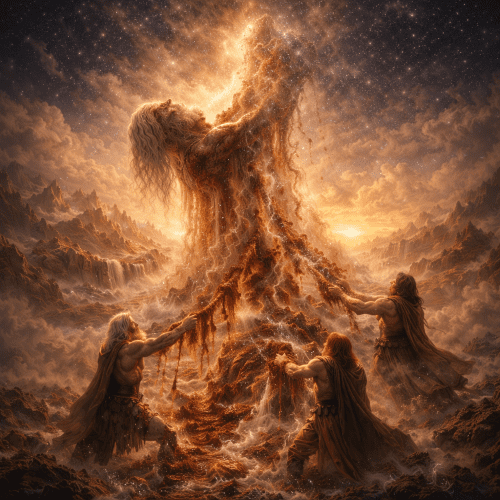
The Prose Edda is divided into four distinct sections, each serving a specific purpose while contributing to a larger narrative framework. The Prologue establishes a rationalized origin of the gods, setting the stage for the mythological accounts that follow. Gylfaginning, the most narrative-driven section, recounts the creation of the world from the body of the giant Ymir, the formation of the first humans Ask and Embla, and the unfolding events leading to Ragnarök, the final destruction and rebirth of the cosmos.
Skáldskaparmál shifts focus to the art of poetry, presenting dialogues that explain the origins of poetic metaphors known as kennings. These expressions rely heavily on mythological knowledge, making this section essential for understanding how Norse poetry functioned. Háttatal, the final section, demonstrates various poetic meters through examples composed by Snorri himself, effectively serving as a technical manual.
Across these sections, several themes emerge consistently. The inevitability of fate is central, especially in the depiction of Ragnarök, where even the gods cannot escape their destined end. The tension between order and chaos is reflected in the ongoing conflict between gods and giants. At the same time, the text highlights the cultural importance of poetry as a means of preserving identity and memory. The subtle influence of Christianity is also present, framing the myths within a broader moral and historical context.
Key Characters
The Prose Edda introduces a wide range of figures who define Norse cosmology and narrative tradition. Odin stands at the center as the chief of the Aesir, associated with wisdom, sacrifice, and war. His relentless pursuit of knowledge, including the loss of his eye, reflects the high value placed on insight and foresight.
Thor represents strength and protection. Armed with his hammer Mjölnir, he defends the gods and humanity from chaotic forces, particularly the giants. His role is direct and physical, contrasting with Odin’s intellectual approach.
Loki introduces complexity into the narrative. As a shapeshifter and trickster, Loki blurs the line between ally and enemy. His actions ultimately lead to the death of Baldr and contribute to the events of Ragnarök.
Other important figures include Freyja, who embodies fertility and mystical power, and Ymir, whose body forms the foundation of the world. Creatures like Fenrir and the Midgard Serpent further reinforce the theme of looming cosmic conflict.
Cultural & Religious Significance
The Prose Edda plays a crucial role in preserving the structure of Norse cosmology, including the concept of the nine worlds connected by Yggdrasil. It offers one of the clearest insights into how the Norse people understood existence, from creation to destruction and renewal. Without this text, much of what is known about Norse mythology would have been lost.
Beyond mythology, the work is essential for understanding skaldic poetry, a highly complex and formalized tradition that relied on mythological references and intricate language. By explaining kennings and poetic forms, the Prose Edda ensured that this art form could continue even as cultural contexts changed.
Religiously, the text reflects a transitional period. While it documents pre-Christian beliefs, it does so through a lens shaped by Christian ideology. This dual perspective makes the Prose Edda not just a mythological record but also a historical document that captures the evolution of belief systems in medieval Scandinavia.
Modern Adaptations
The influence of the Prose Edda extends far beyond its original context, shaping modern storytelling across multiple forms of media. Writers like J. R. R. Tolkien drew heavily from Norse traditions preserved in the Edda, incorporating elements such as dwarves, elves, and epic quests into modern fantasy literature.
Contemporary authors like Neil Gaiman have reinterpreted these myths for modern audiences, maintaining their core themes while adapting their presentation. In popular culture, the Marvel Cinematic Universe has brought characters like Thor and Loki into global recognition, though often in reimagined forms.
Video games such as God of War (2018) explore the emotional and narrative depth of these myths, presenting characters like Baldr and Freya with psychological nuance. Television series, operas, and novels continue to revisit the themes of fate, conflict, and cosmic cycles introduced in the Prose Edda, proving its lasting relevance.

Source
Byock, J. (Trans.). (2005). The Prose Edda. Penguin Classics. (Original work published ca. 1220)
Orchard, A. (Ed.). (2011). The Poetry and Mythology of the Elder Eddas. Medieval Institute Publications.
Snorri Sturluson. (1995). Edda (A. Faulkes, Trans.). Everyman. (Original work published 13th century)
Study.com. (2023). The Prose Edda summary & authors.
https://study.com/academy/lesson/the-prose-edda-summary-authors.html
BookBrief. (2024). The Prose Edda summary. https://bookbrief.io/books/the-prose-edda-snorri-sturluson/summary
GradeSaver. (n.d.). The Prose Edda character list. https://www.gradesaver.com/the-prose-edda/study-guide/character-list
Britannica. (2025). Prose Edda. https://www.britannica.com/topic/Prose-Edda
Wikipedia. (2024). Edda. https://en.wikipedia.org/wiki/Edda
Frequently Asked Questions
What is the Prose Edda?
The Prose Edda is a 13th-century Icelandic work by Snorri Sturluson that preserves Norse myths and explains poetic techniques used in skaldic poetry.
Why was the Prose Edda written?
It was written to teach poets how to use traditional mythological references and to preserve Norse cultural knowledge during a time of Christian influence.
What are the main parts of the Prose Edda?
The text is divided into four sections: Prologue, Gylfaginning, Skáldskaparmál, and Háttatal.
Is the Prose Edda historically accurate?
While it preserves genuine mythological traditions, it also includes reinterpretations influenced by Christian ideas and Snorri’s perspective.
How does the Prose Edda influence modern culture?
It has shaped literature, films, and games, inspiring works by Tolkien, Neil Gaiman, and major franchises like Marvel and God of War.
