


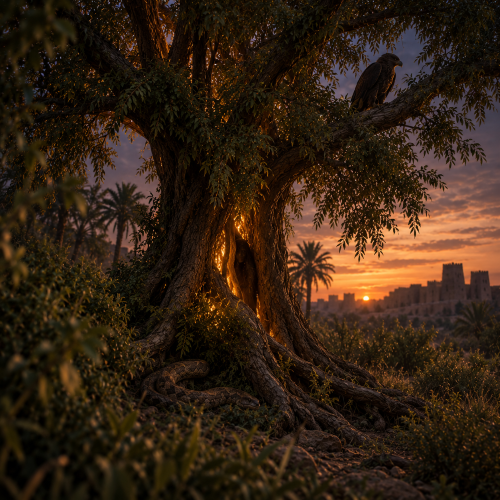
Huluppu Tree : The Sacred Tree of Sumerian Tradition
| Description | |
|---|---|
| Origin | Sumerian Mythology |
| Description | Sacred tree rescued by Inanna |
| Associated Characters | Inanna, Gilgamesh, An, Enlil, Enki, Lilith, Anzu |
| Symbolism | Axis mundi, Kingship, Divine sovereignty |
| Source Texts | Inanna and the Huluppu Tree |
Mythlok Perspective
In Mythlok’s Perspective, the Huluppu Tree reveals how power can depend on controlling the resources that sustain it. Inanna’s struggle resembles the challenges faced by rulers across cultures, from those associated with Yggdrasil in Norse tradition to sacred trees elsewhere that connect nature with authority. Yet the Sumerian story offers a distinctive tension: Inanna nurtures the tree, but Gilgamesh resolves the crisis. Its enduring lesson lies in the uneasy relationship between ownership, agency, and the power to transform the natural world.
Huluppu Tree
Introduction
The Huluppu Tree is a sacred tree in ancient Sumerian literature, best known for its appearance in the story of Inanna and Gilgamesh. Growing beside the Euphrates River, the tree is uprooted by the South Wind and carried away by the water. The goddess Inanna discovers it, rescues it, and plants it in her garden at Uruk, hoping to use its wood to create a throne and a bed. However, three supernatural inhabitants eventually prevent her from claiming the tree for herself.
The narrative survives as part of Gilgamesh, Enkidu, and the Netherworld, a Sumerian literary composition preserved on cuneiform tablets. Its combination of divine ambition, dangerous creatures, and heroic intervention has made the Huluppu Tree an enduring subject of comparative mythology. The story explores the relationship between nature, authority, and the challenges involved in transforming something wild into something useful to society. Although the tree is frequently interpreted as a World Tree connecting different cosmic realms, this symbolism is an interpretation rather than an explicit explanation supplied by the ancient text.
Description
The Huluppu Tree is described as a single tree growing along the banks of the pure Euphrates River. Its exact botanical identity remains uncertain. Some modern interpretations suggest that it may have been a willow or a black poplar, both of which are associated with river environments, but neither identification is definitive.
After the South Wind uproots the tree, the Euphrates carries it away. Inanna finds it and transports it to her luxuriant garden in Uruk, where she plants and nurtures it. The narrative describes the passage of five and ten years as the tree grows, establishing the time between its rescue and the goddess’s plans for its wood.
The tree eventually becomes home to three beings. A serpent settles among its roots, the Anzu bird establishes itself in its branches, and a mysterious female spirit builds a dwelling within its trunk. Their presence prevents Inanna from using the tree as she intended. The arrangement of these creatures gives the Huluppu Tree its distinctive visual and symbolic character. Its roots, trunk, and branches become separate territories occupied by beings that resist the goddess’s claim. What began as a rescued tree in a sacred garden has become a space that Inanna cannot fully control.
Mythological Background
The Huluppu Tree episode belongs to the Sumerian composition Gilgamesh, Enkidu, and the Netherworld. Its opening establishes a primordial setting in which heaven and earth have been separated and the gods have received their respective domains. The narrative then introduces the tree beside the Euphrates, connecting the wider cosmic setting with the natural landscape of southern Mesopotamia.
Inanna, one of the most prominent goddesses of ancient Sumer, plays the central role in the tree’s early history. Closely associated with the city of Uruk, she represents a complex range of powers, including love, sexuality, fertility, and warfare. Her decision to rescue and cultivate the tree reflects her desire to make it part of her sacred environment.
The goddess intends to fashion a magnificent throne and a bed from its wood. These objects carry significance beyond their practical uses. The throne represents authority and status, while the bed connects with intimacy, sexuality, and the goddess’s personal sphere. Her plans are interrupted by the three inhabitants. Inanna seeks help from her brother Utu, the sun god, but he does not resolve the problem. Gilgamesh eventually intervenes, confronting the serpent and causing the other inhabitants to abandon the tree. The people accompanying him then cut it down.
Inanna receives the wood for her throne and bed, while Gilgamesh makes the tree’s base and crown into objects known as the pukku and mikku. Their precise identification is debated, although they are often interpreted as a drum and drumstick. The story consequently connects Inanna’s ambitions with Gilgamesh’s strength, bringing divine authority and heroic action together within a single narrative.
Mythological Functions
The Huluppu Tree serves several purposes within Sumerian literature. Its significance comes not from an explicit description of its supernatural powers but from the events surrounding its rescue, occupation, and eventual transformation. One important function is its connection with fertility and natural abundance. The tree grows beside the Euphrates, a river essential to agricultural life in southern Mesopotamia. Its survival depends on its relationship with the natural environment, while its transplantation to Uruk brings it into a cultivated and sacred setting.
The tree also represents the material foundations of authority. Inanna intends to turn its wood into a throne, an object associated with rulership and status. Its transformation into furniture therefore connects the natural world with the expression of divine power. Another function emerges through Gilgamesh’s intervention. The tree cannot fulfil Inanna’s purpose while its inhabitants remain. By removing the obstacles, Gilgamesh makes its transformation possible. His actions establish a connection between heroic strength and the restoration of access to a contested resource.
The Huluppu Tree is also interpreted as a possible World Tree because its roots, trunk, and branches accommodate beings associated with different environments. This vertical arrangement invites comparisons with cosmic trees in other traditions. However, the Sumerian narrative does not explicitly describe the Huluppu Tree as a structure connecting heaven, earth, and the underworld.
Origins & Geographic Context
The Huluppu Tree belongs to the literary and religious world of ancient Mesopotamia, particularly the southern region associated with Sumer. Today, much of this historical landscape lies within modern Iraq. Its cities developed around the Tigris and Euphrates river systems, where agricultural prosperity depended on managing water and cultivating fertile land.
The Euphrates is central to the tree’s story. The river first sustains the tree and later carries it away after the South Wind uproots it. Inanna’s decision to bring the tree to Uruk establishes a connection between the natural landscape and an important centre of religious and political life. Uruk, known as Unug in Sumerian, was one of the major urban centres of ancient Mesopotamia. Inanna held a particularly important place in its religious identity, making the garden an appropriate setting for a story about her ambitions and authority.
Modern understanding of the narrative owes much to Assyriologist Samuel Noah Kramer, whose 1938 publication, Gilgamesh and the Ḫuluppu-Tree: A Reconstructed Sumerian Text, presented a reconstructed text, translation, and detailed commentary. The episode is also available in the Electronic Text Corpus of Sumerian Literature under the title Gilgamesh, Enkidu, and the Netherworld.
The popular retelling Inanna, Queen of Heaven and Earth, published by Diane Wolkstein and Samuel Noah Kramer in 1983, further introduced the story to modern readers. Its presentation should be distinguished from the surviving ancient composition, whose fragmentary textual history creates difficulties for interpretation and translation.
Symbolism and Archetypes
The Huluppu Tree lends itself to several symbolic interpretations, although the distinction between ancient textual evidence and modern analysis is important. Its most recognisable interpretation is that of a World Tree. The serpent occupies its roots, the female spirit lives within its trunk, and the Anzu bird settles in its branches. Together, these inhabitants create a vertical arrangement that invites readers to imagine the tree as a meeting point between different aspects of existence.
The serpent represents a dangerous presence that resists control. The original narrative describes it as a creature immune to incantations, emphasising the difficulty of overcoming its occupation of the tree. Its presence at the roots has encouraged later readers to associate it with the earth and hidden forces. The Anzu bird occupies the upper branches, placing it in a contrasting position. Known elsewhere in Mesopotamian traditions as a powerful supernatural bird, Anzu is associated with the wider symbolic world of storms and divine conflict. In this particular story, however, the text focuses on its occupation of the tree rather than providing a detailed explanation of its symbolism.
The female figure in the trunk is especially significant in modern interpretations. The Sumerian text describes a mysterious female spirit, often rendered in modern retellings as Lilith. However, identifying this figure directly with the later Jewish Lilith is debated and should not be treated as established fact. Inanna represents another important dimension of the narrative. She rescues and nurtures the tree, yet cannot complete her plans without assistance. Gilgamesh’s intervention makes him the heroic figure who removes the obstacles, creating a story that can be interpreted through themes of power, dependence, and the transformation of potential into achievement.
Cultural Significance
The Huluppu Tree provides insight into how ancient Sumerian literature brought together the natural world, sacred spaces, and the exercise of authority. Its story begins with a tree shaped by wind and water before moving into a cultivated garden associated with one of the most important goddesses of Uruk. Inanna’s relationship with the tree is central to its cultural meaning. She does not simply discover a useful resource; she rescues it, plants it, and waits for it to mature. Her plans for a throne and bed connect the tree with her identity, status, and personal power.
Gilgamesh’s role introduces the relationship between heroic action and divine authority. His intervention enables Inanna to obtain the objects she wants, but it also allows him to claim part of the tree’s wood for his own purposes. The outcome links the interests of a goddess and a legendary king without reducing the entire narrative to a simple contest between order and chaos.
Some modern feminist interpretations, including Johanna H. Stuckey’s analysis of the story, examine how the narrative can be read as a reduction or displacement of female authority. These interpretations draw attention to Inanna’s initial independence and the fact that a male hero ultimately resolves the problem she faces. They represent a modern critical reading, rather than a universally accepted explanation of the ancient composition’s original purpose. The tree remains significant because its story raises questions about who controls sacred resources, how authority is expressed, and why powerful figures sometimes depend on others to achieve their ambitions.
Modern Influence
The Huluppu Tree continues to attract attention through comparisons with sacred trees in other cultures. Its layered structure invites discussion alongside the Norse World Tree, Yggdrasil, which connects different realms of existence. Both provide useful examples of how trees can become powerful images in religious imagination, although their stories and cultural settings are distinct.
Comparisons with the biblical Garden of Eden are also common. Both traditions contain a sacred setting and a serpent, encouraging readers to explore possible connections involving nature, human desire, and divine authority. However, shared motifs do not establish direct borrowing, and the surviving evidence does not prove that the Huluppu Tree narrative directly inspired the biblical account.
The story also offers material for contemporary discussions about gender and power. Inanna’s experience can be examined through questions of agency, dependence, and the ways narratives distribute authority between female and male figures. These readings make the ancient composition relevant to modern debates without requiring readers to accept a single interpretation.
Environmental readings offer another point of connection. The tree’s journey from a riverbank to a sacred garden can prompt reflection on the relationship between natural resources and human ambition. The original text is not an environmental manifesto, but its attention to the movement, growth, and eventual cutting of a tree gives modern audiences a meaningful starting point for considering humanity’s relationship with nature.




Sources
Black, J. A., Cunningham, G., Robson, E., & Zólyomi, G. (Eds.). (2004). The literature of ancient Sumer. Oxford University Press.
Kramer, S. N. (1938). Gilgamesh and the Ḫuluppu-tree: A reconstructed Sumerian text (Assyriological Studies No. 10). University of Chicago Press. https://isac.uchicago.edu/research/publications/as/10-gilgamesh-and-%E1%B8%ABuluppu-tree-reconstructed-sumerian-text
Kramer, S. N. (1972). Sumerian mythology (Rev. ed.). University of Pennsylvania Press.
Wolkstein, D., & Kramer, S. N. (1983). Inanna, queen of heaven and earth: Her stories and hymns from Sumer. Harper & Row.
Electronic Text Corpus of Sumerian Literature. (n.d.). Gilgamesh, Enkidu, and the Netherworld (ETCSL 1.8.1.4). University of Oxford. https://etcsl.orinst.ox.ac.uk/section1/tr1814.htm
Institute for the Study of Ancient Cultures. (n.d.). Gilgamesh and the Ḫuluppu-tree: A reconstructed Sumerian text. University of Chicago. https://isac.uchicago.edu/research/publications/as/10-gilgamesh-and-%E1%B8%ABuluppu-tree-reconstructed-sumerian-text
Webster, M. (n.d.). Sumerian myths. Grand Valley State University. https://faculty.gvsu.edu/websterm/sumerianmyth.htm
Wolkstein, D., & Kramer, S. N. (2002). Inanna, queen of heaven and earth: Her stories and hymns from Sumer. HarperCollins.
Frequently Asked Questions
What is the Huluppu Tree in Sumerian tradition?
The Huluppu Tree is a sacred tree in an ancient Sumerian narrative associated with the goddess Inanna and the legendary king Gilgamesh. After the tree is uprooted beside the Euphrates River, Inanna rescues it and plants it in her garden at Uruk.
Which three beings lived in the Huluppu Tree?
Why did Inanna want the Huluppu Tree?
Inanna wanted to use its wood to make a throne and a bed. These objects were associated with her authority, status, and personal life.
Is the Huluppu Tree the same as the biblical Tree of Life?
No direct identification has been established. The Huluppu Tree and the biblical sacred trees share certain motifs that invite comparison, but there is insufficient evidence to conclude that they are the same tree or that one narrative directly inspired the other.
Is the female spirit in the Huluppu Tree the goddess Lilith?
The identification is uncertain. Some modern retellings identify the female spirit as Lilith, but the original Sumerian text uses a different designation. The relationship between this figure and the later Jewish Lilith tradition remains debated.


