
Anzu : The Mesopotamian Storm Bird of Chaos
At a glance
| Description | |
|---|---|
| Origin | Akkadian Mythology |
| Classification | Hybrids |
| Family Members | Abzu (Father), Mami or Siris (Mother) |
| Region | Iraq |
| Associated With | Storms, Chaos, Wind, Thunder |
The Mythlok Perspective
In Mythlok’s Perspective, Anzu represents the timeless archetype of rebellion against cosmic order, not as pure evil but as a force that tests the strength of structure itself. His story mirrors figures like the Greek Typhon or the Norse Jormungandr, each embodying chaos challenging divine authority. Unlike Prometheus, who defies for humanity, Anzu seeks power for dominion, aligning him closer to primordial disruptors. Across cultures, such beings are necessary, as they provoke renewal and reaffirm the balance between control and entropy.
Anzu
Introduction
Anzu is one of the most intriguing figures from ancient Mesopotamian tradition, appearing in both Sumerian and Akkadian narratives as a powerful and rebellious being. Known originally as Imdugud in Sumerian texts, Anzu emerges as a storm-associated creature whose actions challenge the very foundation of divine authority. His story is preserved across multiple versions of the myth, most notably in the Epic of Anzu, where his theft of the Tablet of Destinies disrupts the cosmic balance maintained by the gods.
This act is not just a theft but a symbolic overthrow of order itself. The Tablet of Destinies was believed to hold the laws that governed the universe, granting supreme authority to whoever possessed it. By seizing it from Enlil, the chief deity of the pantheon, Anzu temporarily gained control over fate and divine decree. The resulting chaos forced the gods to seek a champion, eventually leading to a confrontation with the warrior god Ninurta. Through this narrative, Anzu becomes a representation of disorder, ambition, and the ever-present threat to cosmic stability.
Physical Traits
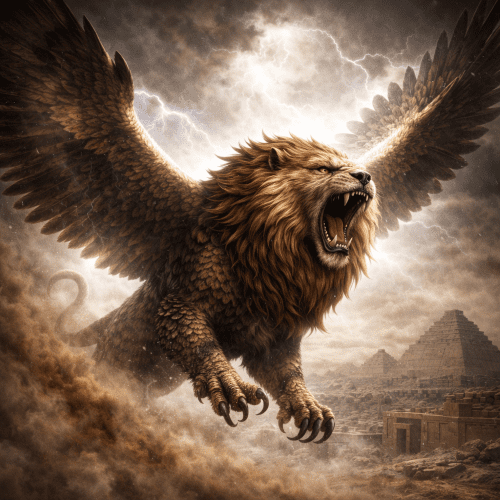
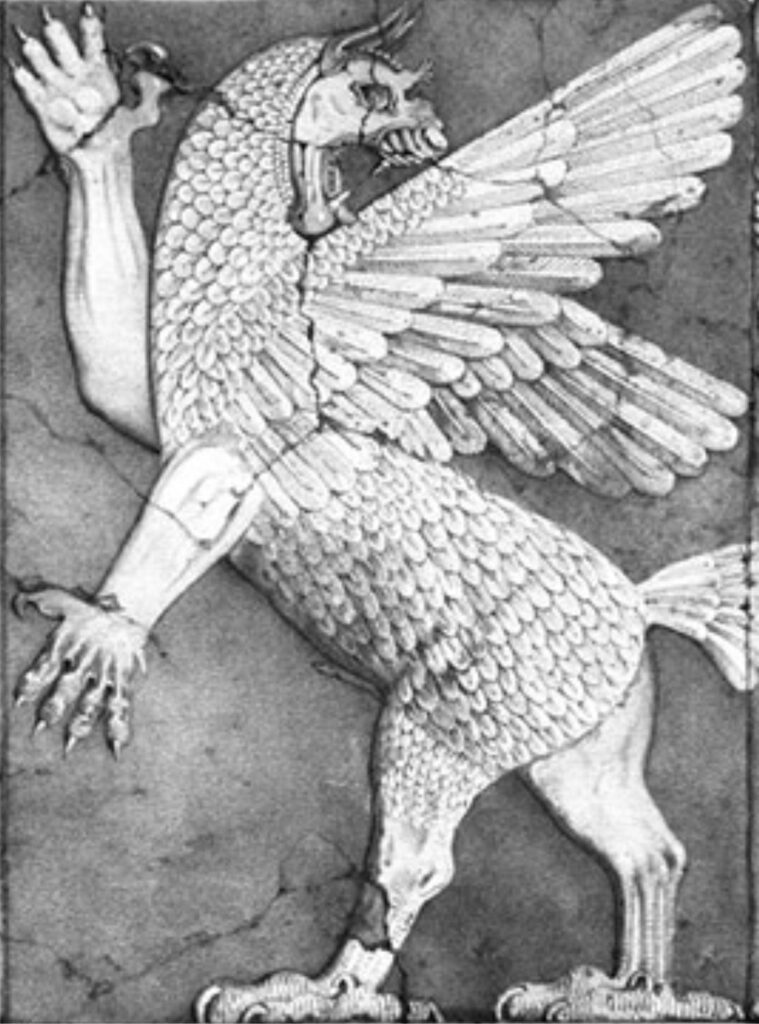
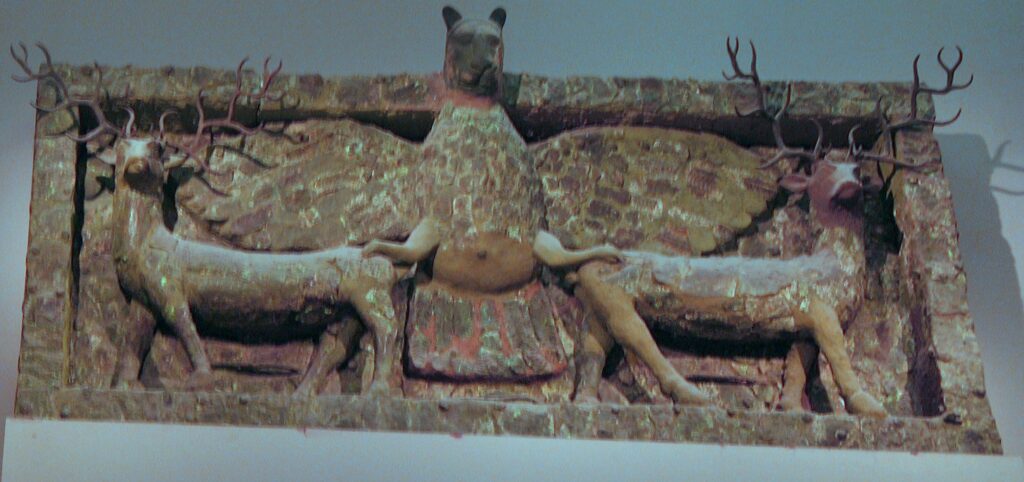
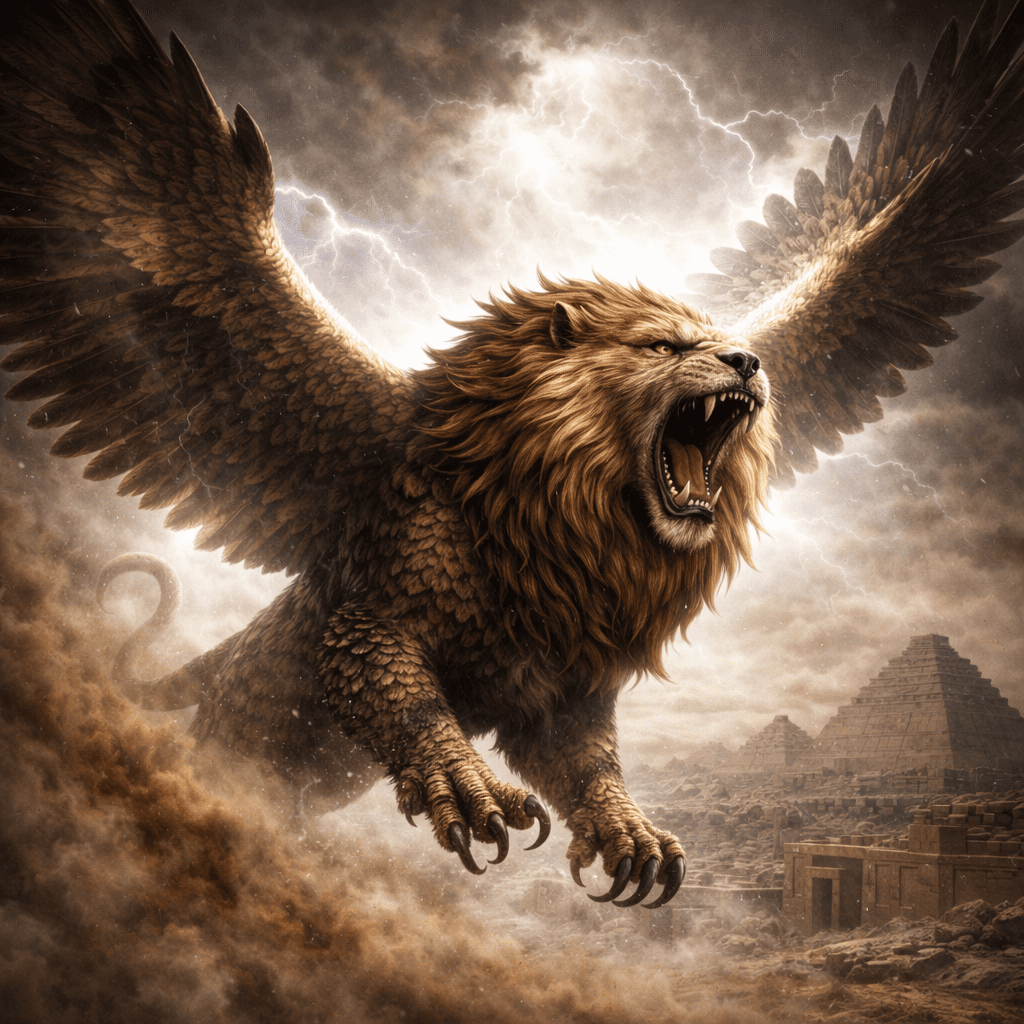
Anzu is consistently depicted as a hybrid creature that merges the most dominant traits of land and sky predators. He is typically described as having the body and wings of a massive eagle combined with the head of a lion. This fusion is not arbitrary; it symbolizes the convergence of celestial and terrestrial power, making him a being that transcends natural categories.
Ancient art and cylinder seals portray him with outstretched wings, often in a dynamic pose that conveys movement and aggression. His sheer size is emphasized in mythological descriptions, with some accounts suggesting that his wingspan could obscure sunlight when fully extended. This visual detail reinforces his association with storms and darkness.
In literary traditions, Anzu is also attributed with elemental abilities. Some texts describe him as capable of breathing fire and water, linking him to destructive natural forces such as lightning and torrential storms. His roar is said to shake the earth, further establishing him as a creature whose presence alone disrupts the natural world.
Family
The genealogy of Anzu is not fixed, reflecting the fluid nature of Mesopotamian mythological traditions. In some accounts, he is described as the offspring of Abzu, the primordial freshwater deity, and Mami, a mother goddess associated with creation. This lineage connects Anzu to both cosmic origins and the generative forces of the earth.
Other traditions offer an alternative parentage, naming the goddess Siris as his mother. These variations highlight how myths evolved across regions and time periods, often adapting existing figures into new theological frameworks.
Despite this ambiguity, one consistent narrative element is Anzu’s role as a parent. In the Sumerian tale of Lugalbanda, the hero encounters Anzu’s chick and cares for it, offering food and protection. This episode humanizes Anzu to a degree, presenting him not just as a force of chaos but also as part of a familial structure within the mythological world.
Other names
Anzu is known by several names that reflect the linguistic and cultural transitions between Sumerian and Akkadian civilizations. His earliest name, Imdugud, appears in Sumerian texts and is often translated as “storm bird” or “thunder cloud.” This name directly ties him to atmospheric phenomena and reinforces his identity as a creature of the skies.
In Akkadian sources, he is commonly referred to as Anzu or Zu. The variation dZû appears in cuneiform inscriptions, representing another phonetic adaptation of the same entity. Over time, scholars clarified that the initial sign in his name should be read as a phonetic element rather than a divine determinative, leading to the standardized reading of Anzu. These multiple names are not separate identities but rather different cultural expressions of the same mythological figure, illustrating the interconnected nature of Mesopotamian belief systems.
Powers and Abilities
Anzu’s abilities are deeply tied to his identity as a storm being and a challenger of divine order. His control over wind and weather is central to his characterization. When he moves, storms follow. His wings generate powerful gusts, sandstorms, and thunderclouds, making him a living embodiment of atmospheric chaos.
His most significant act, however, is the theft of the Tablet of Destinies. This artifact was believed to contain the decrees that governed the cosmos, effectively granting its holder authority over both gods and humans. By stealing it from Enlil, Anzu did not merely rebel; he attempted to rewrite the structure of existence itself.
With the tablet in his possession, Anzu gained the ability to nullify divine powers. In some versions of the myth, even the weapons of the gods became ineffective against him. This temporary invincibility forced the pantheon into a state of crisis until Ninurta accepted the challenge. The battle that followed was not just physical but symbolic, representing the restoration of order over chaos. Anzu’s defeat ultimately reaffirms the stability of the divine hierarchy, but his actions leave a lasting impression as one of the boldest acts of defiance in ancient myth.
Modern Day Influence
Although Anzu does not enjoy the same widespread recognition as figures like Gilgamesh, his legacy continues to influence modern culture in subtle but meaningful ways. In academic circles, his myth remains an important source for understanding Mesopotamian views on authority, rebellion, and cosmic balance.
His striking hybrid form has inspired artistic interpretations across various media, particularly in fantasy art and literature. The concept of a lion-headed eagle or storm bird can be seen echoed in modern depictions of mythical creatures, including griffin-like beings.
Anzu has also appeared in popular culture, including video games such as World of Warcraft, where his image is used as a powerful and ominous symbol. Beyond entertainment, his name has even been adopted in scientific nomenclature, most notably in the dinosaur species Anzu wyliei, whose bird-like features reminded researchers of the ancient myth.
Interestingly, early 20th-century advertising also used Anzu as a metaphor for deception and danger, demonstrating how his symbolic association with chaos has been adapted for entirely different contexts. These varied appearances show that Anzu’s identity continues to evolve, maintaining relevance in both scholarly and popular imagination.
Related Images



Source
Annus, A. (2001). The standard Babylonian epic of Anzu: Introduction, cuneiform text, transliteration, score, glossary, indices and sign list. Neo-Assyrian Text Corpus Project.
Dalley, S. (1989). Myths from Mesopotamia: Creation, the flood, Gilgamesh, and others. Oxford University Press.
Fuhr-Jaeppelt, I. (1976). [Study on Anzu iconography, referenced in Nimrud project]. University of Pennsylvania.
Hruška, B. (1975). [Critical edition of the Epic of Anzu]. Referenced in Nimrud: Materialities of Assyrian Knowledge Production.
Wikipedia contributors. (2026). Anzû. In Wikipedia, The Free Encyclopedia. Retrieved March 31, 2026, from https://en.wikipedia.org/wiki/Anzu_(mythology)
Horry, R. A., & Robson, E. (2019). Anzu the monstrous lion-eagle. Nimrud: Materialities of Assyrian Knowledge Production. Retrieved from https://oracc.museum.upenn.edu/nimrud/livesofobjects/anzu/index.html
Black, J., & Green, A. (1992). Gods, demons and symbols of ancient Mesopotamia: An illustrated dictionary. British Museum Press.
Frequently Asked Questions
Who is Anzu in Mesopotamian tradition?
Anzu is a mythological storm bird from Sumerian and Akkadian tradition, known for stealing the Tablet of Destinies and challenging the authority of the gods.
What is the Tablet of Destinies?
The Tablet of Destinies is a sacred object that grants control over cosmic laws and divine authority to whoever possesses it.
Who defeated Anzu?
Anzu was defeated by the warrior god Ninurta, who restored the Tablet of Destinies and reestablished cosmic order.
Is Anzu a god or a monster?
Anzu is generally classified as a powerful mythological creature or hybrid being rather than a traditional god.
What does Anzu symbolize?
Anzu symbolizes chaos, rebellion, and the disruption of divine order, often representing uncontrolled natural forces like storms.