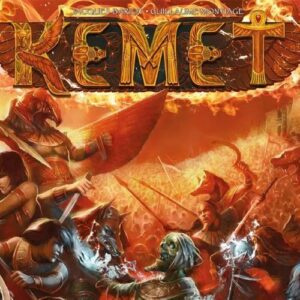
Kemet : The Ancient Egyptian Board Game of Divine Warfare
| Description | |
|---|---|
| Inspiration | Egyptian Mythology |
| Developer | Matagot |
| Type | Board Game |
| Release Year | 2012 |
| Storyline | Warring tribes harness divine powers and mythological creatures to dominate Egypt |
Mythlok Perspective
In Mythlok’s Perspective, Kemet succeeds because it captures the spirit of ancient Egypt rather than attempting to recreate its history. The game transforms temples, pyramids, gods, and sacred creatures into tools of strategic storytelling, allowing players to experience a world where divine power directly shapes human destiny. A useful comparison can be made with the Greek-inspired board game Cyclades, where divine favor also influences warfare and expansion. Both games turn mythology into an active force on the battlefield, but Kemet places greater emphasis on relentless aggression and supernatural empowerment.
Kemet
Introduction
Kemet is one of the most celebrated strategy board games inspired by ancient Egypt. Released by Matagot and designed by Jacques Bariot and Guillaume Montiage, the game immerses players in a mythic vision of the ancient world where powerful gods influence mortal conflicts and legendary creatures roam the desert. The title itself comes from the ancient Egyptian word “Kmt” or “Kemet,” meaning “the Black Land,” a reference to the fertile soil deposited by the Nile River that sustained Egyptian civilization for thousands of years.
Unlike many strategy games that reward patience and defensive play, Kemet encourages constant action. Players are pushed into conflict from the opening turns, creating a fast-paced experience where every decision can dramatically alter the balance of power. While the game borrows heavily from Egyptian imagery, religion, and symbolism, it presents a fantasy interpretation rather than a historically accurate recreation. The result is an exciting blend of mythology, warfare, and tactical strategy that has earned Kemet a lasting place among modern tabletop classics.
Game Overview
Kemet is designed for two to five players and typically lasts between ninety and one hundred twenty minutes. Each player controls a powerful Egyptian faction competing for dominance across a landscape filled with temples, pyramids, and sacred locations. The objective is straightforward: accumulate enough victory points before your opponents do.
Victory points are primarily earned through winning battles, controlling temples, and maintaining influence over important regions of the map. This focus on military success makes combat a central part of the experience. Players cannot simply build defenses and wait. Instead, they must actively expand their influence and challenge rival factions.
One of the game’s defining features is that every faction begins with the same capabilities. As the game progresses, players purchase power tiles that transform their faction into something unique. Some players may focus on military strength, while others invest in mobility, divine powers, or economic advantages. This customization ensures that no two games unfold in exactly the same way.
The game’s structure revolves around Day and Night phases. During the Day phase, players move armies, recruit troops, build pyramids, and engage in combat. During the Night phase, they receive resources, collect prayer points, and prepare for future actions. This cycle creates a rhythm that keeps the game moving quickly while providing meaningful strategic choices.
Mythological Inspirations
The world of Kemet draws inspiration from ancient Egyptian religion and mythology. Throughout Egyptian history, gods were believed to influence every aspect of life, from agriculture and warfare to kingship and the afterlife. Kemet adapts this concept into gameplay by allowing divine powers to directly shape the battlefield.
Players can recruit powerful mythological creatures inspired by Egyptian symbolism and legendary traditions. These creatures include giant scorpions, sacred beasts, massive serpents, phoenix-like creatures, sphinxes, and other supernatural entities. Each provides unique abilities that can dramatically change the outcome of battles.
Temples play an equally important role. In ancient Egypt, temples served as sacred centers where people honored the gods and sought divine favor. In Kemet, controlling temples grants valuable advantages and victory points, reflecting their religious and political importance.
The game also incorporates themes associated with Egyptian funerary traditions. While it does not directly recreate historical beliefs about the afterlife, its use of sacred powers, divine intervention, and supernatural creatures echoes the rich mythological landscape that defined Egyptian culture. Rather than depicting a specific myth, Kemet creates a fantasy world where multiple elements of Egyptian mythology coexist in a single epic conflict.
Characters
Unlike narrative-driven games that focus on individual heroes, Kemet centers on factions empowered by divine forces. Players effectively take on the role of powerful rulers, priests, or god-like entities guiding entire civilizations.
The true identity of a faction emerges through the power tiles selected during play. These upgrades determine whether a player becomes an aggressive conqueror, a master strategist, or a devotee of supernatural powers. As a result, each faction develops its own personality and style despite sharing identical starting conditions.
The armies themselves consist of loyal warriors devoted to their leaders and gods. Supporting them are mythical creatures that serve as living manifestations of divine power. Whether commanding a giant scorpion across the desert or unleashing a sacred beast into battle, players experience the fantasy of leading an army blessed by the gods.
Later expansions such as Kemet: Rise of the Gods further emphasize divine involvement by introducing additional god-focused mechanics that make the presence of Egyptian deities even more tangible on the battlefield.
Symbolism & Gameplay Mechanics
Many of Kemet’s mechanics reflect themes associated with ancient Egyptian civilization, even when adapted for modern gameplay. Pyramids are among the most important elements in the game. Players develop different colored pyramids, each representing a path of advancement. Red pyramids focus on military power and aggression. Blue pyramids unlock divine abilities and supernatural advantages. White pyramids improve economic and logistical capabilities. This system symbolically connects monumental architecture with political and spiritual power.
Power tiles serve as permanent upgrades that define a faction’s evolution. These upgrades represent growing influence, divine blessings, and technological advancement. They ensure that every strategic path feels distinct and meaningful.
Prayer points function as the game’s primary resource and can be viewed as a representation of devotion and divine favor. Players use them to purchase powers, recruit units, and perform important actions. This reinforces the theme that success depends not only on military strength but also on maintaining a connection with the gods.
The combat system avoids excessive randomness by relying on tactical card play rather than dice. Players must carefully choose when to attack, defend, and sacrifice resources. This emphasis on planning rewards strategic thinking and makes victories feel earned.
The board itself is designed to keep players close together. Teleportation mechanics allow armies to move rapidly between important locations, ensuring constant interaction. Temples regularly change hands, creating a dynamic battlefield where no position remains secure for long.
Cultural Impact
Since its release, Kemet has become one of the most influential area-control games in modern tabletop gaming. Critics and players frequently praise its combination of strategic depth, fast pacing, and thematic immersion.
The game helped demonstrate that aggressive conflict could coexist with Euro-style resource management and decision-making. This blend appealed to both strategy enthusiasts and players who enjoy direct competition.
Kemet has also contributed to the modern popular image of ancient Egypt as a realm of gods, monsters, and epic warfare. While historians may distinguish between mythology and historical reality, the game successfully captures the sense of wonder that Egyptian culture continues to inspire.
For many players, Kemet serves as an introduction to Egyptian mythology. Its use of temples, pyramids, divine powers, and legendary creatures often encourages curiosity about the real beliefs and traditions that inspired its world.
Creative Liberties
Although Kemet borrows extensively from Egyptian culture, it is ultimately a fantasy board game rather than a historical simulation. The designers intentionally prioritized exciting gameplay over strict accuracy.
The game combines creatures, symbols, and concepts from different periods of Egyptian history into a single setting. Mythological beings appear alongside military units without concern for historical chronology. Teleportation, magical powers, and supernatural warfare are inventions designed to create a more engaging experience.
Many aspects of Egyptian religion are simplified or omitted entirely. Complex ideas such as the weighing of the heart, the journey through the underworld, and detailed divine genealogies receive little attention. Instead, the focus remains firmly on conflict, conquest, and strategic decision-making.
These creative liberties allow Kemet to transform Egyptian mythology into an accessible and highly interactive experience. Rather than teaching history directly, the game captures the imagination by presenting a dramatic vision of a world where gods and mortals fight side by side for control of the Black Land.
Sources
Boardgame.tips. (2018, August 23). Kemet [Board game overview]. Retrieved June 10, 2026, from
https://boardgame.tips/kemet
Islaythedragon.com. (n.d.). Review: Kemet. Retrieved June 10, 2026, from
https://islaythedragon.com/featured/i-like-king-tut-and-i-cannot-lie-a-review-of-kemet/
Jade Temple. (n.d.). KEMET | The eponymous ancestor. Retrieved June 10, 2026, from
https://www.jadetemple.org/the-meaning-of-kemet
Metropolitan Museum of Art. (2018, September 30). Board games from ancient Egypt and the Near East. Retrieved June 10, 2026, from
https://www.metmuseum.org/essays/board-games-from-ancient-egypt-and-the-near-east
Space-Biff. (2013, March 14). Kemet the Frog Jackal. Retrieved June 10, 2026, from
https://spacebiff.com/2013/03/15/kemet/
ThePlayerSaid.com. (2017, July 20). Best 3 games with… Egyptian theme! Retrieved June 10, 2026, from
https://theplayersaid.com/2017/07/21/best-3-games-with-egyptian-theme/
Tompkin, D. (n.d.). Kemet: Rules update v1.5 [PDF]. University of Waterloo. Retrieved June 10, 2026, from
https://cs.uwaterloo.ca/~dtompkin/archive/dtlib/base/Kemet%20~%20Rules%20Update%20v1-5.pdf
Frequently Asked Questions
What does Kemet mean in ancient Egypt?
Kemet means “The Black Land,” referring to the fertile soil along the Nile River that sustained ancient Egyptian civilization.
Is Kemet based on real Egyptian mythology?
Kemet is inspired by Egyptian mythology and symbolism but presents a fantasy version rather than a historically accurate recreation.
How do players win in Kemet?
Players earn victory points through battles, temple control, and strategic objectives until they reach the required total.
What makes Kemet different from other strategy board games?
Kemet encourages constant conflict, rapid movement, and aggressive play instead of defensive or slow-building strategies.
Does Kemet include Egyptian gods and mythical creatures?
Yes. The game features divine powers, temples, and mythological creatures inspired by Egyptian legends and religious imagery.