
Helheim : The Norse Realm of the Dead Beyond Valhalla
| Description | |
|---|---|
| Mythology | Norse Mythology |
| Description | Cold, shadowy underworld beneath Yggdrasil |
| Ruler/Guardian | Hel, Garmr |
| Inhabitants | Dead from illness, old age, dishonor |
| Nature | Neutral |
Mythlok Perspective
From the Mythlok perspective, Helheim is best understood not as a realm of despair but as an elemental domain of stillness. Where Valhalla embodies fire and motion, Helheim reflects ice and rest. Similar concepts appear across cultures, from the quiet fields of Kur to the shadowed edges of Annwn, suggesting a shared human recognition that most deaths are unremarkable yet meaningful. Helheim reminds us that mythology does not always glorify endings; sometimes it simply accepts them.
Helheim
Introduction
Helheim occupies a central yet often misunderstood position in Norse cosmology. Far removed from later Christian ideas of fiery punishment, Helheim represents the most common destination of the dead, shaped by the Norse understanding of fate, inevitability, and natural endings. Rooted in the earliest poetic traditions preserved in the Poetic and Prose Eddas, Helheim reflects a worldview where death is neither moral reward nor divine retribution, but a continuation of existence in altered form. The keyword Helheim itself derives from the Proto-Germanic haljō, meaning a concealed or hidden place, reinforcing its identity as a realm withdrawn from the living rather than a place of suffering.
Description
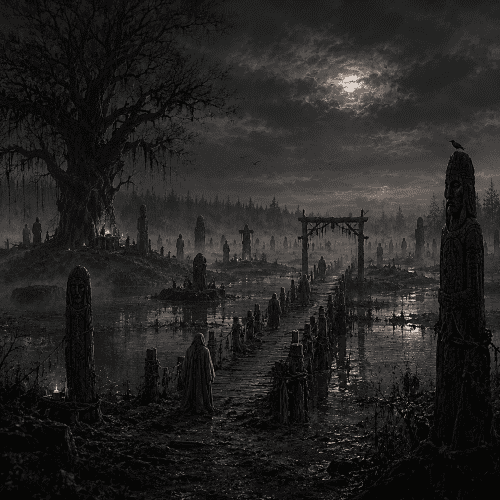
Helheim is described as a cold, dim, and mist-filled realm located deep beneath the roots of Yggdrasil, the World Tree. It is closely associated with Niflheim, the primordial world of ice and fog that predates the shaping of the cosmos. Unlike later depictions of hell as fiery or chaotic, Helheim is defined by stillness, silence, and a sense of suspended time. Snorri Sturluson describes the hall Éljúðnir as vast and forbidding, furnished with objects symbolically named Hunger, Famine, and Misfortune, imagery that evokes deprivation rather than torment. The landscape itself mirrors winterbound Scandinavia, reinforcing death as a cold withdrawal from life rather than a violent punishment.
Ruler/Guardian
Helheim is ruled by Helheim’s namesake, Hel, the daughter of Loki and the giantess Angrboða. Odin cast her into the depths of Niflheim and granted her authority over those who die of sickness or old age. Hel’s appearance is famously dual, with one half resembling a living woman and the other a decaying corpse, embodying the boundary between vitality and dissolution. She is not portrayed as cruel or merciful, but as absolute. The realm’s defenses include the hound Garmr, who guards the gates of Helgrind, and the maiden Móðgudr, who oversees passage across Gjallarbrú. These figures do not judge the dead; they enforce inevitability.
Inhabitants
The inhabitants of Helheim are the majority of humanity, those who died without heroic distinction. Farmers, children, elders, and the ill find their final dwelling here, regardless of moral character or social rank. Unlike the einherjar of Valhalla, these souls do not train for battle or feast eternally, nor are they tortured. Sources suggest a muted continuation of existence, marked by stillness and memory rather than activity. Even gods are not exempt. Baldr, beloved son of Odin, resides in Helheim after his death, underscoring that the realm is governed by fate rather than status. Helheim thus reflects a profoundly egalitarian vision of death.
Access
Reaching Helheim requires traversal of Helvegr, the road to the dead, a journey described as long, downward, and oriented toward the cold north. Souls must cross the river Gjöll via the bridge Gjallarbrú, whose golden roof contrasts starkly with the darkness surrounding it. The bridge is guarded by Móðgudr, who questions travelers but does not bar those destined to pass. Beyond lies Helgrind, the great gate watched by Garmr. For the living, entry is nearly impossible without divine assistance, as demonstrated by Hermóðr’s ride on Sleipnir. Burial customs in the Viking Age, including grave goods and mound interments, reflect the belief that death involved a journey requiring preparation.
Instances of Visit
Several myths describe rare visits to Helheim, each emphasizing its finality. Hermóðr’s journey to retrieve Baldr remains the most detailed account. Riding Odin’s eight-legged horse, he crossed Gjallarbrú and stood before Hel herself. Her condition for Baldr’s release, that all creation must weep, reveals her authority and the cosmic scale of death’s rules. Saxo Grammaticus recounts the descent of King Hadding, guided by a mysterious woman into a realm of mist and shadow, where tasting the food of the dead binds him to their world. These stories portray Helheim as accessible only at great cost, reinforcing its role as a threshold rarely crossed twice.
Symbolism
Helheim symbolizes inevitability and the quiet entropy that follows life. Its cold environment reflects the Norse association between death and winter, dormancy, and withdrawal rather than punishment. Hel’s divided form captures the liminal nature of death as both an ending and a transformation. Structures like Gjallarbrú represent transition, while Garmr’s howling at Ragnarök ties individual mortality to cosmic collapse. Helheim stands as the inverse of Valhalla, not as its moral opposite, but as its statistical reality. Most lives end not in glory, but in stillness.
Comparative Analysis
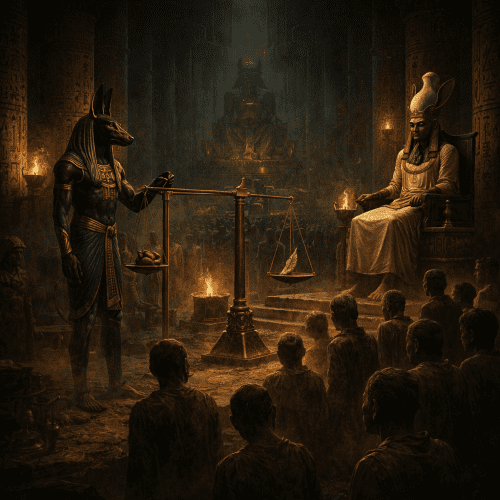
When compared to other underworld traditions, Helheim is strikingly neutral. Greek Hades includes regions of reward and punishment, while the Egyptian Duat subjects souls to trials and judgment. Christian Hell introduces eternal moral condemnation, fundamentally unlike Norse beliefs. Helheim more closely resembles the Mesopotamian Kur, ruled by Ereshkigal, another queen of the dead whose realm is somber rather than punitive. Celtic Annwn shares Helheim’s mist-shrouded otherworldliness, yet often carries a sense of abundance absent from Norse descriptions. These comparisons highlight Helheim’s unique focus on fate over ethics.
Modern Influence
Helheim continues to shape modern imagination through literature, games, and visual media. Contemporary retellings often exaggerate its darkness, yet its core symbolism remains intact. Popular culture frequently reinterprets Hel as a villainous figure, though this diverges from the original sources. Modern Ásatrú practitioners tend to view Helheim as a place of ancestral rest rather than fear, reclaiming its original neutrality. In fantasy and metal music, Helheim represents existential cold and cosmic inevitability, resonating with audiences drawn to themes of fate and impermanence.


Sources
Vikingsons of Odin. (2025, August 25). Helheim: The frozen underworld of Norse mythology. https://vikingsonsofodin.com/helheim-the-frozen-underworld-of-norse-mythology/
Ancient Mythology. (2024, December 8). Helheim: Realm of the dead in Norse mythology.
https://ancientmythology.net/norse-mythology/helheim-realm-of-the-dead-in-norse-mythology/
Norse Mythology for Smart People. (2017, July 8). Hel (the underworld). https://norse-mythology.org/cosmology/the-nine-worlds/helheim/
Vikingr.org. (2024, November 29). The road to Hel. https://vikingr.org/norse-cosmology/helheim
Lindow, J. (2002). Norse mythology: A guide to gods, heroes, rituals, and beliefs. Oxford University Press.
Simek, R. (1993). Dictionary of Northern mythology. D.S. Brewer.
Sturluson, S. (1987). The Prose Edda (A. Faulkes, Trans.). Everyman. (Original work published ca. 1220)
Schjødt, J. P. (1994). Hel as an otherworldly realm in Old Norse mythology. Scandinavian Studies, 66(3), 257–270.
Frequently Asked Questions
What is Helheim in Norse belief?
Helheim is the underworld where most people go after death, especially those who die of illness or old age.
Is Helheim the same as Hell?
No. Although linguistically related, Helheim is neutral and non-punitive, unlike the Christian concept of Hell.
Who rules Helheim?
Hel, daughter of Loki, rules Helheim with absolute authority over the dead.
Can the living enter Helheim?
Only in rare myths, and usually with divine assistance. Entry is considered dangerous and final.
Why did Baldr go to Helheim?
Baldr died without a battle death, making him subject to Helheim despite his divine status.