
Annwn : The Welsh Otherworld of Mystery and Magic
| Description | |
|---|---|
| Mythology | Welsh Mythology |
| Description | Abundant Otherworld, Eternal youth |
| Ruler/Guardian | Arawn / Gwyn ap Nudd |
| Inhabitants | Spirits, Cŵn Annwn, Fair folk |
| Nature | Neutral/Reward |
Mythlok Perspective
In Mythlok’s View, Annwn is not simply an afterlife but a philosophical idea about existence beyond perception. It reflects a worldview where death is transformation rather than judgment, aligning closely with nature’s cycles. Unlike the structured afterlife of Greek Hades or the stark inevitability of Norse Hel, Annwn remains fluid and experiential. It shares similarities with the Irish Tír na nÓg in its promise of timelessness, yet stands apart in its unpredictability. This balance between beauty and danger makes Annwn one of the most nuanced Otherworld concepts across cultures.
Annwn
Introduction
Annwn, also spelled Annwfn or Annwyn, is the Welsh Otherworld, a realm that resists simple definition. In early Celtic tradition, it is not a place of punishment like later ideas of Hell, but a domain of wonder, abundance, and altered existence. The name itself is often interpreted as “deep” or “within-world,” suggesting a hidden layer of reality rather than a distant afterlife. This idea reflects a broader Celtic worldview in which death is not an end, but a transition into another state of being.
Annwn appears most clearly in medieval Welsh texts such as the Four Branches of the Mabinogi and the poem Preiddeu Annwfn. These sources present it as both alluring and dangerous, a place of feasts and beauty, but also of trials and strange laws. Over time, as Christian influence grew in Wales, Annwn’s image shifted. Some traditions began to associate it with darker, more infernal qualities, yet its earlier identity as a vibrant Otherworld never fully disappeared. Instead, Annwn remains a layered concept, balancing paradise, mystery, and peril.
Description
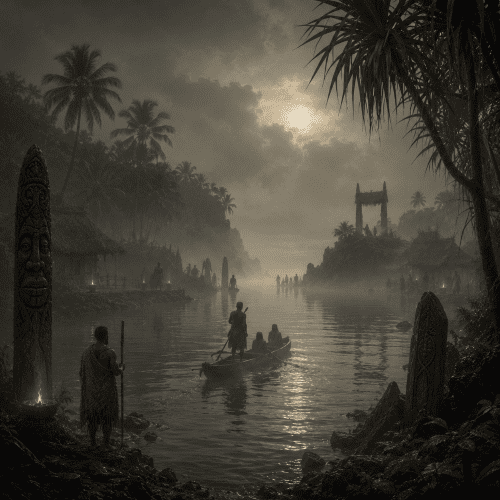
Annwn does not have a single fixed form. In some traditions, it lies beneath the earth, hidden in caves or beneath lakes. In others, it exists across the sea as a distant island. This fluid geography reflects the Celtic idea that the Otherworld is not separate from reality, but intertwined with it, accessible through certain thresholds or moments.
Early descriptions emphasize abundance and perfection. Annwn is portrayed as a land without illness, aging, or scarcity. Food is endless, time flows differently, and joy is constant. Welsh poetry often describes shining halls, magical cauldrons, and landscapes untouched by decay. The realm mirrors the human world, but in an idealized form.
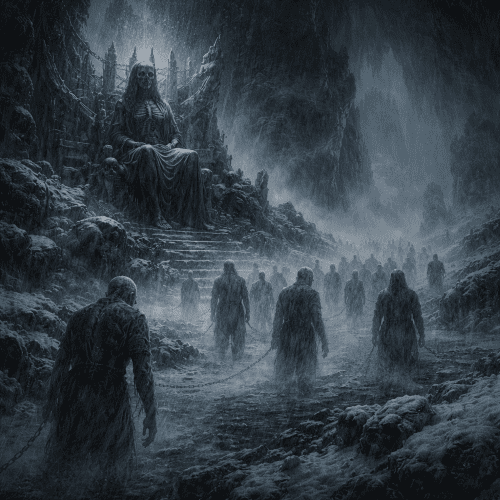
Later sources, especially those influenced by Christian thought, introduce more unsettling imagery. Annwn becomes a place guarded by strange beasts and filled with challenges that test those who enter. The shift does not completely erase its earlier nature, but adds complexity. Annwn becomes both a place of reward and a realm of danger, depending on how it is approached.
Ruler/Guardian
The most prominent ruler of Annwn is Arawn, a figure who appears in the First Branch of the Mabinogi. He is depicted as a just and honorable king, closely associated with hunting and the natural world. Arawn is not a tyrant or judge of souls, but a sovereign who maintains balance within his realm. His encounter with Pwyll, Prince of Dyfed, highlights his fairness and sense of honor, as well as the possibility of cooperation between the mortal and Otherworldly worlds.
In later Welsh and Arthurian traditions, Gwyn ap Nudd emerges as another key figure linked to Annwn. He is associated with the dead and is often described as the leader of the Wild Hunt, a spectral procession that moves between worlds. Gwyn’s role introduces a more ominous aspect to Annwn, as he is tasked with containing chaotic forces and guiding restless spirits.
Together, Arawn and Gwyn ap Nudd represent two sides of Annwn’s nature. One embodies order, hospitality, and honor, while the other reflects its connection to death, mystery, and the supernatural.
Inhabitants
Annwn is populated by a wide range of supernatural beings. Its inhabitants include gods, spirits, and the fair folk, all of whom exist beyond the limitations of the human world. These beings are often described as more beautiful, powerful, and enduring than mortals, reinforcing the idea that Annwn is a perfected version of reality.
Among the most iconic inhabitants are the Cŵn Annwn, the hounds of the Otherworld. These spectral dogs are described as white with red ears, a color combination that signals their connection to the supernatural. Their presence is often linked to the Wild Hunt and to the movement of souls between worlds.
Some texts also describe more fearsome creatures within Annwn, particularly in poetic works like Preiddeu Annwfn. These include monstrous guardians and enigmatic beings that protect the realm’s treasures. Their presence suggests that Annwn is not easily entered or understood, and that it contains layers of meaning beyond its surface beauty.
Access
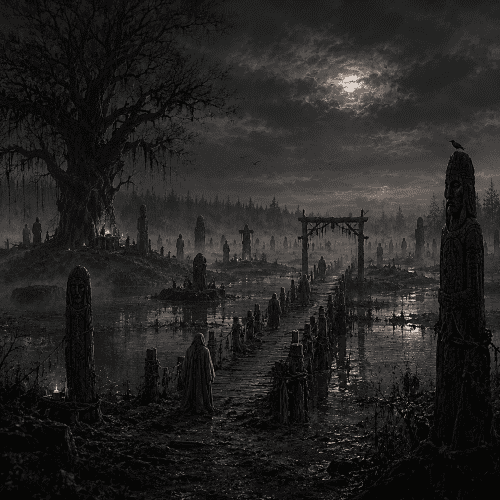
Access to Annwn is never straightforward. There are no fixed gates or permanent entrances. Instead, it is reached through liminal spaces, places where the boundaries between worlds become thin. These can include caves, lakes, mounds, forests, or even moments of altered consciousness.
Stories often emphasize accidental or guided entry. In the tale of Pwyll, a simple hunting mistake leads him into Annwn, where he encounters Arawn. In other traditions, heroes must undertake quests or follow supernatural guides to reach the Otherworld.
Time behaves differently within Annwn, and this is one of its defining features. A short stay in the realm can correspond to years in the human world. This distortion reinforces the idea that Annwn exists outside ordinary reality, governed by its own rules.
Instances of Visit
One of the most well-known visits to Annwn occurs in the story of Pwyll, Prince of Dyfed. After accidentally offending Arawn, Pwyll agrees to exchange places with him for a year and a day. During this time, Pwyll rules Annwn and defeats Arawn’s rival, Hafgan. The story emphasizes themes of honor, trust, and the possibility of harmony between worlds.
Another significant account appears in Preiddeu Annwfn, where King Arthur leads an expedition into Annwn to retrieve a magical cauldron. The journey is perilous, and only a few of his companions return. The tale presents Annwn as a place of hidden knowledge and powerful artifacts, but also as a realm that resists intrusion.
Other traditions, including later folklore, describe encounters with Gwyn ap Nudd and the Wild Hunt. These stories often blur the line between vision and reality, suggesting that Annwn can be experienced in fleeting, unsettling glimpses.
Symbolism
Annwn carries rich symbolic meaning within Welsh tradition. At its core, it represents abundance and renewal. The presence of magical cauldrons, often associated with rebirth or inspiration, connects it to cycles of life, death, and transformation.
It also embodies liminality, the idea of existing between states. Annwn is neither fully separate from the human world nor entirely part of it. This in-between quality makes it a space of testing and revelation, where ordinary rules no longer apply.
Over time, Annwn also came to symbolize the unknown. As its image absorbed darker elements, it began to reflect human anxieties about death and the afterlife. Yet even in these interpretations, it never becomes purely a place of punishment. Instead, it remains a realm of possibility, where outcomes depend on knowledge, behavior, and intent.
Comparative Analysis
Annwn shares similarities with many Otherworld traditions, yet remains distinct in its balance of beauty and danger. Unlike the Greek realm of Hades, which is structured around judgment and moral order, Annwn does not divide souls into reward or punishment. Instead, it reflects a continuation of existence in a more vibrant and mysterious form.
It is often compared to Avalon, the misty island of Arthurian legend, but while Avalon is largely peaceful and restorative, Annwn carries an edge of unpredictability. Irish realms like Tír na nÓg and Mag Mell come closer in their promise of eternal youth and abundance, though they are typically more welcoming, whereas Annwn frequently tests those who enter.
In contrast to the bleak inevitability of the Norse Hel, Annwn feels alive, dynamic, and transformative. Ultimately, its defining quality is duality. It is neither purely paradise nor peril, but a shifting realm where wonder and risk coexist, reflecting a worldview that embraces the unknown rather than categorizing it.
Modern Influence
Annwn continues to shape modern imagination, particularly in fantasy literature and spiritual practice. It appears in reimagined forms in works like Lloyd Alexander’s Prydain Chronicles, where it becomes Annuvin, and in Susan Cooper’s The Dark Is Rising sequence, where elements of the Wild Hunt persist.
In contemporary spirituality, especially within Neo-pagan and Druidic traditions, Annwn is often viewed as a sacred Otherworld connected to ancestors and inner journeys. It is sometimes interpreted as a symbolic landscape accessed through meditation or ritual.
Welsh folklore also preserves echoes of Annwn in seasonal traditions such as Calan Gaeaf, where the boundary between worlds is believed to thin. In modern media, the imagery of spectral hounds, hidden realms, and enchanted feasts continues to draw from Annwn’s enduring mythic presence.
Sources
Davies, S. (2007). The Mabinogion. Oxford University Press.
Green, M. J. (1995). The Celtic World. Routledge.
Puhvel, J. (1987). Comparative mythology. Johns Hopkins University Press.
Sims-Williams, P. (1990). The early Welsh Arthurian tradition. Cambridge Medieval Celtic Studies, 9, 1-28.
Wikipedia. (n.d.). Annwn. Retrieved March 19, 2026, from https://en.wikipedia.org/wiki/Annwn
Encyclopedia.com. (n.d.). Annwn. Retrieved March 19, 2026, from https://www.encyclopedia.com/environment/encyclopedias-almanacs-transcripts-and-maps/annwn
Celtic Earth Spirit. (2023, April 6). Annwn the Otherworld. https://celticearthspirit.co.uk/folklore-mythology-culture/annwn-theotherworld/
Woodbury, S. (2024, April 19). What was Annwn? https://www.sarahwoodbury.com/what-was-annwn/
Frequently Asked Questions
What is Annwn in Welsh tradition?
Annwn is the Welsh Otherworld, a mystical realm associated with abundance, transformation, and supernatural beings rather than punishment or judgment.
Is Annwn the same as Hell?
No, Annwn was not originally a place of punishment. It was later influenced by Christian ideas, but early traditions describe it as a realm of beauty and mystery.
Who rules Annwn?
Arawn is the primary ruler in early tales, while Gwyn ap Nudd is later associated with the realm, particularly in connection with the Wild Hunt.
How can someone enter Annwn in myths?
Entry usually occurs through liminal spaces like caves, lakes, or magical encounters, often unintentionally or through quests.
What makes Annwn different from other Otherworlds?
Annwn uniquely blends paradise and danger, offering both rewards and challenges, unlike more fixed or moralized afterlife realms.