


Cyclades : A Battle of Gods, Strategy, and Ancient Power
| Description | |
|---|---|
| Inspiration | Greek Mythology |
| Developer | Bruno Cathala & Ludovic Maublanc |
| Type | Board Game |
| Release Year | 2009 |
| Storyline | Competing city-states in Cyclades islands, bidding for gods’ favor to build cities |
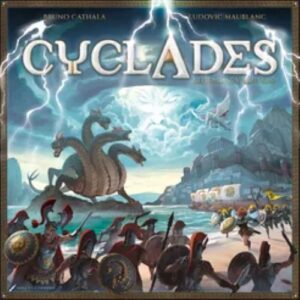
Mythlok Perspective
In Mythlok’s Perspective, Cyclades reflects the timeless human desire to negotiate with forces beyond control. The game transforms divine power into a resource, turning faith into strategy and fate into a calculated risk. This echoes similar ideas seen in Norse traditions, where warriors sought Odin’s favor, and in Mesopotamian cultures, where offerings shaped destiny. Across civilizations, the same pattern emerges: humans do not simply worship power, they attempt to wield it.
Cyclades
Introduction
Cyclades is a strategy board game that transports players into the myth-rich world of ancient Greece, where ambition, divine favor, and calculated risk shape the path to victory. First released in 2009 and designed by Bruno Cathala and Ludovic Maublanc, the game quickly established itself as a modern classic by blending auction mechanics with territorial control. Set across the iconic island chain of the Cyclades in the Aegean Sea, it challenges players to rise as dominant rulers under the watchful eyes of the Olympian gods.
What makes Cyclades stand apart is not just its mechanics, but its atmosphere. Every decision feels like a negotiation with fate. Every move echoes the ancient tension between mortals and deities. The result is a deeply thematic experience where strategy is constantly shaped by divine intervention.
Game Overview
Cyclades is designed for two to five players, with expansions allowing additional participants. Each game typically lasts between sixty and ninety minutes, offering a tightly paced experience that balances planning with unpredictability. Players begin as leaders of rival Greek city-states, each seeking to establish supremacy by constructing powerful metropolises.
The game unfolds in structured rounds. Players collect income from the islands they control, then compete in an auction to gain the favor of specific gods. This auction system is the core of Cyclades, forcing players to make difficult economic decisions. Spending too much gold may secure powerful actions for a turn, but it can also leave a player vulnerable in future rounds.
Each god grants a different strategic advantage. Military expansion, naval dominance, economic growth, and intellectual progress are all tied to divine patronage. Players must adapt constantly, choosing not only what actions to take, but when to take them.
Victory is achieved by building two metropolises. These can be constructed through a combination of infrastructure, intellectual advancement, or conquest. This flexible path to victory ensures that no two games of Cyclades feel the same, and every strategy remains viable until the final moments.
Mythological Inspirations
The foundation of Cyclades lies in the rich traditions of ancient Greek storytelling. The very name refers to the real island group surrounding Delos, a sacred center in Greek culture. Mythologically, the islands were believed to have been formed or influenced by divine forces, particularly associated with Poseidon.
The game draws heavily from the Olympian pantheon. Zeus represents authority and divine will, Poseidon governs the seas, Ares embodies warfare, Athena symbolizes wisdom and strategy, and Apollo reflects prosperity and balance. Each deity’s in-game abilities are inspired by their traditional roles, though simplified for gameplay clarity.
Mythological creatures further enhance this connection. Figures such as the Minotaur, Medusa, and Kraken appear as powerful tools that players can summon. These beings are not just decorative references; they actively shape the flow of the game, introducing sudden shifts that mirror the unpredictable nature of myth itself. Rather than retelling a single story, Cyclades captures the broader spirit of Greek myth. It recreates a world where gods intervene, monsters roam, and human ambition constantly tests divine limits.
Characters
Cyclades does not center on individual heroes in the traditional narrative sense. Instead, players represent entire city-states competing for dominance. This abstraction allows the focus to remain on strategy rather than storytelling, while still maintaining a strong thematic identity.
The true “characters” of the game are the gods. Each deity functions as a strategic pathway, shaping how a player approaches the board. Choosing a god is not simply selecting an action; it is committing to a temporary identity within the game’s evolving landscape.
Mythological creatures act as powerful extensions of this identity. They introduce surprise elements that can disrupt opponents or reinforce a player’s position. In later editions and expansions, heroes are introduced as additional figures with unique abilities, adding another layer of tactical depth. Together, these elements create a dynamic cast that reflects the complexity of Greek myth without being tied to a single storyline.
Symbolism & Gameplay Mechanics
Cyclades uses its mechanics to echo the deeper themes of ancient Greek culture. The auction system represents the transactional relationship between mortals and gods. Players offer wealth in exchange for divine favor, but there is no guarantee of success. This mirrors the uncertainty of ancient religious practices, where offerings did not always yield predictable outcomes.
Territorial control reflects the historical rivalry between Greek city-states. Expansion is necessary, but overextension can lead to vulnerability. The balance between aggression and restraint becomes a central tension throughout the game.
The construction of metropolises symbolizes the ideal of a complete civilization. Military strength, economic infrastructure, religious devotion, and intellectual growth all contribute to this goal. Players who focus too heavily on one aspect may find themselves outpaced by more balanced strategies.
Even combat carries symbolic weight. Battles are resolved through a mix of strength and chance, reflecting the belief that victory in war was influenced as much by fate and divine will as by human skill. These layered mechanics ensure that Cyclades is not just a strategy game, but a reflection of the philosophical and cultural ideas embedded in ancient Greece.
Cultural Impact
Since its release, Cyclades has become a significant title in modern board gaming. It helped popularize the fusion of Euro-style mechanics with highly thematic experiences, influencing later games that blend strategy with mythological settings.
The game’s success led to multiple expansions, including Hades and Titans, each adding new layers of complexity and replayability. More recently, a Legendary Edition brought together refined mechanics, updated components, and integrated content, introducing the game to a new generation of players.
Cyclades also contributed to the broader resurgence of Greek themes in gaming culture. Its visual design, created by Miguel Coimbra, played a key role in this appeal, presenting mythology in a vibrant yet accessible style.
Beyond mechanics, the game fostered a dedicated community. Discussions, strategy guides, and competitive play have kept Cyclades relevant years after its initial release. It stands as a benchmark for how mythology can be successfully translated into interactive experiences.
Creative Liberties
While Cyclades is deeply inspired by Greek traditions, it does not aim for strict historical or mythological accuracy. Instead, it reshapes these elements to serve gameplay.
The gods are streamlined into functional roles, each representing a specific strategic domain rather than their full mythological complexity. Creatures appear outside their traditional narratives, acting as tactical tools rather than story-bound beings.
The concept of building metropolises through philosophers or structures is also an abstraction. It captures the idea of progress without adhering to historical processes. Similarly, the constant interaction between gods and mortals reflects a dramatized version of ancient belief systems.
These liberties are intentional. They allow Cyclades to maintain a strong thematic identity while ensuring that gameplay remains engaging and balanced. Rather than recreating history, the game captures the essence of myth and transforms it into a living, strategic experience.


Sources
Cathala, B., & Maublanc, L. (2009). Cyclades ( rulebook). Studio H/Asmodee. https://cdn.1j1ju.com/medias/a5/48/50-cyclades-rulebook.pdf
Mr- Boardgames. (2025, March 14). Cyclades: Legendary Edition: Strategy, auctions and mythology.
https://mr-boardgames.com/en/cyclades-legendary-edition-strategy-auctions-and-mythology-what-do-the-people-want/
Brodaty Boardgames. (2025, March 26). Cyclades Legendary Edition. https://brodatyboardgames.com/cyclades-legendary-edition/
Hellenic Moon. (2026, January 11). Cyclades: Legendary Edition named greatest board game.
https://hellenicmoon.com/cyclades-legendary-edition-named-greatest-board-game-of-all-time-again/
Player Elimination. (2025, June 2). A Cyclades: Legendary Edition review. https://playerelimination.com/2025/06/02/a-cyclades-legendary-edition-review/
There Will Be Games. (2021, September 14). Interview with Bruno Cathala. https://therewillbe.games/articles-interviews/4001-interview-with-bruno-cathala
GMS Magazine. (2010, November 16). Cyclades – Your own Iliad!. https://www.gmsmagazine.com/cycladesyour-own-iliad/
BoardGameGeek. (n.d.). Cyclades. https://boardgamegeek.com/boardgame/9609/cyclades
Frequently Asked Questions
What is Cyclades board game about?
Cyclades is a strategy board game set in ancient Greece where players compete to build metropolises by gaining the favor of gods, controlling territories, and using mythological creatures.
How do you win Cyclades?
Players win Cyclades by constructing two metropolises, which can be achieved through buildings, philosophers, or conquering opponents.
Is Cyclades based on real Greek mythology?
Yes, Cyclades is inspired by Greek mythology, featuring gods like Zeus, Athena, and Poseidon, along with creatures such as the Minotaur and Kraken, though adapted for gameplay.
How long does a Cyclades game take?
A typical game of Cyclades lasts between 60 and 90 minutes, depending on the number of players and chosen expansions.
What makes Cyclades unique among board games?
Cyclades stands out for its auction system, where players bid for divine favor, creating a dynamic blend of strategy, resource management, and mythological interaction.


