


Tamamo-no-Mae : The Nine-Tailed Fox Who Bewitched the Japanese Court
At a glance
| Description | |
|---|---|
| Origin | Japanese Mythology |
| Classification | Spirits |
| Family Members | N/A |
| Region | Japan |
| Associated With | Shapeshifting, Deception, Bewitchment, Supernatural intelligence, Fox |
The Mythlok Perspective
In Mythlok’s Perspective, Tamamo-no-Mae represents the fear of intelligence and beauty operating beyond human control. Her story shares an interesting parallel with Daji from Chinese mythology, another legendary woman whose supernatural influence contributed to the downfall of a powerful ruler. While both figures use beauty and deception to influence imperial authority, Tamamo-no-Mae’s transformation into the Killing Stone gives her legend a distinctly Japanese dimension. Together, their stories reveal how different cultures used supernatural female figures to explore political corruption, temptation and the vulnerability of kings.
Tamamo-no-Mae
Introduction
Tamamo-no-Mae (玉藻前) is one of the most fascinating figures in Japanese mythology, remembered as a beautiful court lady whose true identity concealed a dangerous supernatural being. Associated with the kitsune tradition, she is widely recognised as a powerful fox spirit who used human disguise, extraordinary intelligence and supernatural influence to approach Japan’s imperial court. Her legend combines themes of deception, political ambition, supernatural transformation and the uneasy relationship between human authority and the spirit world.
The earliest literary traditions surrounding Tamamo-no-Mae emerged during Japan’s medieval period. Her story appears in works such as Shinmeikyō and the illustrated narrative Tamamo no Sōshi, which helped establish the familiar account of her appearance at the court of Retired Emperor Toba (1103–1156). Some versions place the events during the reign of Emperor Konoe, but Toba remains the central imperial figure in the legend.
According to the story, Tamamo-no-Mae possessed extraordinary beauty and knowledge, quickly becoming a favourite at court. However, the emperor eventually developed a mysterious illness that neither physicians nor Buddhist prayers could cure. The court diviner Abe no Yasunari discovered that the woman was actually an ancient fox spirit responsible for the emperor’s suffering.
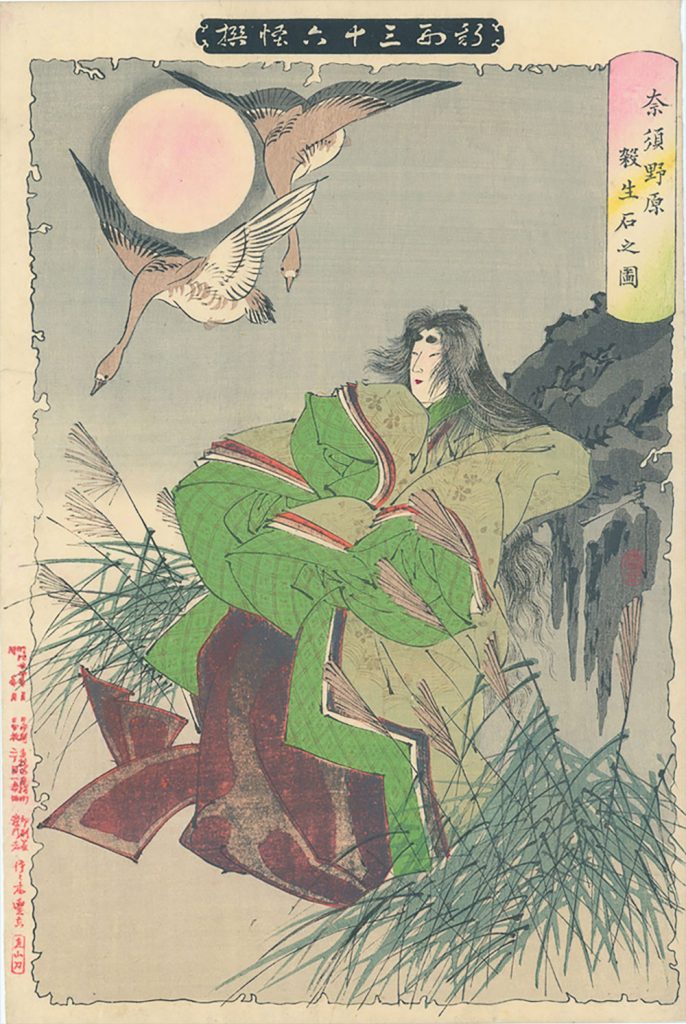
Her identity exposed, Tamamo-no-Mae escaped to the Nasu Plain in present-day Tochigi Prefecture. Imperial warriors eventually hunted her down, and her death gave rise to another enduring legend: the Sesshō-seki, or Killing Stone, believed to contain her malevolent spirit. Through centuries of storytelling, Tamamo-no-Mae became one of Japan’s most recognisable yōkai.
Physical Traits
Tamamo-no-Mae is primarily remembered for her extraordinary human appearance. In her disguised form, she looked like an exceptionally beautiful and refined court woman whose intelligence was considered just as remarkable as her physical appearance. She possessed extensive knowledge of poetry, philosophy, Buddhist teachings and courtly traditions, allowing her to impress even the most educated individuals at the imperial palace.
Some versions describe her body as producing an unusual radiance, particularly during musical and literary gatherings at court. This supernatural brilliance eventually contributed to suspicions about her identity. Her ability to maintain a convincing human appearance was central to her success in gaining the emperor’s confidence.
Her actual form was that of a powerful fox spirit. However, her physical description changed considerably as the legend developed. The medieval Tamamo no Sōshi describes an ancient fox from the Nasu Plain that was approximately eight hundred years old, measured seven fathoms in length and possessed two tails. Another illustrated version preserved by Kyoto University describes a hundred-year-old fox measuring 42 feet in height, demonstrating how differently early manuscripts presented the creature.
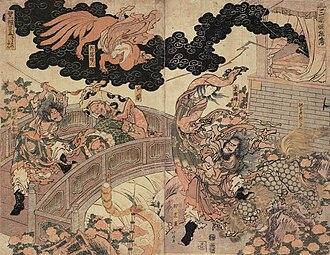
The familiar image of Tamamo-no-Mae as a white-faced, golden-furred nine-tailed fox became prominent much later. Edo-period puppet performances and illustrated popular books helped establish this appearance, which eventually became the standard representation of the character. Her nine tails symbolise the exceptional age and supernatural power associated with the most formidable fox spirits in Japanese folklore.
Family
Traditional accounts do not establish a biological family for Tamamo-no-Mae. Her origins are presented through her supernatural nature rather than through a conventional genealogy involving parents, siblings or descendants. She is understood as an ancient fox spirit whose identity and activities extend beyond a single human lifetime. Later versions of the legend connect her with several legendary women from different parts of Asia. These include Lady Kayō in India and Daji in China, alongside other identities such as Bao Si, associated with the downfall of the Zhou dynasty. These figures appear in expanded narratives that portray the same supernatural fox moving between kingdoms and adopting different human identities.
The connections are not entirely consistent across surviving versions. Some accounts associate Daji with the Shang dynasty, while Bao Si belongs to the later Zhou tradition. Their combination into one continuous supernatural biography reflects the development of the legend rather than established historical relationships. Tamamo-no-Mae’s connection with Emperor Toba is similarly part of the supernatural narrative. Although she is described as a favoured woman at court, the surviving traditions do not establish a recognised marriage or biological descendants. Her story is primarily concerned with her disguise, influence over the ruler and eventual exposure.
Other names
Tamamo-no-Mae appears under several names and descriptions in Japanese literature and the wider East Asian fox-spirit tradition. These names reflect different stages of the legend rather than necessarily representing interchangeable identities. Tamamo-no-Mae (玉藻前) is her most widely recognised Japanese name. It identifies the beautiful court woman whose supernatural identity became the centre of the Nasu legend.
Keshō no Mae is associated with her appearance at Retired Emperor Toba’s palace in certain medieval narratives. The name refers to her mysterious, supernatural presence before she becomes known as Tamamo-no-Mae. Daji is the Chinese identity attributed to the fox spirit in expanded versions of the legend. She is associated with the downfall of the Shang dynasty’s final ruler, King Zhou, in Chinese historical tradition.
Bao Si is another Chinese identity connected with the same supernatural being in later Japanese retellings. She is traditionally associated with King You of Zhou and the political decline of the Western Zhou dynasty. Lady Kayō is the name attributed to the fox spirit during the Indian portion of the three-country narrative. Kyūbi no Kitsune, meaning nine-tailed fox, describes her familiar supernatural form rather than being a separate personal name. These identities helped transform Tamamo-no-Mae’s story into a transnational legend connecting supernatural deception with the downfall of powerful rulers.
Powers and Abilities
Tamamo-no-Mae’s defining supernatural ability is shapeshifting. As a powerful kitsune, she could transform herself into a beautiful human woman and maintain that appearance convincingly enough to enter the imperial court. Her disguise allowed her to approach influential individuals while concealing her true nature.
Her extraordinary intelligence was another important characteristic. She possessed knowledge of poetry, literature, philosophy and religious teachings, making her appear exceptionally accomplished even among the educated members of the imperial court. This ability to impress through intellect was as important to her disguise as her physical beauty.
The legend also associates her with supernatural deception and bewitchment. Her influence over Retired Emperor Toba is portrayed as more than ordinary attraction, with her presence gradually becoming connected to his declining health. When conventional treatments and religious ceremonies failed, the court turned to divination to identify the cause. Abe no Yasunari eventually exposed her identity through a religious ritual associated with Taizan Fukun, a deity connected with fate and the underworld. When Tamamo-no-Mae was required to participate in the ceremony, she disappeared, confirming the diviner’s suspicions.
After escaping to the Nasu Plain, she was pursued by two imperial warriors, Miura no Suke and Kazusa no Suke. Their hunt eventually ended with her death. However, her supernatural influence supposedly survived through the Sesshō-seki. The Killing Stone was believed to release poisonous gases and kill animals or people who approached it. In this way, Tamamo-no-Mae’s supernatural presence continued even after her physical destruction. The Buddhist monk Gennō Shinshō is associated with the later tradition of pacifying the stone’s spirit through religious intervention.
Modern Day Influence
Tamamo-no-Mae remains an important character in Japanese cultural heritage, with her story influencing traditional theatre, literature, painting and contemporary entertainment. Her transformation from a medieval supernatural antagonist into an internationally recognised nine-tailed fox has made her particularly influential in modern interpretations of Japanese folklore.
Traditional performances helped preserve her legend through Noh, Kabuki and Bunraku. The Noh play Sesshō-seki explores the supernatural presence associated with the Killing Stone, while Kabuki and puppet theatre brought the character’s dramatic transformation and eventual defeat to wider audiences. Japanese woodblock artists also portrayed her in different forms, particularly during the Edo period.
Her legend continues to attract attention through manga, anime and video games. One prominent example is the Fate franchise, which features a fictional interpretation of Tamamo-no-Mae. Such portrayals frequently explore her identity as a nine-tailed fox while introducing new personalities and storylines that differ from the traditional legend.
The Sesshō-seki in Nasu, Tochigi Prefecture, remains one of the most tangible connections to her story. The site attracts visitors interested in Japanese folklore and is associated with the belief that the fox spirit’s malevolent presence became embedded in the stone. In March 2022, the famous rock split into two pieces, attracting international attention and prompting renewed discussion of the legend. The physical event, however, is understood in terms of natural weathering and existing fractures rather than supernatural activity.
Tamamo-no-Mae’s enduring appeal comes from the unusual combination of beauty, intelligence and danger embodied in her character. Her story also illustrates how Japanese folklore absorbed and transformed narratives from neighbouring cultures, creating a supernatural figure whose legend travelled across centuries and geographical boundaries.
Related Images







Source
Bathgate, M. (n.d.). Exorcism of the fox-woman Tamamo-no-maye. University of California, Irvine.
http://faculty.humanities.uci.edu/sbklein/images/GHOSTS/foxes/pages/foxorcism.html
Bathgate, M. (n.d.). Tamamo no Mae. University of California, Irvine. http://faculty.humanities.uci.edu/sbklein/images/GHOSTS/foxes/pages/tamamo.html
Japan International Cooperation Center. (n.d.). The legend of the nine-tailed fox and the “Killing Stone.” Ministry of Land, Infrastructure, Transport and Tourism. https://www.mlit.go.jp/tagengo-db/common/001564229.pdf
Nippon.com. (2023, April 12). Foxy lady, foxy “yōkai”: How Japan’s “kitsune” bewitched the world.
https://www.nippon.com/en/articles/-/12507
Reider, N. T. (2006). The fox’s craft in Japanese religion and folklore: Shapeshifters, transformations, and duplicities [Review of the book by M. Bathgate]. Journal of Asian Studies. https://muse.jhu.edu/article/218306/summary
YOKAI.JP. (2025, August 21). Tamamo-no-Mae. https://yokai.jp/en/yokai/tamamo-no-mae
YOKAI.JP. (2025, September 21). Tales of the fox: Kitsune in Japanese folklore. https://yokai.jp/en/collections/kitsune
YOKAI.JP. (2026, March 23). Beautiful yokai collection: Legends of Japanese folklore. https://yokai.jp/en/collections/utsukushii
Frequently Asked Questions
Who is Tamamo-no-Mae in Japanese mythology?
Tamamo-no-Mae is a legendary Japanese fox spirit who disguised herself as a beautiful and intelligent court lady before her supernatural identity was exposed.
Was Tamamo-no-Mae really a nine-tailed fox?
Later Japanese traditions portray Tamamo-no-Mae as a golden-furred, nine-tailed fox. However, some early medieval accounts describe her with only two tails.
Why did Tamamo-no-Mae want to harm Emperor Toba?
According to the legend, Tamamo-no-Mae used her disguise to approach the emperor as part of a supernatural scheme involving political power and opposition to Buddhism.
What happened to Tamamo-no-Mae after her death?
Her spirit supposedly entered the Sesshō-seki, or Killing Stone, at Nasu. The stone was believed to release poisonous gases that killed nearby living creatures.
Is Tamamo-no-Mae connected to the Chinese fox spirit Daji?
Yes. Later Japanese narratives identify Tamamo-no-Mae with Daji and other legendary women, presenting them as successive identities of one supernatural fox.


