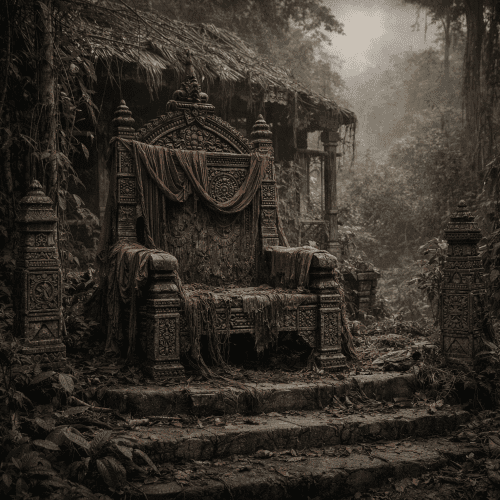


Curse of the Killing Stone : Tamamo-no-Mae’s Poisonous Legacy
At a glance
| Description | |
|---|---|
| Mythology | Japanese Mythology |
| Cursed Individual(s) | Emperor Toba, Warriors of Nasu |
| Cursed By | Tamamo-no-Mae |
| Primary Consequence | Grave illness, Death in battle |
| Symbolism | Deception undermining leadership, Struggle against hidden malevolence |
Mythlok Perspective
In Mythlok’s View, Tamamo-no-Mae’s Curse reflects a universal mythic pattern where beauty masks destruction and power hides behind illusion. Japanese folklore presents the fox spirit as a master of deception, but the deeper lesson lies in the persistence of imbalance when ambition overtakes harmony. Similar narratives appear in other cultures. The seductive downfall of kings in Tamamo-no-Mae’s tale echoes the manipulative figure of Daji in Chinese tradition and even the destructive enchantresses of European legends. Across cultures, the message remains clear: the greatest threats often appear in the most alluring forms.
Tamamo-no-Mae’s Curse
Introduction
Tamamo-no-Mae’s Curse is one of the most chilling legends in Japanese folklore. The story revolves around Tamamo-no-Mae, a mysterious woman of extraordinary beauty who served in the imperial court during the late Heian period. Beneath her elegance, intelligence, and charm, however, lurked a powerful and malevolent spirit. According to legend, she was not human at all but a nine-tailed fox known as a kyūbi no kitsune, one of the most powerful forms of yokai in Japanese tradition.
The tale combines political intrigue, supernatural deception, and moral symbolism. Tamamo-no-Mae’s Curse begins with the mysterious illness of Emperor Toba and ends with the creation of the infamous Sesshō-seki, or “Killing Stone,” said to poison all life that comes near it. Over centuries, the legend has evolved into a cautionary narrative about hidden evil, the dangers of deception, and the lingering power of curses.
Even today, Tamamo-no-Mae remains one of the most recognizable fox spirits in Japanese folklore. Her story appears in literature, theater, anime, and modern games, while the stone associated with her curse still stands in the volcanic landscape of Nasu in Tochigi Prefecture. The legend continues to fascinate audiences because it blends historical figures with supernatural storytelling, creating a myth that feels both eerie and timeless.
Mythological Background
Tamamo-no-Mae’s Curse is deeply rooted in Japanese kitsune folklore. Kitsune, or fox spirits, occupy an unusual place in Japanese mythology because they can be both benevolent and dangerous. Some serve as messengers of the rice deity Inari, while others are tricksters capable of manipulating humans through illusions and shapeshifting.
Tamamo-no-Mae represents the darker side of this fox-spirit tradition. She is commonly described as a kyūbi no kitsune, a nine-tailed fox that has lived for centuries and accumulated immense supernatural power. These spirits are believed to grow stronger and wiser as they age, eventually gaining the ability to transform into humans.
In many later versions of the legend, Tamamo-no-Mae’s story stretches beyond Japan. Some traditions claim she was previously the infamous fox spirit Daji from Chinese mythology, a concubine blamed for the downfall of the Shang dynasty. Others connect her to figures in ancient Chinese and Indian legends before she finally arrived in Japan. While these cross-cultural connections are more mythic embellishment than historical fact, they emphasize the idea that Tamamo-no-Mae was an ancient spirit that moved through civilizations, leaving chaos behind her.
Within Japanese tradition, she eventually appeared at the imperial court as Tamamo-no-Mae, an impossibly talented and beautiful woman who quickly gained favor with Emperor Toba. Her intelligence was legendary; it was said she could answer any question posed to her, whether philosophical, poetic, or political. This perfection, however, soon became suspicious.
Origin of the Curse
The origins of Tamamo-no-Mae’s Curse begin with Emperor Toba’s mysterious illness during the early twelfth century. Despite the efforts of court physicians, the emperor’s health deteriorated rapidly. No treatment seemed effective, and the illness baffled those around him.
Court diviners were eventually summoned to investigate the spiritual cause of the emperor’s suffering. Among them was the onmyōji Abe no Yasunari, a practitioner of onmyōdō, the Japanese system of divination and spiritual balance influenced by Taoist cosmology.
Through ritual divination, Abe no Yasunari revealed a shocking truth. The source of the emperor’s illness was Tamamo-no-Mae herself. Her presence at court was not merely suspicious; she was secretly draining the emperor’s life force. When confronted, the elegant court lady abandoned her human disguise and fled.
Tamamo-no-Mae escaped to the plains of Nasu in what is now Tochigi Prefecture. There, imperial forces were sent to hunt the fox spirit. According to the legend, two warriors eventually managed to kill her. Yet her death did not end the curse. Instead, her spirit transformed into a stone infused with deadly power. This stone would become known as the Sesshō-seki, or Killing Stone.
Nature of the Curse
Tamamo-no-Mae’s Curse did not disappear with her defeat. Instead, it transformed into something far more ominous. The stone created from her spirit was believed to release poisonous energy that killed animals and humans who approached it.
The Sesshō-seki became infamous throughout Japan as a place of danger and supernatural dread. Local legends claimed birds fell from the sky when flying over it, and travelers who lingered too close could die suddenly. The stone was said to emit toxic gas, which likely reflects the real volcanic fumes present in the Nasu region.
In folklore, however, the phenomenon was interpreted as the lingering hatred of the fox spirit. Tamamo-no-Mae’s Curse had shifted from a hidden threat within the imperial court to a visible and terrifying landmark. The stone symbolized the idea that destructive forces can survive even after their source has been destroyed. For generations, the Sesshō-seki was treated as a cursed object that embodied unresolved spiritual energy.
Victims and Key Figures
Several historical and legendary figures appear within the story of Tamamo-no-Mae’s Curse. Emperor Toba stands as the most prominent victim, as his mysterious illness was blamed on the fox spirit’s influence. Although the legend exaggerates the supernatural aspects, the story reflects real political tensions of the Heian period.
A crucial role in exposing Tamamo-no-Mae was played by Abe no Yasunari, the court diviner who revealed her true nature through spiritual investigation. His role emphasizes the importance of onmyōji within Japanese folklore as protectors who maintained balance between the human world and the supernatural realm.
The warriors sent to hunt Tamamo-no-Mae are also significant figures in the legend. They pursued the fox spirit across Japan and eventually defeated her in the Nasu plains. Their victory demonstrated that human courage and divine protection could overcome even powerful yokai. Centuries later, a Buddhist monk named Gennō Shinshō became another key figure. According to legend, he performed rituals to pacify the spirit trapped within the Killing Stone.
Consequences and Resolution
Although Tamamo-no-Mae’s physical form was destroyed, the curse continued through the Sesshō-seki stone. The area around the stone became feared as a deadly place where supernatural forces lingered. Eventually, the Buddhist monk Gennō Shinshō confronted the curse. Through prayer and ritual purification, he attempted to calm the spirit that inhabited the stone. Some versions of the story say he struck the stone with a hammer, causing it to break and releasing the trapped spirit.
After this ritual, Tamamo-no-Mae’s spirit supposedly appeared to the monk, expressing regret for her actions before finally disappearing. The curse was believed to have been lifted, though the location remained associated with eerie legends. Interestingly, the real Sesshō-seki stone in Nasu cracked naturally in 2022, which quickly reignited public fascination with the myth. Many people jokingly wondered whether Tamamo-no-Mae’s spirit had finally escaped again.
Symbolism and Moral Lessons
Tamamo-no-Mae’s Curse carries several symbolic meanings that have resonated in Japanese storytelling for centuries. One of the strongest themes is the danger of deception. Tamamo-no-Mae’s beauty and intelligence allowed her to infiltrate the highest levels of power, reminding audiences that appearances can conceal dangerous intentions. The story also reflects anxiety about political manipulation within imperial courts. A seemingly harmless figure can influence rulers and destabilize entire kingdoms. In this sense, Tamamo-no-Mae represents the fear of hidden corruption.
Another layer of symbolism involves the persistence of evil. Even after the fox spirit was defeated, her curse remained through the Killing Stone. This suggests that destructive forces rarely vanish instantly; they leave lingering consequences that society must confront and resolve. Finally, the intervention of the monk Gennō highlights the importance of spiritual purification. Ritual, wisdom, and moral clarity ultimately restore balance.
Cultural Impact and Legacy
Tamamo-no-Mae remains one of the most famous yokai in Japanese folklore. Her legend appears in classical literature, Noh and kabuki theater, and traditional art such as ukiyo-e prints. The story has also entered modern pop culture. Tamamo-no-Mae appears in anime, manga, and video games, including the popular Fate franchise. These interpretations often reinterpret her character, sometimes portraying her as tragic rather than purely villainous.
The Sesshō-seki stone itself has become a tourist attraction in Nasu. Visitors come to see the location associated with the legendary curse and the volcanic gases that once inspired the myth. Through centuries of retelling, Tamamo-no-Mae’s Curse has evolved into a powerful narrative about illusion, ambition, and the lingering consequences of destructive power. Her story continues to fascinate because it blends historical figures, supernatural mystery, and timeless moral themes.




Source
Foster, M. D. (2009). Pandemonium and parade: Japanese monsters and the culture of yokai. University of California Press.
Klein, S. B. (n.d.). Tamamo no Mae. University of California, Irvine. http://faculty.humanities.uci.edu/sbklein/images/GHOSTS/foxes/pages/tamamo.html
The Type-Moon Wiki. (2010, July 1). Tamamo-no-Mae. Fandom. https://typemoon.fandom.com/wiki/Tamamo-no-Mae
Tyler, R. J. (Trans.). (1988). Japanese tales. Pantheon Books.
Wikipedia contributors. (2006, February 21). Tamamo-no-Mae. Wikipedia. https://en.wikipedia.org/wiki/Tamamo-no-Mae
Yokai.com. (n.d.). Tamamo no Mae. https://yokai.com/tamamonomae/
Your Secret Japan. (2025, May 3). The nine-tailed fox: Myth, mystery, and modern imagination. https://www.yoursecretjapan.com/articles/nine-tailed-fox
Frequently Asked Questions
What is Tamamo-no-Mae’s Curse?
Tamamo-no-Mae’s Curse refers to the deadly supernatural power attributed to the fox spirit Tamamo-no-Mae, whose spirit supposedly became the Sesshō-seki Killing Stone that poisoned those who approached it.
Who was Tamamo-no-Mae in Japanese folklore?
Tamamo-no-Mae was believed to be a powerful nine-tailed fox spirit disguised as a beautiful court lady who infiltrated Emperor Toba’s court during the Heian period.
How is Sigurd connected to Brynhildr’s Curse?
What is the Sesshō-seki Killing Stone?
The Sesshō-seki is a legendary stone in Nasu, Japan, believed to contain Tamamo-no-Mae’s spirit and emit deadly poison that killed animals and humans.
Did the Killing Stone really exist?
Yes. The Sesshō-seki is a real volcanic rock formation in Tochigi Prefecture associated with toxic gases from the surrounding hot springs.