


Cronus : The Greek Titan King Who Feared the Future
At a glance
The Mythlok Perspective
In Mythlok’s Perspective, Cronus is most compelling not as a simple harvest deity or embodiment of time, but as a ruler consumed by the fear of succession. Like Odin in Norse mythology, he understands that power has an ending, yet his response is radically different. Cronus attempts to defeat destiny by destroying the future, only to create the conditions for his own downfall. His story makes succession feel less like fate and more like a consequence of fear.
Cronus
Introduction
Cronus, also spelled Kronos or Cronos, is one of the most important figures in Greek mythology and the youngest of the twelve Titans. He was the son of Uranus, the Sky, and Gaia, the Earth, and belonged to the divine generation that ruled before Zeus and the Olympian gods. In Hesiod’s Theogony, Gaia turns to Cronus when Uranus imprisons her children, giving him a sickle with which he overthrows his father and takes control of the cosmos.
Cronus’ reign is remembered as the age before the Olympians, and later Greek tradition connected his rule with the Golden Age, a mythical period associated with abundance and an easier relationship between gods and humanity. Yet Cronus himself is far from an uncomplicated symbol of prosperity. His fear of losing power drives some of the darkest episodes in Greek mythology.
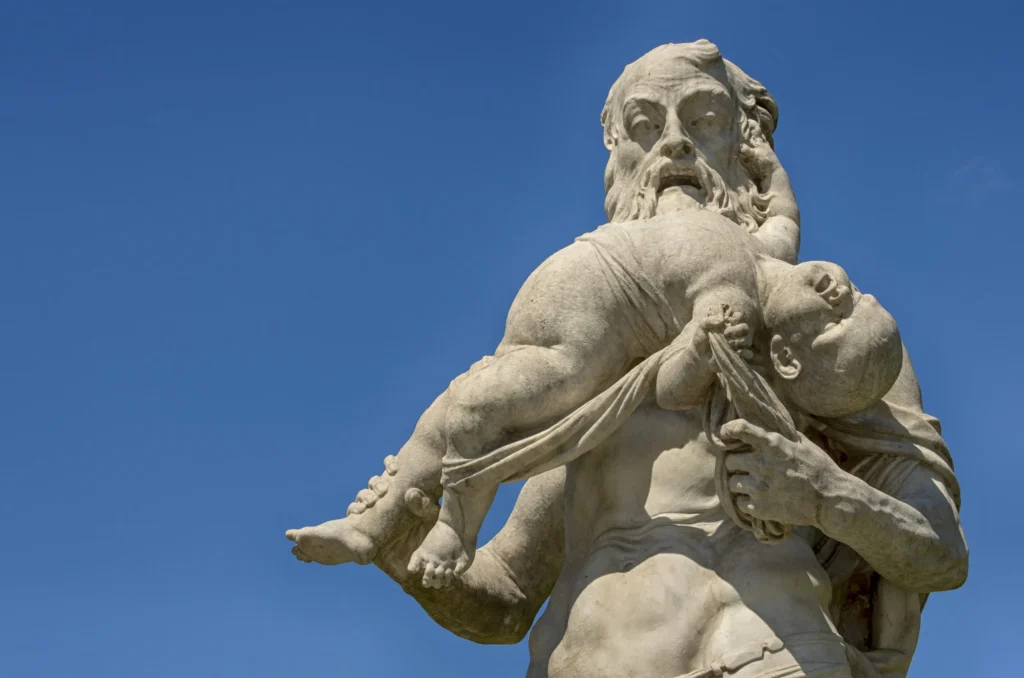
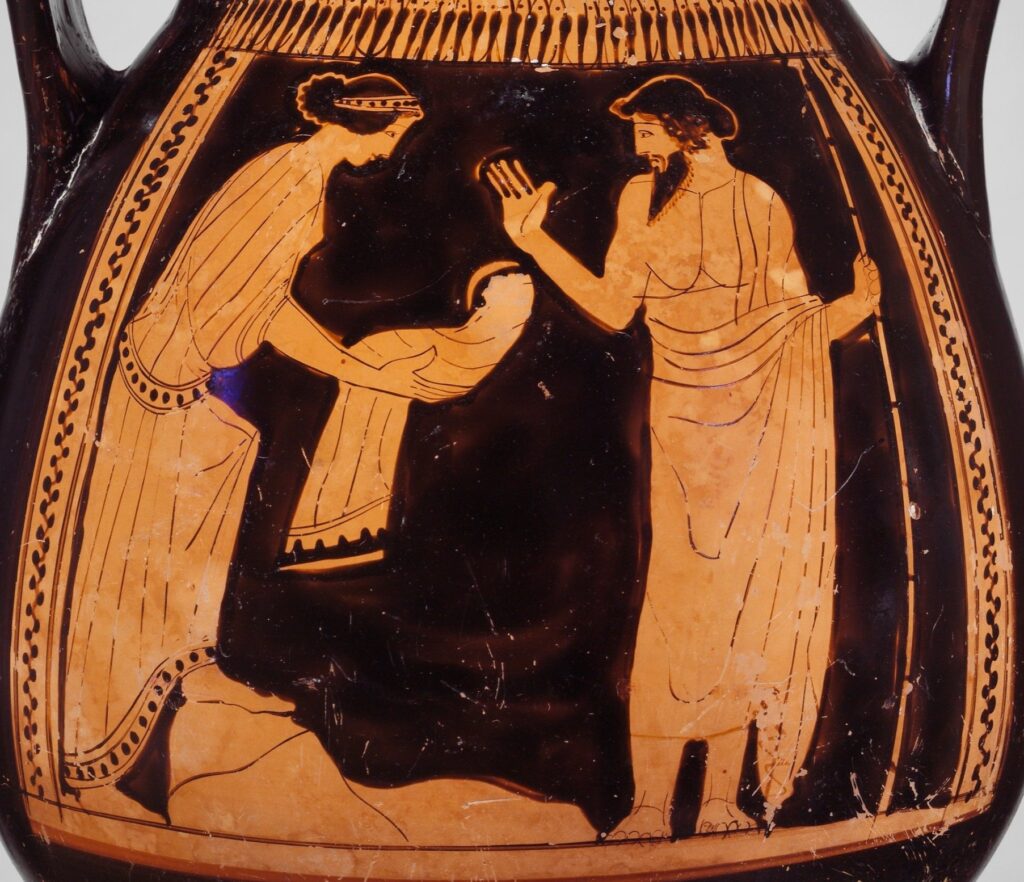
After becoming ruler, Cronus marries his sister Rhea. A prophecy warns him that one of his own children will eventually overthrow him, just as he overthrew Uranus. Determined to prevent the prophecy, Cronus swallows each child born to him. Rhea eventually saves Zeus by hiding him and giving Cronus a stone wrapped in swaddling clothes instead. When Zeus grows to adulthood, Cronus is forced to disgorge his children, who join Zeus in the war against the Titans.
The resulting Titanomachy establishes Zeus and the Olympians as the new ruling generation. Cronus is therefore central to one of Greek mythology’s recurring themes: no ruler can permanently escape succession.
Physical Traits
Greek mythology does not give Cronus a single detailed physical description that can be treated as definitive. Unlike some later mythological characters, ancient literary sources concentrate on his ancestry, actions and position rather than specifying his height, clothing, complexion or facial features.
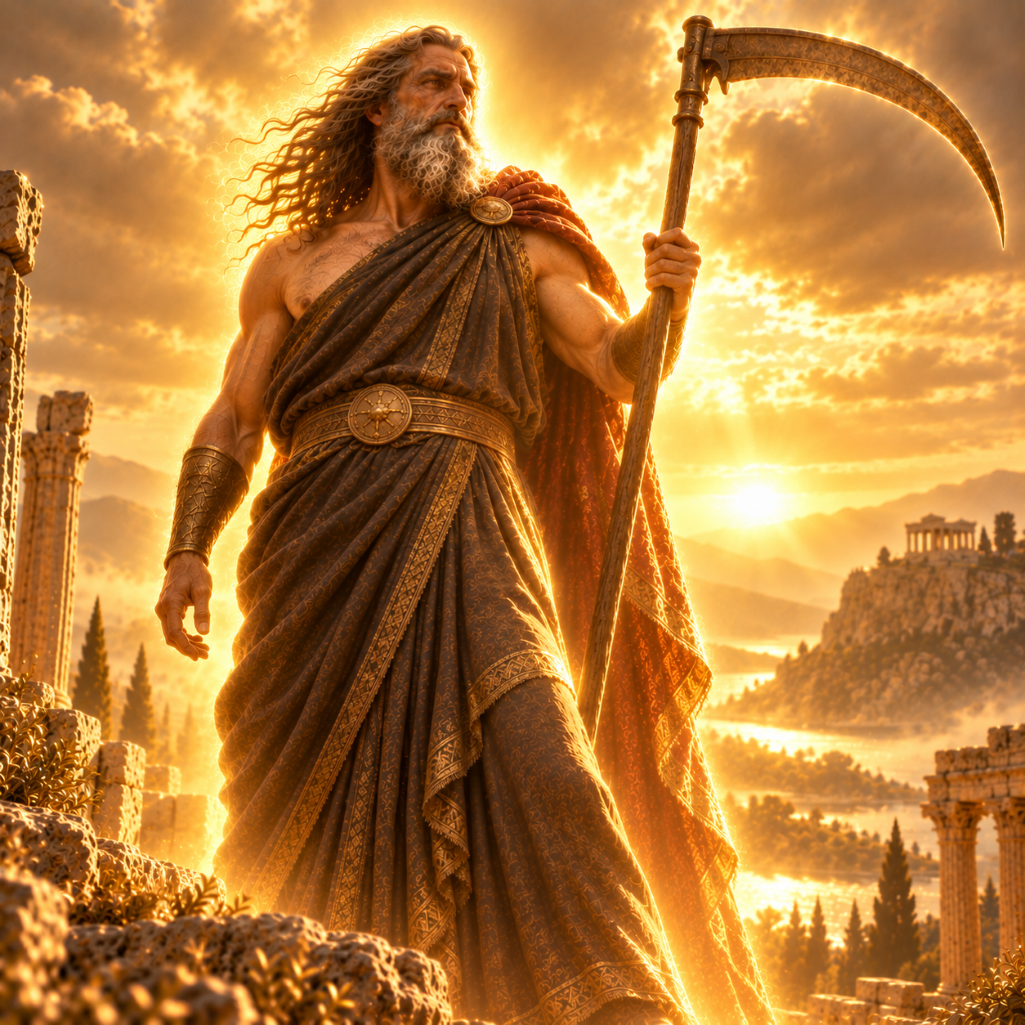
Artistic traditions commonly present Cronus as a mature or elderly male deity, often with a beard and a powerful build. His most recognisable attribute is the sickle or curved blade associated with his attack on Uranus. In the succession myth, Gaia provides Cronus with the weapon, and he uses it to overthrow his father.
The sickle later became closely connected with Cronus’ agricultural associations. The Athenian Kronia, a festival held in his honour, has traditionally been interpreted in connection with the grain harvest, although the precise religious significance of the festival changed over time.
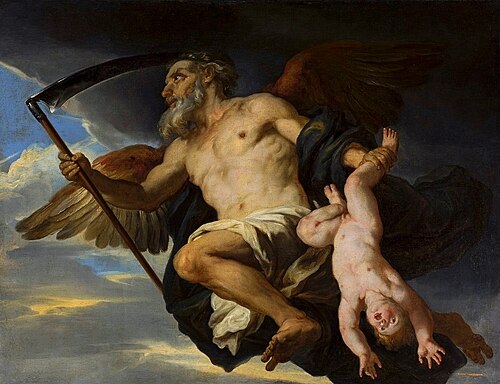
Later artistic traditions also contributed to the image of Cronus as an old man carrying a harvesting tool. Some of this imagery became entangled with the Roman Saturn and with Chronos, the personification of time. That is why modern depictions sometimes show Cronus with the appearance of an aged figure representing time itself. This should not be mistaken for a detailed physical description found in early Greek mythology.
Family
Cronus was the son of Uranus and Gaia and the youngest of the twelve Titans in the principal genealogical tradition. His siblings included Oceanus, Coeus, Hyperion, Crius and Iapetus, along with the Titan goddesses Rhea, Themis, Mnemosyne, Tethys, Theia and Phoebe.
Cronus married his sister Rhea, and together they became the parents of the six major children who would form the core of the Olympian generation: Hestia, Demeter, Hera, Hades, Poseidon and Zeus. Homeric and Hesiodic traditions confirm Cronus as the father of these gods, although different sources sometimes vary in genealogical detail.
The relationship between Cronus and his children is dominated by his fear of prophecy. Having taken power from Uranus, Cronus learns that the same fate awaits him at the hands of one of his own offspring. He therefore swallows Hestia, Demeter, Hera, Hades and Poseidon as soon as they are born. Rhea saves Zeus by concealing him in Crete and giving Cronus a stone instead.
Some later traditions also identify Chiron, the wise centaur, as a son of Cronus and the nymph Philyra. In these accounts, Cronus takes the form of a horse during their encounter, resulting in Chiron’s unusual half-horse, half-human form.
Other names
The name appears as Cronus, Cronos and Kronos, with Kronos representing a transliteration closer to the Greek Κρόνος. These forms generally refer to the same Titan. Cronus is also strongly associated with Saturn, the Roman god who was identified with him in later Greco-Roman tradition. The identification created an extensive overlap between their mythology, festivals and symbolism, but Saturn and Cronus originated within different religious traditions and should not simply be treated as identical from the beginning.
Cronus is also frequently confused with Chronos, the Greek personification or primordial conception of Time. The similarity between the names encouraged later philosophical, religious and artistic associations between the two figures. However, Cronus and Chronos are distinct figures in Greek mythological traditions, and treating Cronus as originally being the Greek god of time oversimplifies the evidence.
This distinction is particularly important when interpreting the famous image of an aged figure carrying a scythe. The modern association of the scythe, old age and time reflects centuries of interaction between Cronus, Saturn and Chronos rather than a single ancient Greek tradition.
Powers and Abilities
Cronus’ power is primarily demonstrated through his position as king of the Titans and through the major acts attributed to him in the succession myths. He is not described in Greek mythology through a fixed catalogue of supernatural abilities in the way modern fantasy often presents mythological characters. His first major act of power is the overthrow of Uranus. Armed with the sickle supplied by Gaia, Cronus attacks his father and removes him from power, becoming ruler of the Titans.
His second defining characteristic is his extraordinary fear of succession. After learning that one of his children will overthrow him, Cronus swallows his offspring one by one. Zeus ultimately survives because Rhea deceives Cronus with a stone. Zeus later forces Cronus to release the swallowed gods, giving the younger generation the strength needed to challenge the Titans.
Cronus is therefore associated with kingship, succession, generational conflict, fertility and harvest traditions, although the strength of these associations varies between periods and sources. The Kronia provides evidence for his connection with harvest celebrations, while his sickle reinforces the agricultural imagery that became attached to him.
His association with time is more complicated. Later traditions connected Cronus with Chronos and Saturn, encouraging the interpretation of him as a force that consumes everything with the passage of time. This interpretation fits his myth remarkably well because he literally consumes his children to prevent the future from replacing him, but it should be understood as a later interpretive development rather than a simple description of his original Greek domain.
Cronus eventually loses his position during the Titanomachy, the ten-year conflict between the Titans and the younger Olympian gods. Zeus and his allies defeat the Titans and imprison them in Tartarus in the tradition preserved by Apollodorus.
Modern Day Influence
Cronus remains one of the most recognisable figures from Greek mythology, particularly because his story combines several themes that continue to resonate: parental fear, political power, rebellion, succession and the inability of a ruler to escape the future. His conflict with Zeus has become one of the defining narratives of the Titanomachy, inspiring novels, comics, films, television, games and modern retellings of Greek mythology. Contemporary adaptations often exaggerate his size, destructive power or connection with time, transforming the ancient Titan into a cosmic antagonist.
Cronus also remains important in discussions of ancient religion and mythology because his story illustrates how Greek traditions developed across different periods. The early succession myth preserved in Hesiod focuses on the transfer of cosmic authority from Uranus to Cronus and eventually to Zeus. Later interpretations added stronger associations with agriculture, Saturn and time.
The Kronia, celebrated in Athens in honour of Cronus, provides evidence for his ritual importance and is generally associated with the grain harvest. His Roman counterpart Saturn later became the focus of Saturnalia, one of the best-known Roman festivals, although Saturn’s religious identity developed within Roman tradition rather than simply reproducing Greek Cronus. Cronus also has a lasting presence in astronomy through Saturn, whose name comes from the Roman deity identified with Cronus. The planet’s mythology-inspired naming reflects the long-lasting influence of the Greco-Roman tradition on scientific and cultural language.
Perhaps Cronus’ strongest modern legacy, however, is symbolic. He represents a ruler who knows that power is temporary but responds to that knowledge with increasingly desperate violence. His attempt to prevent succession becomes the very reason his succession becomes inevitable. That paradox is what makes Cronus more than simply an ancient villain: he is one of Greek mythology’s clearest embodiments of the fear of being replaced.
Related Images

Source
Britannica, T. Editors of Encyclopaedia. (n.d.). Cronus. Encyclopædia Britannica. https://www.britannica.com/topic/Cronus
GreekMythology.com. (2018, October 31). Cronus :: The Titan Leader. https://www.greekmythology.com/Titans/Cronus/cronus.html
Mark, J. J. (2022, October 25). Cronus. World History Encyclopedia. https://www.worldhistory.org/Cronus/
Mythopedia. (2023, March 8). Cronus. https://mythopedia.com/topics/cronus/
Olympioi. (n.d.). Cronus | Leader of the Titans and God of Time and Destruction. https://olympioi.com/greek-gods/cronus
Theoi Project. (2019, March 10). Kronos. https://www.theoi.com/Titan/TitanKronos.html
Wikipedia contributors. (n.d.). Cronus. In Wikipedia. https://en.wikipedia.org/wiki/Cronus
Wikipedia contributors. (n.d.). Titans. In Wikipedia. https://en.wikipedia.org/wiki/Titans
Frequently Asked Questions
Who was Cronus in Greek mythology?
Cronus was the youngest of the twelve Titans, son of Uranus and Gaia, and father of Zeus. He ruled before the Olympian gods and was eventually overthrown by Zeus.
Why did Cronus swallow his children?
Cronus swallowed his children because a prophecy warned that one of them would overthrow him, just as he had overthrown his own father, Uranus.
Who defeated Cronus?
Zeus defeated Cronus during the Titanomachy. After Zeus freed his swallowed siblings, they joined him in the war that established the Olympian gods.
Was Cronus the Greek god of time?
Cronus was not originally the Greek god of time. He was a Titan king, but later traditions connected him with Chronos and the Roman Saturn, creating strong associations with time.
Is Cronus the same as Saturn?
Cronus and Saturn are different deities from Greek and Roman traditions, but the Romans identified Saturn with Greek Cronus, causing their myths and symbolism to become closely connected.


