


Gaia : The Primordial Earth Goddess of Greek Mythology
At a glance
| Description | |
|---|---|
| Origin | Greek Mythology |
| Classification | Gods |
| Family Members | Chaos (Parent), Uranus (Husband), Titans, Cyclopes, Hecatoncheires, Ourea, Pontus, Gigantes and Typhon (Children) |
| Region | Greece |
| Associated With | Earth, Creation, Fertility, Nourishment, Mountains, Prophecy |
The Mythlok Perspective
In Mythlok’s Perspective, Gaia is interesting when compared with Bhumi Devi from Indian mythology. Both personify the Earth and represent its role as a source of life, nourishment and existence, but their mythological functions are different. Gaia stands at the beginning of the Greek cosmic genealogy, giving birth to primordial beings, Titans and other forces that shape the divine order. Bhumi Devi, by contrast, is more closely associated with the Earth as a sustaining and nurturing goddess within the wider Vaishnava tradition. The comparison shows how two cultures could personify the same fundamental reality while giving it very different places within their understanding of creation and the divine.
Gaia
Introduction
Gaia, also spelled Gaea or Ge, is the primordial goddess and personification of Earth in Greek mythology. She is one of the earliest beings in Hesiod’s Theogony, emerging after Chaos and becoming one of the fundamental powers from which the divine cosmos develops. Gaia is not simply a goddess who governs the Earth; in the mythological imagination, she is the Earth itself.
Hesiod describes Gaia as the “broad-bosomed Earth” and an enduring foundation for the gods. From Gaia come major features of the cosmos, including Uranus (the Sky), the mountains and Pontus (the Sea). Her later union with Uranus produces the Titans, Cyclopes, and Hecatoncheires, placing Gaia at the beginning of the genealogical line that eventually leads to the Olympian gods.
Gaia’s importance extends beyond creation. She is an active participant in the succession of divine rulers. She helps Cronus overthrow Uranus, later assists Rhea and Zeus against Cronus, and in some traditions becomes an opponent of Zeus. Her mythology therefore presents Earth as both the source of life and an ancient force capable of challenging those who disturb the established order.
Gaia was also associated with prophecy and sacred oaths. Ancient traditions connect her with the oracle at Delphi before Apollo became its principal divine patron. Pausanias, for example, records a tradition in which she shared the Delphic oracle with Poseidon before it passed to Themis and eventually Apollo.
Physical Traits
Gaia does not have one universally fixed physical appearance in ancient Greek literature. Because she personifies Earth itself, her identity is expressed through the physical world rather than through a standardized humanoid form.
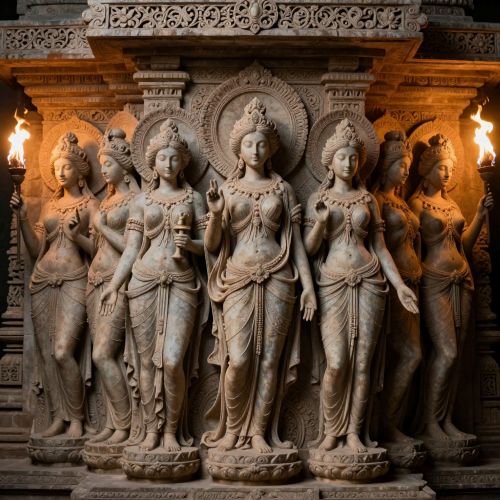
In later Greek and Roman artistic traditions, she could be represented as a mature or maternal woman emerging from or reclining upon the Earth. Such imagery emphasizes fertility, nourishment, abundance, and the generative nature of the ground. Theoi’s survey of ancient representations notes depictions of Gaia as a matronly, full-bodied woman associated directly with the earth.
Her mythological body can also be understood on a much larger scale. Mountains, plains, caves and the ground itself belong to the realm represented by Gaia. Hesiod’s cosmology makes this particularly clear because Gaia gives birth to Uranus, the Ourea or mountains, and Pontus, the sea. These are not merely children who happen to have natural associations; they are divine personifications of fundamental parts of the cosmos.
This makes Gaia different from many Greek gods whose identities are tied primarily to particular activities or social functions. Her physical presence is the landscape itself, making her simultaneously a divine personality and a cosmic substance.
Family
Gaia emerges from Chaos and, in Hesiod’s account, has no parents. She then independently produces Uranus, the Ourea and Pontus. Uranus becomes both her son and later her consort, and together they produce the Titans, Cyclopes and Hecatoncheires. The twelve Titans in Hesiod’s genealogy are Oceanus, Coeus, Crius, Hyperion, Iapetus, Cronus, Theia, Rhea, Themis, Mnemosyne, Phoebe and Tethys. Gaia and Uranus also have the three Cyclopes—Brontes, Steropes and Arges—and the three Hecatoncheires: Cottus, Briareus and Gyges.
Uranus fears his powerful children and confines some of them within Gaia. In response, Gaia fashions a sickle and encourages Cronus to overthrow his father. Cronus succeeds, beginning a new generation of divine rule. Gaia’s descendants eventually include many of the best-known Greek gods. Her daughter Rhea becomes the mother of Hestia, Demeter, Hera, Hades, Poseidon and Zeus. Gaia therefore stands at the ancestral beginning of both the Titan and Olympian generations.
Other traditions expand Gaia’s family still further. She is associated with the Erinyes, Gigantes and Meliae following the castration of Uranus, while Hesiod identifies Typhon as a child of Gaia and Tartarus. Because Greek mythology developed through multiple literary and local traditions, genealogies can vary between sources.
Other names
Gaia is the most familiar modern spelling of the Greek name, but the goddess appears under several related forms. Gaea is an alternative spelling commonly found in English, while Ge or Gē reflects the Greek name for Earth. The name represents more than a geographical concept. In Greek religious thought, Earth could be understood as a divine and generative presence. Gaia could therefore function simultaneously as a cosmic being, an ancestral mother and the physical ground upon which gods and mortals existed.
Her Roman counterpart is generally identified with Tellus, or Terra Mater, although Greek Gaia and Roman Tellus belong to different religious traditions and should not be treated as perfectly interchangeable figures. Gaia was also associated with chthonic, or earth-related, religious functions. Her connection with the soil, burial, fertility, oaths and subterranean spaces gave her a role extending beyond the simple idea of a fertility goddess. Ancient evidence also records worship of Gaia at several Greek locations.
Powers and Abilities
Gaia’s defining power is creation. As the personification of Earth, she generates beings that represent some of the most fundamental structures of the Greek cosmos. Her children include Uranus, the mountains and Pontus, while her union with Uranus produces an entire generation of divine beings. Her power is therefore fundamentally generative rather than martial. Gaia provides the foundation upon which the gods exist and from which successive divine generations emerge. This makes fertility, nourishment, stability and reproduction central aspects of her character.
She also possesses prophetic authority. Ancient traditions associate her with Delphi before the oracle came under Apollo’s control. Pausanias describes a succession in which Gaia’s share of the oracle passed to Themis and subsequently to Apollo, while other traditions give slightly different accounts of Delphi’s earliest divine occupants. Her influence over divine succession is equally important. Gaia helps Cronus overthrow Uranus and later gives crucial guidance concerning Zeus. In Hesiod’s account, Gaia advises Zeus during the conflict with the Titans, including the release of the Hecatoncheires, whose strength contributes to the Olympians‘ victory.
Modern Day Influence
The name Gaia has acquired a major modern meaning through the Gaia hypothesis, developed by scientist James Lovelock and microbiologist Lynn Margulis during the 1970s. Their influential 1974 paper, Atmospheric Homeostasis by and for the Biosphere: The Gaia Hypothesis, examined how living organisms interact with Earth’s physical and chemical environment and proposed that the biosphere can contribute to the regulation of planetary conditions.
The scientific Gaia hypothesis should not be confused with the goddess Gaia. The mythological Gaia is a primordial deity and personification of Earth, while the scientific concept concerns relationships between life and Earth’s atmosphere, oceans, soils and other environmental systems. The shared name was inspired by the ancient Greek figure. She has also become an influential symbol in environmental writing, ecological philosophy, literature, fantasy and popular culture. Modern portrayals frequently use her as an embodiment of nature or the planet, although these interpretations often combine ancient mythology with contemporary environmental ideas.
The distinction is important because modern references to Gaia can therefore describe three related but different ideas: the ancient Greek Earth goddess, the scientific Gaia hypothesis, and the modern cultural symbol of a living or interconnected Earth. For ancient Greek mythology, however, Gaia remains first and foremost the primordial Earth: the ancient mother from whom mountains, sea, gods and successive generations of divine beings emerge.
Related Images



Source
Atsma, A. J. (n.d.). Gaia. Theoi Greek Mythology. https://www.theoi.com/Protogenos/Gaia.html
Britannica, T. Editors of Encyclopaedia. (1998, July 20). Tellus. Encyclopaedia Britannica. https://www.britannica.com/topic/Tellus
Hesiod. (2006). Theogony and works and days (M. L. West, Trans.). Oxford University Press. (Original work published ca. 700 BCE)
Hesiod. (n.d.). Theogony (H. G. Evelyn-White, Trans.). The Internet Classics Archive, Massachusetts Institute of Technology. https://classics.mit.edu/Hesiod/hes.th.html
Lovelock, J. E. (1979). Gaia: A new look at life on Earth. Oxford University Press.
Lovelock, J. E., & Margulis, L. (1974). Atmospheric homeostasis by and for the biosphere: The Gaia hypothesis. Tellus, 26(1–2), 2–10. https://doi.org/10.1111/j.2153-3490.1974.tb01946.x
Murray, A. T. (Ed.). (2015). Gaia, Gē. In Oxford Classical Dictionary. Oxford University Press. https://academic.oup.com/edited-volume/61673/chapter/548936329
Pausanias. (1918). Description of Greece (W. H. S. Jones, Trans.). Harvard University Press. https://www.perseus.tufts.edu/hopper/text?doc=Perseus:text:1999.01.0160
Frequently Asked Questions
Who is Gaia in Greek mythology?
Gaia is the primordial goddess and personification of Earth in Greek mythology. She emerges from Chaos and becomes the ancestral mother of many major Greek gods.
What are Gaia's powers in Greek mythology?
Gaia is associated with creation, fertility, Earth, prophecy, sacred oaths and divine ancestry. She can also influence conflicts between successive generations of gods.
Who are Gaia's children?
Gaia’s children include Uranus, the mountains and Pontus. With Uranus, she becomes the mother of the Titans, Cyclopes and Hecatoncheires.
Was Gaia the goddess of Delphi?
Ancient traditions associate Gaia with the early oracle at Delphi. Pausanias says she shared the oracle with Poseidon before it passed to Themis and Apollo.
Is Gaia the same as the Gaia hypothesis?
No. Gaia is an ancient Greek Earth goddess, while the Gaia hypothesis is a scientific concept developed by James Lovelock and Lynn Margulis.


