


Crius : The Greek Titan Who Watched Over the Constellations
At a glance
| Description | |
|---|---|
| Origin | Greek Mythology |
| Classification | Gods |
| Family Members | Uranus (Father), Gaia (Mother), Eurybia (Wife); Oceanus, Coeus, Hyperion, Iapetus, Cronus, Rhea, Theia, Themis, Mnemosyne, Phoebe, Tethys (Siblings), Astraeus, Pallas, Perses (Children) |
| Region | Greece |
| Associated With | Constellations, Southern heavens |
The Mythlok Perspective
In Mythlok’s Perspective, Crius is compelling precisely because Greek mythology does not tell us very much about him. Unlike Cronus or Hyperion, he survives mainly through genealogy and cosmic interpretation, making him a reminder that mythological importance does not always depend on dramatic stories. His connection with the southern heavens and constellations gives him a quiet structural role, more like a celestial marker than a conventional hero or warrior. In that sense, Crius resembles the cosmic-order figures found across mythologies who define the universe without dominating its stories.
Crius
Introduction
Crius, also known as Krios or Kreios, was one of the twelve elder Titans of Greek mythology and a son of Uranus, the Sky, and Gaia, the Earth. He belongs to the generation of primordial divine powers that existed before Zeus and the Olympian gods established their rule. Although Crius is far less prominent in surviving mythology than Cronus, Rhea or Oceanus, his place in the Titan genealogy is firmly established in Hesiod’s Theogony.
Crius is an unusual figure because mythology gives him a stronger symbolic identity than an individual story. He appears mainly in genealogies and in accounts of the struggle between the older and younger generations of gods. His most enduring association is with the heavens and constellations. Later mythological interpretation connects him with the southern quarter of the sky and with Aries, the Ram, creating an image of Crius as a cosmic figure concerned with orientation and the ordering of the celestial world. These associations should, however, be distinguished from what the earliest surviving texts explicitly say.
Crius was also part of the Titan rebellion against Uranus. According to the myth preserved by Apollodorus, he and his brothers helped restrain their father while Cronus carried out the overthrow that began the succession of divine generations. His importance therefore lies not in a collection of dramatic personal adventures, but in his position at a crucial turning point in the Greek mythological universe.
Physical Traits
There is no reliable ancient description of Crius’s physical appearance. Neither Hesiod’s Theogony nor the surviving account of his family and mythology provides details about his height, facial features, clothing, weapons or bodily form. Hesiod simply names Crius among the sons born to Gaia and Uranus.
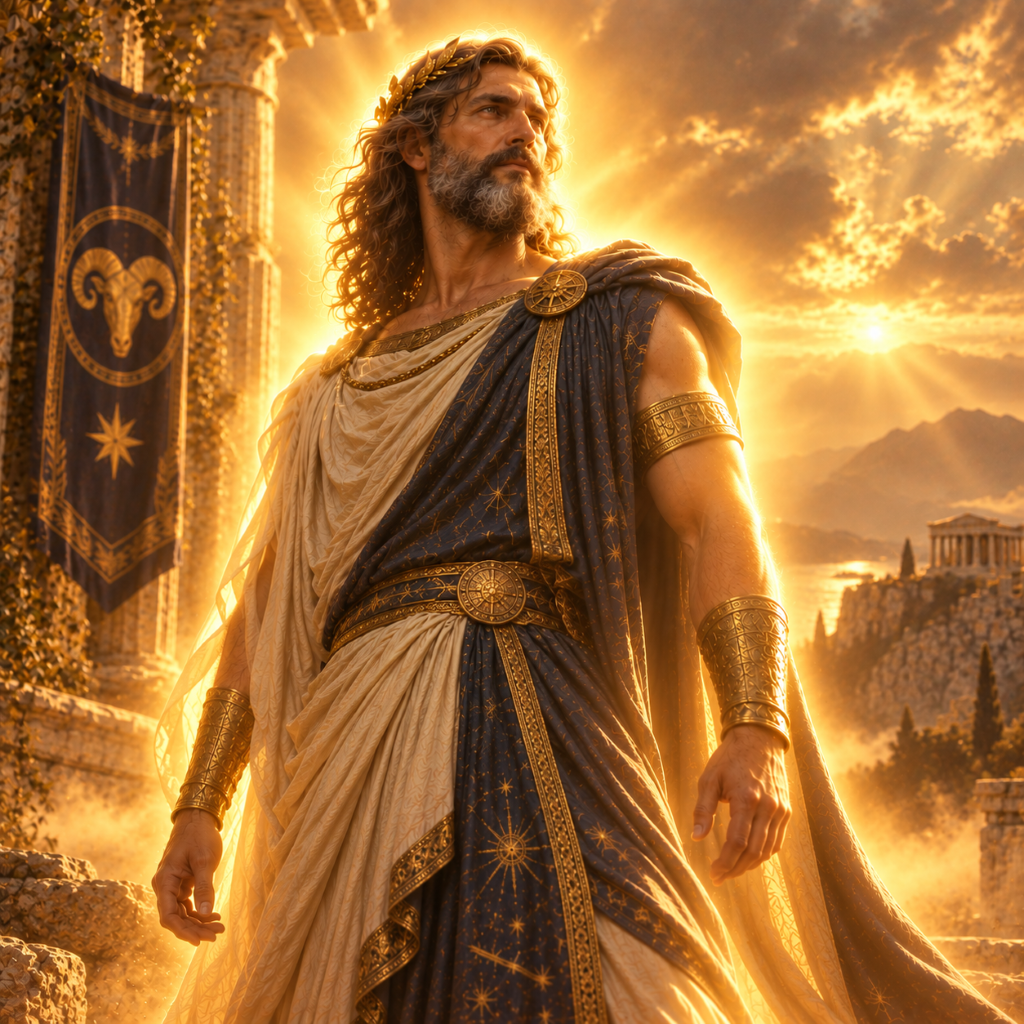
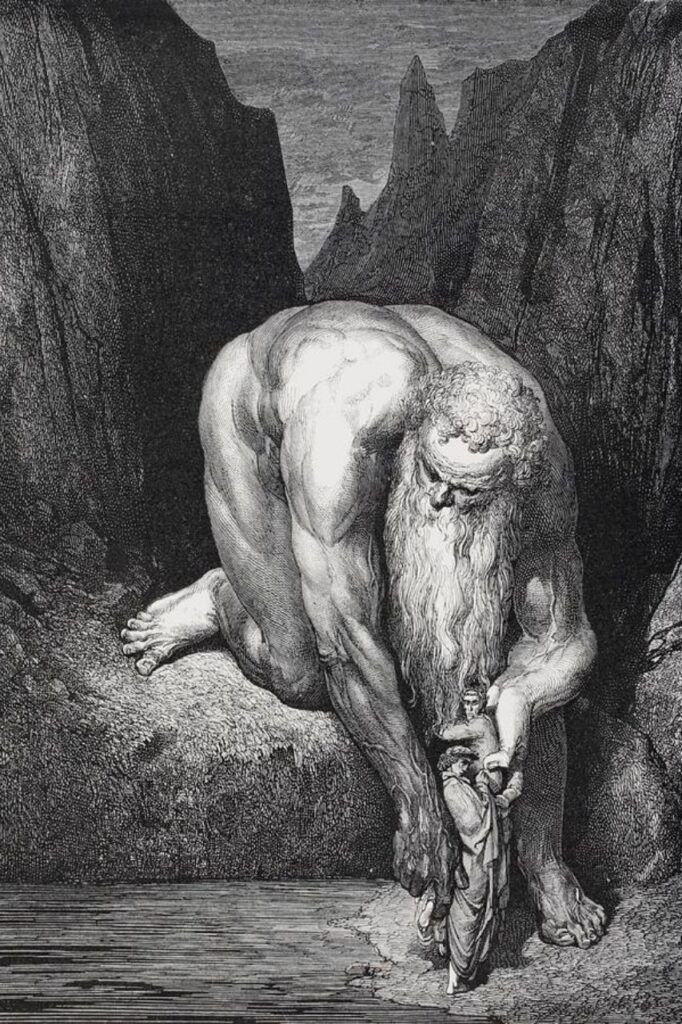
This makes Crius different from gods whose appearances are supported by literary descriptions or established artistic traditions. Modern portrayals sometimes give him enormous proportions, armour, a celestial crown or ram-like horns, but these are artistic interpretations rather than features recorded in classical mythology.
The ram connection does have a legitimate mythological basis at the level of his name. Krios can be connected with the Greek word for “ram,” while the variant Kreios has been associated with ideas of lordship or rulership. This has encouraged later artists and writers to represent Crius with imagery inspired by Aries. Yet the evidence does not establish that Crius literally possessed ram horns or routinely appeared in animal form.
Family
Crius was born to Uranus and Gaia, placing him among the twelve elder Titans. His brothers were Oceanus, Coeus, Hyperion, Iapetus and Cronus, while his sisters included Rhea, Theia, Themis, Mnemosyne, Phoebe and Tethys. Hesiod names Crius directly within this first Titan generation.
His closest family relationship in later mythology was with Eurybia, a daughter of Pontus, the primordial sea, and Gaia. Hesiod records that Eurybia and Crius became the parents of Astraeus, Pallas and Perses. Pseudo-Apollodorus preserves the same genealogy, confirming the three sons as part of Crius’s established mythological family.
These children gave Crius an important connection to later generations of divine beings. Astraeus became associated with the stars and, in later genealogical traditions, fathered the winds and celestial bodies with Eos. Pallas became the husband of Styx and fathered figures including Nike, Kratos, Zelos and Bia. Perses became the father of Hecate through Asteria.
Crius’s role in his own generation was equally significant. In the succession myth, his brother Cronus enlisted Crius, Coeus, Hyperion and Iapetus to help overthrow Uranus. Pseudo-Apollodorus describes the brothers participating in the attack while Cronus performed the decisive act against their father. The family therefore places Crius at the intersection of two major mythological generations: the Titans who challenged Uranus and the divine descendants who would eventually populate the Greek cosmos.
Other names
Crius is commonly rendered as Krios, Kreios or Crius, reflecting differences between the ancient Greek forms and their Latin transliteration. The name is particularly interesting because two related Greek forms have been interpreted differently: Krios is associated with “ram,” while Kreios has been connected with “lord” or “ruler.”
Crius is also associated with the name Megamedes. This identification appears in later classical-reference traditions and is supported by the Homeric Hymn to Hermes, where Pallas is described as the son of “Megamedes.” Since Hesiod identifies Pallas as the son of Crius, ancient and modern scholars have connected Megamedes with Crius. The identification is plausible but should not be treated as equally explicit in every ancient source.
The popular descriptions “Lord of the South” and “Southern Pillar” are better understood as interpretive titles based on the four-pillar theory surrounding the Titan brothers. They are useful for explaining Crius’s traditional symbolism, but they are not straightforward titles recorded by Hesiod himself.
Powers and Abilities
Crius is most strongly associated with the celestial realm. Later mythological interpretation describes him as a Titan connected with the constellations and identifies him with the southern pillar of the heavens. This interpretation arises from the roles assigned to the four Titan brothers—Crius, Coeus, Hyperion and Iapetus—in the story of Uranus’s overthrow. The brothers are understood by some scholars and mythographers as representing cosmic pillars that separate heaven and earth.
Crius’s connection with the constellation Aries is also an interpretive development rather than a clearly stated domain in Hesiod. The name Krios, meaning “ram,” encouraged an association with the Ram constellation, while his son Astraeus strengthened the family’s connection with the stars.
His symbolic powers can therefore be understood as celestial orientation, the constellations and cosmic structure, rather than as a catalogue of supernatural abilities. There is no classical evidence that Crius controlled starlight, fired cosmic energy, manipulated constellations or possessed other fantasy-style powers sometimes attributed to him in modern adaptations.
Crius also possessed the immense divine power expected of an elder Titan. He took part in the Titanomachy, the war between the Titans and Zeus’s younger generation. After the Titans were defeated, the traditional account places them in Tartarus. Pseudo-Apollodorus states that Zeus and his allies defeated the Titans and confined them there.
His power, then, is best understood through his place in the structure of the old cosmos. Crius was not a warrior god with a famous weapon or a thunder-wielding deity. His importance came from belonging to the generation that established and contested the first divine order.
Modern Day Influence
Crius remains one of the least familiar members of the Greek Titan generation, but his obscurity has not prevented him from appearing in modern mythology resources, fantasy interpretations and popular retellings. His appeal comes largely from the gaps in the ancient record. Because the classical sources provide only limited individual characterization, modern writers have considerable freedom to develop him as a celestial or astronomical Titan.
His association with constellations is particularly useful in modern interpretations because it gives Crius a clear visual identity without contradicting his basic mythological genealogy. The ram symbolism connected with his name also makes Aries a natural modern motif, although the connection should be presented as a later interpretation rather than an unequivocal ancient cult role.
Crius is also important for understanding how Greek mythology preserves incomplete characters. Not every Titan was given a long narrative, a famous cult or a clearly defined domain. Some survive primarily because their names appear in genealogies. Crius is one of these figures, yet his genealogy links him to Astraeus, Pallas and Perses, extending his presence into several later mythological traditions.
His modern significance therefore lies less in a single famous story and more in what he reveals about the architecture of Greek myth. Crius represents an older cosmic generation whose identity survives through family, succession and celestial symbolism. That makes him an important, if understated, figure in the mythology of the Titans.
Related Images



Source
Grimal, P. (1991). The dictionary of classical mythology. Blackwell.
Hesiod. (1988). Theogony (M. L. West, Trans.). Clarendon Press. (Original work composed circa 700 BCE)
BehindTheName. (2020). Meaning, origin and history of the name Kreios. https://www.behindthename.com/name/kreios
GreekBoston. (2019). Crius – Titan God of the South Wind. https://www.greekboston.com/culture/mythology/crius/
GreekGods.org. (n.d.). Crius, god of heavenly constellations. https://www.greek-gods.org/titans/crius.php
GreekMythology.com. (n.d.). Crius. https://www.greekmythology.com/Titans/Crius/crius.html
HistoryAndMyths. (2025, October 25). Crius: The Greek Titan of Constellations and Celestial Order. https://www.historyandmyths.com/2025/10/greek-titan-crius-constellations-celestial-order.html
Olympioi. (n.d.). Crius: The Pillar of the South in Greek Mythology. https://olympioi.com/greek-gods/crius
Theoi.com. (n.d.). CRIUS (Krios) – Greek Titan God of the Constellations. https://www.theoi.com/Titan/TitanKrios.html
TimelessMyths. (2002, April 2). Crius – Greek Gods. https://timelessmyths.com/gods/greek/crius/
Wikipedia. (2002, September 3). Crius. https://en.wikipedia.org/wiki/Crius
Wiktionary. (2023, March 18). κριός. https://en.wiktionary.org/wiki/%CE%BA%CF%81%CE%B9%CF%8C%CF%82
Frequently Asked Questions
Who was Crius in Greek mythology?
Crius was one of the twelve elder Titans, the son of Uranus and Gaia. He was associated with the constellations and fathered Astraeus, Pallas and Perses.
What was Crius the Titan of?
Crius is traditionally associated with the constellations and celestial order. Later interpretations also connect him with the southern pillar of heaven and Aries.
Who were the parents of Crius?
Crius was the son of Uranus, the personification of the Sky, and Gaia, the personification of the Earth, according to Hesiod’s Theogony.
Who was Crius married to?
Crius was associated with Eurybia, daughter of Pontus and Gaia. Their children were Astraeus, Pallas and Perses, according to Hesiod and Apollodorus.


