


Bia : The Akan River Spirit and Guardian of the Wild
At a glance
The Mythlok Perspective
In Mythlok’s Perspective, Bia represents a form of divinity that is inseparable from the land itself. He is not a ruler who commands nature but a presence that exists within it, reflecting a worldview where the sacred is embedded in rivers and forests rather than distant heavens. This makes Bia less visible but more immersive than many classical deities. Similar figures appear across cultures, such as the river spirits of Japanese tradition or the Slavic Leshy who guards forests. However, Bia stands apart in how directly his story explains geography and ecological balance. He is not just a guardian of nature but a mythic explanation for why nature exists as it does.
Bia
Introduction
Bia is a powerful yet understated figure in Akan tradition, representing the deep bond between divinity and the natural world. Among the Akan people of present-day Ghana and Ivory Coast, spirituality is inseparable from the environment, and Bia emerges as a living embodiment of this connection. He is counted among the abosom, the divine spirits that act as intermediaries between humanity and Nyame, the supreme sky creator.
As the son of Nyame and the earth goddess Asase Yaa, Bia belongs to a sacred lineage that governs the forces of nature. His presence is most strongly associated with the Bia River and the surrounding wilderness, where he is believed to reside not as a distant god, but as a living force within the land itself. Oral traditions preserve his story through themes of inheritance, rivalry, and ecological balance, reflecting how geography and myth intertwine.
Bia’s narrative is not simply about divine hierarchy. It is about how landscapes are shaped by cosmic events. His story explains why certain lands are fertile while others remain wild, offering a mythic lens through which the Akan people understand their environment.
Physical Traits
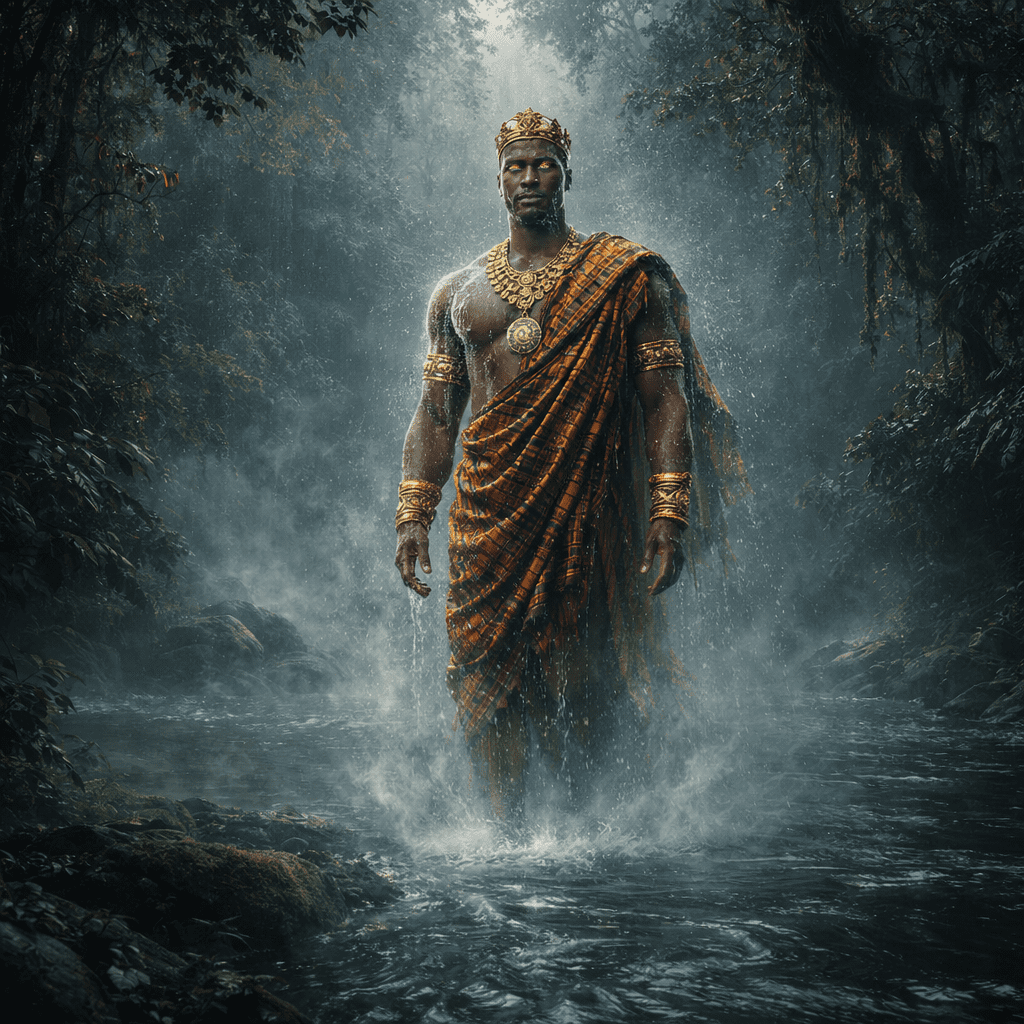
Unlike many deities in global traditions, Bia does not possess a fixed human-like form. Akan cosmology does not rely on rigid anthropomorphic depictions for its divine beings. Instead, abosom such as Bia are experienced through natural elements, making their presence both tangible and elusive.
Bia is most accurately understood as the spirit of the Bia River and the surrounding forested regions. The flowing water, dense vegetation, and untamed wilderness serve as his physical manifestation. Rather than being seen, he is felt through the movement of water, the stillness of the forest, and the rhythms of nature.
This absence of a defined body is not a limitation but a philosophical statement. It reinforces the Akan belief that divinity is embedded within the environment itself. Bia is not separate from nature; he is nature. His “form” changes with the river’s flow, the seasons, and the health of the land.
Family
Bia is part of a divine family that reflects the structure of the natural world. He is the son of Nyame, the supreme sky god, and Asase Yaa, the earth goddess who governs fertility and life. This parentage places Bia at the intersection of sky and earth, making him a mediator between cosmic forces and the physical world.
He shares this lineage with notable siblings such as Tano, Bosomtwe, and Epo, each associated with different natural domains. Among them, Tano plays a central role in Bia’s story due to their well-known rivalry.
According to Akan oral tradition, Nyame intended Bia to inherit the most fertile lands of the Akan region. However, a deception involving Nyame’s messenger, the goat Akua Abirekyi, allowed Tano to claim this inheritance by impersonating Bia. As a result, Tano became associated with the fertile Tano River basin, while Bia was left with the more rugged and less fertile western territories.
This myth does more than narrate sibling conflict. It explains the geographical distribution of fertile and wild regions in Akan lands. Bia’s association with wilderness is therefore not incidental but the direct outcome of divine events.
Other names
Bia’s identity remains remarkably consistent across Akan traditions. He is primarily known by his association with the Bia River, which serves as both his domain and his living representation. In some variations of oral storytelling, his name appears as “Bea,” reflecting linguistic differences rather than distinct identities.
Unlike many deities who accumulate numerous titles, Bia’s simplicity is significant. His identity is not built on elaborate epithets but on place and function. He is the river, the forest, and the unseen guardian of untamed land.
Occasionally, he is described in broader terms such as a wilderness spirit or forest guardian, but these are interpretive descriptions rather than formal names. The lack of multiple titles reinforces the idea that Bia’s essence is tied to a specific landscape rather than abstract attributes.
Powers and Abilities
Bia’s powers are deeply rooted in the natural world, reflecting his role as an abosom. He governs the Bia River and the surrounding wilderness, influencing both ecological balance and spiritual order.
His authority is expressed through the fertility of the land and the life sustained by the river. Water, in Akan belief, is not merely a resource but a sacred force, and Bia ensures its continuity and purity. His presence supports the growth of vegetation, the survival of wildlife, and the stability of ecosystems.
Bia is also associated with spiritual laws and taboos. One well-known tradition warns against mixing water from the Bia River with that of the Tano River. This act is believed to disrupt the balance between the rival deities and carries severe consequences in folklore, including transformation into a palm tree. Such stories reinforce respect for natural boundaries and sacred spaces.
Beyond fertility and protection, Bia embodies balance. His role is not to dominate but to maintain harmony between human activity and the environment. In this sense, his power is both ecological and moral.
Modern Day Influence
Bia’s influence continues to resonate in modern Akan communities, even as religious practices evolve. While many people in Ghana and Ivory Coast now follow Christianity or Islam, elements of traditional belief systems remain deeply embedded in cultural identity.
The Bia River itself remains a symbol of spiritual and ecological importance. Local traditions emphasize respect for the river and surrounding forests, echoing ancient beliefs about Bia’s guardianship. These practices align closely with modern environmental conservation efforts, demonstrating how traditional knowledge can inform contemporary sustainability.
In recent years, Bia has also gained attention in digital spaces. Storytelling platforms, documentaries, and cultural discussions highlight his role as a guardian of nature, connecting ancient cosmology with modern ecological awareness. Rather than fading into obscurity, Bia has adapted to new contexts. He now stands as both a cultural memory and a symbol of environmental responsibility, bridging the past and present.
Related Images


Source
Rattray, R. S. (1923). Ashanti. Oxford University Press.
Christaller, J. G. (1933). Dictionary of the Asante and Fante language called Tshi (Twi). Basel Evangelical Missionary Society.
Busia, K. A. (1951). The position of the chief in the modern political system of Ashanti. Oxford University Press.
Opoku, A. A. (1978). West African traditional religion. FEP International Publishers.
Meyerowitz, E. L. R. (1951). The divine king in Ashanti and the origins of the Akan. Faber & Faber.
Wikipedia. (2026). Akan religion. https://en.wikipedia.org/wiki/Akan_religion
TV Tropes. (n.d.). Myth / Akan mythology. https://tvtropes.org/pmwiki/pmwiki.php/Myth/AkanMythology
Tanoriver.com. (2025). The legend of Tano and Bia. https://tanoriver.com/the-legend-of-tano-and-bia/
Frequently Asked Questions
Who is Bia in Akan tradition?
What does Bia represent?
Bia represents rivers, forests, ecological balance, and the spiritual connection between humans and nature.
Is Bia a human-like god?
No, Bia does not have a fixed human form. He is understood as a spiritual presence manifested through natural elements like rivers and forests.
What is the story of Bia and Tano?
Bia was meant to inherit fertile lands from Nyame, but Tano deceived their father and claimed them instead, leaving Bia associated with less fertile regions.
Why is the Bia River important?
The Bia River is considered sacred as it embodies the spirit of Bia and plays a central role in cultural, ecological, and spiritual traditions.
