


Chernabog : The Dark God of Slavic Legends
At a glance
| Description | |
|---|---|
| Origin | Slavic Mythology |
| Classification | Gods |
| Family Members | N/A |
| Region | Germany |
| Associated With | Darkness, Misfortune, Chaos, Winter, Fear, Bad fate |
The Mythlok Perspective
In Mythlok’s Perspective, Chernabog represents humanity’s fear of chaos, darkness, and misfortune rather than pure evil. Much of his terrifying modern image comes from later Christian and fantasy reinterpretations instead of original Slavic belief. Similar to Hades and Kali, Chernabog reflects the idea that destruction and darkness are natural parts of cosmic balance, not simply forces of evil. His mystery also makes him one of the most intriguing figures in Slavic tradition because so little verified mythology survives about him. That uncertainty allows every generation to reinterpret him through its own fears, beliefs, and imagination.
Chernabog
Introduction
Chernabog is one of the most mysterious figures in Slavic tradition. Often translated as the “Black God,” he is associated with darkness, bad fortune, chaos, and fear. Unlike many mythological beings whose stories survive through epics and folklore, Chernabog appears only briefly in historical records, making him one of the most debated figures in Slavic belief systems. His earliest known mention comes from the 12th-century chronicle written by the German historian Helmold of Bosau, who described the worship practices of the Polabian Slavs.
According to Helmold, Slavic tribes believed that both good and bad fortune came from supernatural forces. During rituals and feasts, people would invoke a dark deity believed to bring suffering and calamity. This figure became known as Chernabog. Over time, scholars interpreted him as the dark counterpart to Belobog, the “White God,” though the existence of Belobog in ancient worship remains uncertain.
Modern interpretations often portray Chernabog as an evil god similar to the devil of Christian tradition. However, many historians argue that this understanding is heavily shaped by medieval Christian writers who interpreted foreign religions through their own theological lens. In older Slavic belief systems, darkness was not always considered purely evil. Winter, death, night, and destruction were often viewed as natural parts of existence rather than moral corruption.
Because so little original mythology survives, Chernabog exists today in a space between history and imagination. He has become a symbol of the darker side of nature, fate, and the unknown. Despite the limited records, his image continues to fascinate audiences across literature, games, films, and modern neo-pagan traditions.
Physical Traits
Ancient Slavic sources provide almost no verified physical description of Chernabog. Most modern depictions are based on artistic imagination, folklore reconstruction, and later literary influences rather than authentic medieval accounts.
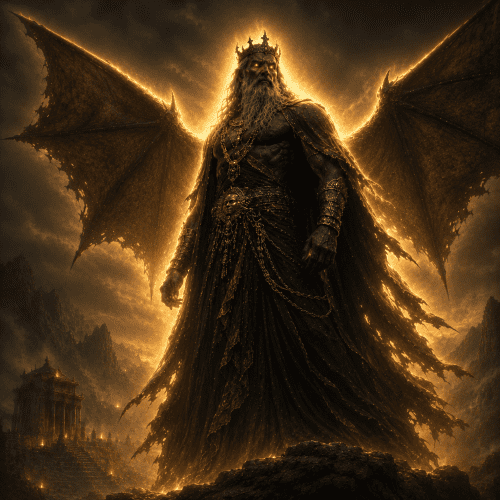
In many modern interpretations, Chernabog appears as a towering figure cloaked in darkness. He is often imagined with black hair, pale or shadow-like skin, glowing eyes, and a heavy, intimidating presence. Some depictions portray him as a horned demon with enormous wings, sharp claws, and fangs, imagery heavily influenced by Christian demonology.
One of the most famous visual representations appears in Fantasia by Walt Disney Productions, where Chernabog emerges from Bald Mountain as a gigantic winged being commanding spirits and flames through the night. This version became deeply influential in shaping how global audiences imagine the deity today.
Traditional symbolism connected to Chernabog focuses less on bodily appearance and more on atmosphere. Darkness, smoke, winter skies, ravens, black horses, barren landscapes, and nighttime storms are all linked to his presence. Rather than being a monster in the traditional sense, he represented the fear and uncertainty that ancient communities associated with misfortune and natural disaster.
Family
The mythology surrounding Chernabog contains very little information about his family or ancestry. Unlike many Indo-European deities who belong to detailed divine lineages, Chernabog appears isolated within surviving records.
The most common association is with Belobog, who is frequently presented as his opposite. In modern folklore and neo-pagan interpretations, Belobog represents light, fortune, and prosperity, while Chernabog governs darkness and suffering. Together, they are often portrayed as balancing cosmic forces. However, historians caution that this dualistic interpretation may not reflect authentic ancient Slavic religion and could instead be a later reconstruction influenced by Christian ideas of good versus evil.
Some later folk traditions and fantasy adaptations loosely connect Chernabog to supernatural beings such as witches, wandering spirits, or death-related entities. Characters like Baba Yaga and Koschei the Deathless are occasionally linked to him in modern storytelling, though no historical evidence confirms such relationships. Because of the fragmented nature of Slavic mythology, Chernabog remains less of a family-centered deity and more of an abstract cosmic force tied to fear, fate, and darkness.
Other names
The name Chernabog comes from Proto-Slavic roots meaning “Black God.” Different regions and historical texts recorded his name in various forms depending on local pronunciation and medieval spelling systems.
Some common variations include Czernobog, Crnobog, Chornobog, Cernobog, and Zcerneboch. The form “Zcerneboch” appears in Helmold’s Latin chronicle and is considered one of the earliest documented references to the deity.
In Eastern European languages, the root word connected to “black” often carried symbolic meanings beyond color alone. It could also imply bad fate, mourning, death, or destructive forces. This linguistic connection strengthens the theory that Chernabog may originally have represented misfortune itself rather than a fully developed god with myths and temples.
Christian chroniclers sometimes equated him with the devil, using terms such as “Diabolus” when translating Slavic beliefs into Latin texts. These descriptions shaped many later interpretations and contributed to his reputation as a purely evil figure.
Powers and Abilities
Chernabog is primarily associated with darkness, bad fortune, destruction, and fear. Medieval accounts suggest that Slavic communities believed he influenced suffering, defeat, famine, and disease. Rather than being worshipped for blessings, he was often invoked to avoid disaster or calm destructive forces.
In reconstructed mythology and modern folklore, his powers expanded dramatically. He became linked with winter storms, death, shadows, fire, nightmares, and supernatural spirits. Some legends describe him ruling over Nav, the Slavic realm of the dead, where lost souls and dark entities reside.
Modern fantasy portrayals frequently give him abilities such as shape-shifting, necromancy, elemental manipulation, and control over demons or spirits. In some stories, he can darken the sky, summon flames, manipulate fear, or influence fate itself. These interpretations are largely creative expansions rather than historically verified beliefs.
Symbolically, Chernabog represents the unavoidable hardships of life. Ancient societies often viewed disease, failed harvests, war, and harsh winters as manifestations of cosmic imbalance. Through this lens, Chernabog became the embodiment of nature’s destructive side rather than simply a villainous figure. His role reflects an important aspect of early Slavic spirituality: the understanding that darkness and suffering are inseparable parts of existence.
Modern Day Influence
Chernabog has experienced a major revival in modern popular culture despite the limited surviving mythology surrounding him. His dark imagery and mysterious origins make him an appealing figure for fantasy, horror, and supernatural storytelling.
His most famous appearance remains in Fantasia, where he appears during the “Night on Bald Mountain” sequence inspired by the music of Modest Mussorgsky. This portrayal transformed him into one of animation’s most iconic demonic figures.
Chernabog also appears in American Gods and its television adaptation, where he is reimagined as a grim Slavic god wielding a hammer. Video games such as Kingdom Hearts and SMITE portray him as a powerful supernatural enemy or playable deity.
In modern Slavic neo-paganism, some groups reinterpret Chernabog as a necessary balance within the universe rather than a purely evil being. He represents endings, transformation, winter, and the darker cycles of nature that eventually lead to renewal. Today, Chernabog remains a compelling example of how fragmented mythology can evolve through literature, film, gaming, and modern spirituality into a globally recognized mythological figure.
Related Images



Source
Helmold of Bosau. (1170). Chronica Slavorum (Tschan, F. J., Trans.). Columbia University Press. (Original work published ca. 1170)
Ivanits, L. J. (1989). Russian folk belief. M.E. Sharpe. https://www.jstor.org/stable/26549843
Mify i legendy narodov mira. (n.d.). Chernobog. In Enciklopediya. https://myths.com.ua/en/slavic-mythology/pantheons-of-the-gods/chernobog.php
Perun Watch. (2025, January 19). From folklore to fame: Slavic mythology in pop culture. https://www.perun.watch/blog/from-folklore-to-fame-slavic-mythology-in-pop-culture
Rosik, S. (2010). The religion in light of 11th and 12th-century chronicles. University of Wrocław Press.
Warner, E. (2002). Russian myths. University of Texas Press
Wikipedia contributors. (2024). Chernobog and Belobog. Wikipedia. https://en.wikipedia.org/wiki/Chernobog_and_Belobog
World Mythology. (2025). Chernobog Slavic god: The dark shadow and the destroyer. https://www.mifologia.com/chernobog-slavic-god-the-dark-shadow-and-the-destroyer/
Frequently Asked Questions
Who is Chernabog in Slavic mythology?
Chernabog is a Slavic deity associated with darkness, misfortune, chaos, and bad fate in medieval chronicles.
Is Chernabog an evil god?
Historical sources suggest he symbolized misfortune rather than pure evil, though later Christian writers portrayed him negatively.
What does the name Chernabog mean?
The name Chernabog translates to “Black God” from Proto-Slavic linguistic roots.
Did Chernabog have a rival?
Later folklore pairs him with Belobog, the “White God,” though historians debate whether this duality existed originally.
Where does Chernabog appear in modern culture?
Chernabog appears in Fantasia, American Gods, Kingdom Hearts, SMITE, and modern Slavic neo-pagan traditions.


