


Yamauba : The Terrifying Japanese Witch Who Devours Travellers
At a glance
| Description | |
|---|---|
| Origin | Japanese Mythology |
| Classification | Spirits |
| Family Members | Kintarō (foster son) |
| Region | Japan |
| Associated With | Mountains, Wilderness, Transformation, Cannibalism, Motherhood, Fertility, Prosperity |
The Mythlok Perspective
Kamohoaliʻi represents a departure from the traditional humanised deity. Within the Mythlok framework, he is understood less as a god who governs the sea and more as the ocean itself choosing to be known. Unlike Mediterranean deities such as Poseidon or Neptune, shaped in the human image to be bargained with, Kamohoaliʻi remains fundamentally elemental. While he shares the predatory divinity of the Fijian shark god Dakuwaqa, he is defined by his sacred role as a navigator, marking the limits of human dominion.
Yamauba
Introduction
Yamauba (山姥), also known as Yamamba or Yamanba, is a female supernatural being from Japanese folklore traditionally associated with remote mountains and forests. Often translated as the mountain witch, mountain crone or mountain hag, she belongs to the world of yōkai, Japan’s diverse collection of supernatural beings and mysterious entities. Her stories have survived through regional folktales, medieval literature, traditional theatre and modern popular culture.
Unlike supernatural figures with clearly established identities and personalities, Yamauba is a character of contradictions. Some stories describe her as a terrifying mountain dweller who lures unsuspecting travellers into her home before attempting to devour them. Others portray her as a generous woman who rewards kindness, offers protection and helps those who find themselves in difficult circumstances. She can be both a predator and a benefactor, making her one of the more complicated female figures in Japanese folklore.
The name Yamauba emerged in medieval Japanese literature, although beliefs about mysterious women inhabiting mountains may have older roots. Folklorist Noriko T. Reider identifies connections between Yamauba’s early representations, female oni and mountain-deity traditions. These associations help explain why her character developed such contrasting qualities. She represents a wilderness that can sustain human life but can also become dangerous when people venture beyond familiar settlements.
Physical Traits
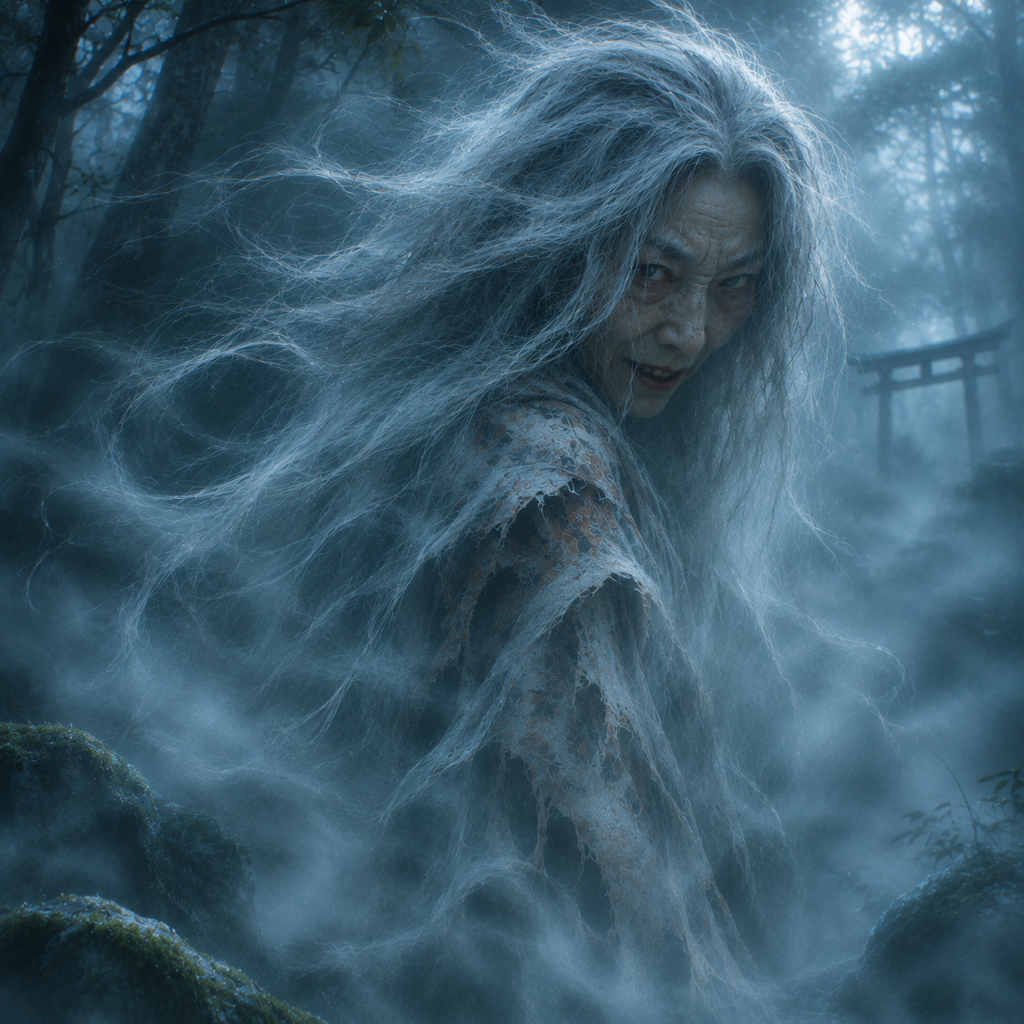
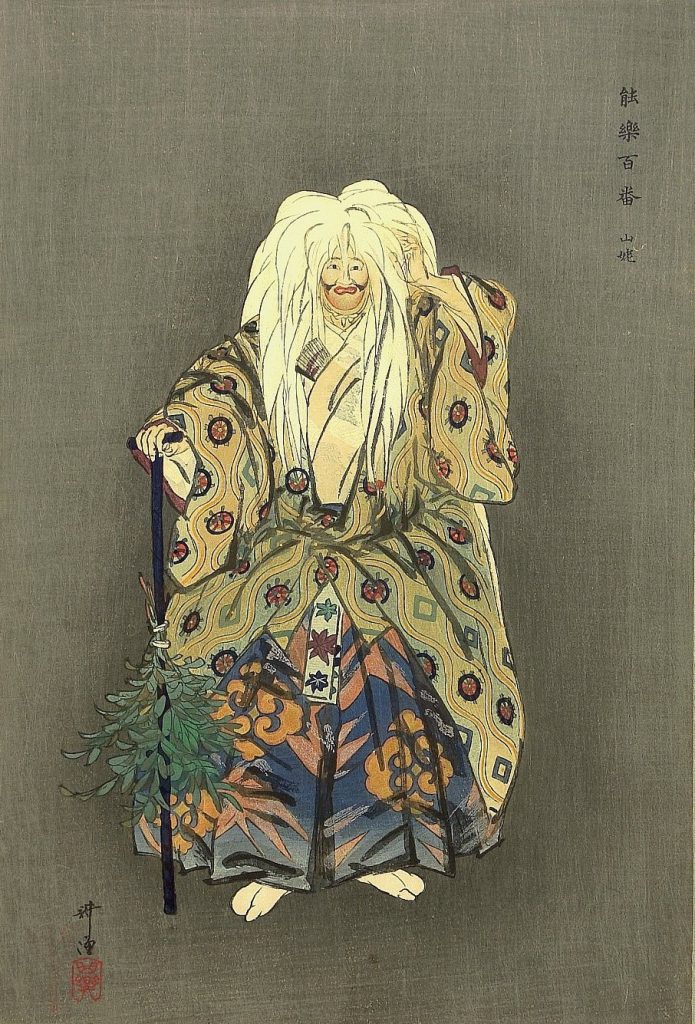
Yamauba is most commonly depicted as an elderly woman with long, dishevelled hair and an unsettling appearance. Her traditional image reflects her isolation from ordinary human communities, with worn clothing, an aged face and an untamed appearance associated with life in the mountains. White or grey hair is particularly common in historical representations.
Some folktales give her more frightening physical characteristics, including an unusually large mouth, sharp teeth and other monstrous features. Certain accounts describe a second mouth concealed beneath her hair, although this is not a universal characteristic of Yamauba. Such details vary between regional narratives and artistic interpretations.
Her appearance is not always frightening. In some stories, she disguises herself as an ordinary elderly woman, concealing her supernatural identity until an unfortunate traveller discovers her intentions. Other traditions allow her to transform into a beautiful young woman. This ability to move between different appearances reinforces her unpredictable nature.
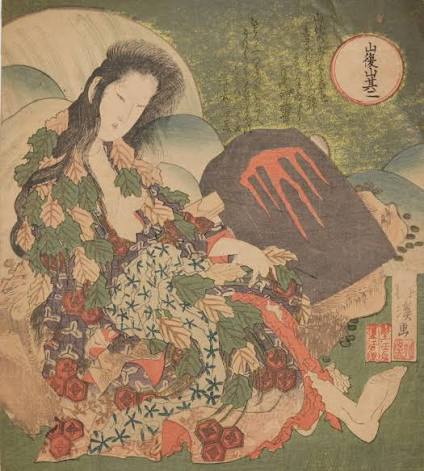
Historical artwork also reveals how dramatically her image evolved. Medieval representations generally emphasised the frightening mountain hag, while artists during the Edo period increasingly portrayed her as an attractive woman, particularly in paintings depicting her alongside Kintarō. These changing representations demonstrate that Yamauba was never restricted to a single physical identity.
Family
Yamauba does not have a consistently established family tree in Japanese folklore. Unlike the major kami of Shinto traditions, she is not associated with a recognised divine genealogy, and her stories rarely identify parents, siblings or a spouse.
Her most famous familial connection is with Kintarō, one of Japan’s best-known legendary child heroes. In a popular tradition, Yamauba raises Kintarō in the mountains, where he develops extraordinary physical strength and forms friendships with wild animals. He is commonly identified with Sakata no Kintoki, the legendary warrior associated with the exploits of Minamoto no Yorimitsu.
The relationship between Yamauba and Kintarō became particularly influential during the Edo period. Earlier representations emphasised her frightening nature, but later theatrical performances and visual art increasingly presented her as a devoted mother. Her maternal identity became an important part of her cultural representation.
However, this relationship should not be treated as universal. Not every Yamauba story features Kintarō, and many traditional narratives portray her as an independent mountain dweller without any identified family. Her association with motherhood is nevertheless significant. She represents a maternal figure capable of extraordinary affection and protection, while retaining the potential for violence and destruction. This combination makes her relationship with Kintarō particularly interesting within Japanese folklore.
Other names
Yamauba appears under several alternative names and romanisations in Japanese folklore. These variations generally refer to the same mountain-witch tradition, although their usage can differ according to regional storytelling, historical literature and performing arts. Yamauba (山姥) is the commonly used spelling in folklore studies. The name combines the Japanese words yama, meaning mountain, and uba, referring to an elderly woman.
Yamamba (山姥) is another widely recognised romanisation. It is particularly associated with traditional theatrical representations and later popular culture. Yamanba is an alternative pronunciation that became especially familiar through contemporary Japanese fashion and youth culture. Yama-uba is a hyphenated rendering occasionally encountered in English-language publications.
Other related terms include Yamahaha, meaning mountain mother, and Yamahime, meaning mountain princess. These names appear in broader traditions concerning mysterious women inhabiting mountainous regions. However, they should not automatically be treated as interchangeable names for Yamauba, since individual regional traditions sometimes distinguish between these supernatural figures.
The name Yamauba is documented in the Nippo Jisho, a Japanese-Portuguese dictionary compiled by Jesuit missionaries and published in 1603–1604. Its entry describes her as a mysterious mountain-dwelling figure whose appearance was not known. This historical reference demonstrates how deeply her identity was connected with the unknown wilderness.
Powers and Abilities
Yamauba possesses several supernatural abilities, although the powers attributed to her differ considerably between individual folktales. Her most recognisable ability is transformation. She can appear as an ordinary elderly woman or a beautiful young woman, allowing her to conceal her identity and approach unsuspecting travellers.
Her reputation as a cannibalistic mountain witch is another defining characteristic. In several traditional stories, she encounters travellers who become trapped in her isolated dwelling. What initially appears to be an offer of hospitality eventually reveals itself as an attempt to capture and devour her visitors.
The folktale Ushikata to Yamauba, commonly translated as The Ox-Cart Puller and the Mountain Witch, illustrates this terrifying side. The mountain witch consumes the fish carried by a travelling merchant, demands his ox and eventually turns her attention towards the man himself. The story establishes her as a formidable predator who threatens anyone entering her territory.
However, Yamauba is not exclusively destructive. Other folktales portray her as a supernatural benefactor who rewards generosity and kindness. She can provide wealth, prosperity and assistance to people who treat her respectfully. Some traditions also connect her with fertility, childbirth and agricultural abundance. Certain literary interpretations attribute additional abilities to her, including mind-reading, fortune-telling and flight. These characteristics are not shared by every regional tradition but demonstrate how her supernatural identity expanded through literature and storytelling.
Her connection with the mountains is perhaps her most important attribute. Yamauba embodies the unpredictable wilderness, where the same environment can provide shelter, food and protection while harbouring dangers beyond human understanding. Her powers therefore represent more than individual supernatural abilities. They reflect the contradictory relationship between human communities and the natural world.
Modern Day Influence
Yamauba continues to influence Japanese literature, theatre, visual art and popular entertainment. Her ability to represent both frightening supernatural power and female independence has made her particularly interesting to contemporary writers and cultural scholars. One of her most important appearances is in the traditional Noh play Yamanba. The production presents the mountain witch as a mysterious supernatural presence encountered by a travelling performer. Rather than portraying her simply as a monster, the play explores her relationship with the mountains and the spiritual dimensions of existence. The work remains an important reference for understanding the historical development of Yamauba’s character.
Her influence also extends into modern Japanese literature. Writer Ōba Minako explored Yamauba-inspired characters to examine female identity, social expectations and the position of women outside conventional society. These interpretations transformed the mountain witch into a symbol of independence, resistance and the rejection of restrictive social roles. Cinema has also drawn inspiration from this tradition. Akira Kurosawa’s 1957 film Throne of Blood, an adaptation of Shakespeare’s Macbeth, features a supernatural forest spirit whose imagery draws upon Japanese traditions of mysterious female mountain beings.
During the 1990s, the term yamanba became associated with a distinctive Japanese youth fashion subculture. Popularly known as Yamanba Gyaru, the style featured heavily tanned skin, exaggerated white eye makeup, brightly coloured hair and unconventional clothing. Although inspired by the folkloric mountain witch, the fashion movement represented a separate cultural phenomenon rather than a direct continuation of the supernatural tradition.
Today, Yamauba continues to appear in manga, anime, video games and contemporary interpretations of Japanese folklore. Her enduring appeal comes from her refusal to fit neatly into conventional categories. She can be frightening yet compassionate, maternal yet dangerous, and isolated yet deeply connected with the human world.
Related Images


Source
Foster, M. D. (2015). The book of yokai: Mysterious creatures of Japanese folklore. University of California Press.
Japan.je. (n.d.). Yamauba: Mountain witch of Japanese folklore. https://japan.je/yokai/yamauba.html
Reider, N. T. (2021). Mountain witches: Yamauba. Utah State University Press.
Reider, N. T. (2021). Mountain witches: Yamauba. Asian Ethnology, 80(2), 447–469. https://upcolorado.com/images/pdfs-doc/MountainWitches_AsianEthnology.pdf
Takashima, T. (2014). Yamauba and oni-women. Asian Ethnology, 73(1), 115–139. https://asianethnology.org/article/2223/download
The Ohio State University Knowledge Bank. (n.d.). A mind-reading yamauba in “The Smile of a Mountain Witch.” https://kb.osu.edu/server/api/core/bitstreams/3d8364e1-aabb-426d-926f-1c71a1415359/content
Yokai.com. (2013, May 31). Yamauba. https://yokai.com/yamauba/
Yokai.jp. (2025, August 20). Yamauba: Mountain witch of Japanese folklore. https://yokai.jp/en/yokai/yamambo
Frequently Asked Questions
Who is Yamauba in Japanese mythology?
Yamauba is a female yōkai from Japanese folklore who inhabits remote mountains. She is known as a mountain witch who can be both a dangerous predator and a benevolent protector.
Is Yamauba a goddess or a demon?
Yamauba is primarily classified as a yōkai rather than a goddess. Some traditions associate her with female oni and older mountain-deity beliefs.
Is Yamauba the mother of Kintarō?
In a popular Japanese tradition, Yamauba raises Kintarō as his foster mother. He later becomes the legendary warrior Sakata no Kintoki.
What powers does Yamauba possess?
Yamauba is associated with shapeshifting, supernatural knowledge and extraordinary predatory abilities. Some stories also connect her with wealth, fertility and protection.
Is Yamauba good or evil?
Yamauba can be both. Some folktales portray her as a cannibalistic mountain witch, while others describe her as a generous figure who rewards kindness.


