


Ningen : The Antarctic Giant of Modern Japanese Legends
| Description | |
|---|---|
| Origin | Japan |
| Classification | Cryptid |
| Demeanour | Hostile, Tragic |
| Habitat | Seas |
| Status | Not Proven |
Mythlok Perspective
In Mythlok’s Perspective, Ningen represents how modern folklore evolves through the internet rather than ancient oral traditions. Like Slender Man in Western urban legends, Ningen demonstrates how mysterious creatures can emerge from contemporary fears and collective imagination. However, while Slender Man developed through online horror storytelling, Ningen draws its unsettling appeal from the remote Antarctic wilderness and humanity’s fascination with unexplored waters. Together, they reveal that the creation of legendary beings continues long after traditional mythology has faded from everyday life.
Ningen
Introduction
The Ningen is a modern Japanese urban legend describing a gigantic, pale humanoid supposedly inhabiting the frigid waters of the Southern Ocean near Antarctica. Its name, written as 人間 in Japanese, means “human being,” reflecting its most unsettling feature: a body that reportedly resembles a person despite its enormous size and aquatic habitat. Unlike traditional Japanese supernatural beings such as oni and kappa, the Ningen emerged through internet discussions rather than an established tradition of ancient mythology. The legend developed on Japanese online forums in the early 2000s and subsequently spread through paranormal publications, illustrations, and international cryptid communities. Today, it is best understood as an internet-born cryptid whose story demonstrates how anonymous accounts and digital storytelling can transform an unexplained rumour into a widely recognised modern legend.
Physical Attributes
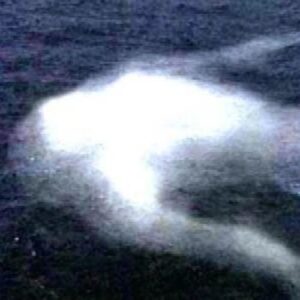
The Ningen is commonly described as a gigantic, white or greyish humanoid measuring approximately 20 to 30 metres in length. Its skin is reportedly smooth and pale, sometimes appearing almost translucent against the dark waters of the Antarctic region. These dimensions and characteristics originate from anecdotal accounts and artistic interpretations rather than verified observations.
Descriptions of its anatomy vary considerably. Some portrayals show a recognisably human head, two arms, and two legs, while others depict a featureless face or a body resembling a whale with human characteristics. Certain interpretations give the creature a mermaid-like tail or a streamlined lower body adapted to swimming. Its hands are occasionally illustrated with distinct fingers, reinforcing the contrast between its human appearance and immense proportions.
The earliest accounts associated with the legend described enormous, white, human-shaped objects emerging from the sea like whales. Subsequent online discussions and illustrations gradually established the appearance familiar today. This variation is characteristic of internet-born cryptids, whose visual identities develop through repeated retellings rather than a consistent tradition of eyewitness descriptions.
First Sighting/Reporting
The earliest documented online reference to the Ningen phenomenon appeared on 2channel, a Japanese internet textboard, on May 11, 2002. The post appeared in a discussion about giant fish and mysterious marine creatures. Its anonymous author relayed a rumour supposedly originating from someone connected with Japanese Antarctic research whaling operations.
According to the account, research crews had allegedly encountered enormous, white, human-shaped objects in Antarctic waters. The post described different forms, including figures with four limbs and a head and unusual shapes resembling two joined human upper bodies. These supposed creatures were said to surface like whales and measure several tens of metres in length. The author also suggested that the sightings were difficult to document and that official disclosure was unlikely.
The original post generated further discussion, leading users to establish dedicated threads where participants shared theories, compared the supposed creatures with known marine animals, and circulated speculative images. The discussions continued through several threads until late 2003.
The legend gained renewed attention in 2007 through Japanese paranormal media. Coverage connected the Ningen to an alleged white figure interpreted from Google Earth imagery and introduced additional speculation about its appearance and origins. Some later retellings also associated it with earlier Antarctic anomalies, although these connections do not establish that the creature existed before the internet legend developed.
Researchers Felicity Greenland and Philip Hayward examined this evolution in their 2020 academic article in Shima. Their analysis situates the Ningen within modern media-lore, demonstrating how an anonymous internet rumour developed into an internationally circulated cryptid narrative.
Other Names
The creature is primarily known as Ningen, derived from the Japanese word for a human being. Another expression appearing in early accounts is hitogata buttai, translated by Greenland and Hayward as “human-shaped objects.” This wording described the alleged entities in the original online rumour rather than establishing a separate traditional species or supernatural identity.
The Ningen is sometimes described as an Antarctic humanoid or an aquatic humanoid in contemporary cryptid discussions. These expressions are descriptive labels rather than recognised alternative names rooted in Japanese folklore. It is also occasionally compared with kaiju, the Japanese term commonly associated with giant monsters in modern popular culture. However, kaiju is a broad category, not another name for the Ningen. Similarly, traditional Japanese supernatural beings such as Amanojaku have no established connection to the creature.
These distinctions matter because the Ningen does not belong to a documented historical tradition of Japanese deities, spirits, or legendary species. Its identity developed through modern internet culture, where terminology and descriptions evolved as the story spread.
Modus Operandi
The Ningen has no established modus operandi in the conventional sense because its legend does not provide a consistent account of its behaviour, intentions, or interactions with humans. Unlike urban legends involving a recurring attacker or a supernatural figure with a defined pattern of activity, Ningen stories primarily focus on alleged sightings of an enormous humanoid in remote Antarctic waters.
In the original online account, the supposed entities emerged from the sea in a manner compared with whales. Their immense size, pale appearance, and brief visibility contributed to the impression that they were difficult to identify or document. Later interpretations frequently portray the Ningen as elusive, disappearing beneath the water or remaining indistinct against the surrounding ice and ocean.
However, claims that it deliberately avoids humans, possesses supernatural camouflage, controls storms, or predicts future events are not established features of the documented legend. Its supposed behaviour varies across retellings, and there is no reliable evidence confirming any encounter.
The narrative’s emphasis on remoteness and limited observation plays an important role in its continued appeal. Antarctica’s harsh environment and vast ocean expanses provide a compelling setting for stories about unidentified creatures. The Ningen’s alleged elusiveness consequently functions as a central element of the legend, rather than evidence of a demonstrated ability or intentional pattern of behaviour.
Pop Culture References
The Ningen’s development illustrates the relationship between internet folklore and contemporary popular culture. Unlike traditional Japanese legendary beings preserved through religious practices, regional storytelling, and literature, the Ningen acquired its identity through anonymous online discussions and subsequent media interpretations.
Japanese paranormal magazine Mu helped bring the creature to a wider audience in 2007 by discussing imagery interpreted as a possible human-shaped monster. Further coverage and a dedicated supplement in 2008 expanded the story, incorporating additional descriptions and speculative historical connections. These publications helped transform the Ningen from an obscure forum rumour into a recognisable subject within Japanese paranormal culture.
Online illustrations and manipulated images have also contributed to its visual identity. Artists have depicted the creature as a featureless white giant, a humanoid marine animal, or a whale-like figure with human characteristics. As these images circulated internationally, different interpretations became incorporated into the broader legend.
The Ningen has subsequently appeared in discussions about cryptozoology, internet horror, and unexplained marine phenomena. Its unusual appearance makes it suitable for creative reinterpretation, although individual claims about its appearances in particular films, manga, anime, or video games should be verified before being treated as established references.
The creature’s cultural significance lies primarily in its development as a collaborative internet legend. Its story demonstrates how online communities, paranormal publishing, and visual media can shape a modern cryptid without relying on an established body of traditional mythology.
Current Status
The Ningen remains an unverified cryptid associated with modern Japanese internet folklore. No credible scientific evidence has established the existence of a gigantic humanoid creature matching the descriptions circulated online. Alleged sightings and images remain anecdotal or unverified, and the original account does not provide independently corroborated evidence of an unknown species.
Its story is nevertheless significant as an example of contemporary legend-making. The Ningen emerged from an anonymous online rumour, acquired a recognisable appearance through digital illustrations, and spread through paranormal publications and international internet communities. Each stage added new interpretations while preserving the central image of an enormous, pale humanoid in Antarctic waters.
The distinction between cultural significance and zoological evidence is essential to understanding the creature. The Ningen is not an established figure in ancient Japanese mythology, nor is it a scientifically recognised marine animal. Its documented importance lies in the evolution of its story and the way digital communities create, circulate, and transform legends.
For cryptid enthusiasts, the Ningen continues to represent the mystery associated with remote oceans and the limits of human observation. For researchers of modern folklore, it offers a more tangible subject of study: a contemporary legend whose origins and development can be traced through online discussions and media coverage.



Source
Foster, M. D. (2009). Pandemonium and parade: Japanese monsters and the culture of Yōkai. University of California Press. https://www.ucpress.edu/books/pandemonium-and-parade/paper
Foster, M. D. (2015). The book of Yōkai: Mysterious creatures of Japanese folklore. University of California Press. https://www.ucpress.edu/books/the-book-of-yokai/paper
Sasama, Y. (2018). Zusetsu Nihon mikakunin seibutsu jiten [Illustrated encyclopedia of unidentified creatures in Japan]. Kadokawa. https://www.kadokawa.co.jp/product/321808000031/
Greenland, F., & Hayward, P. (2020). Ningen: The generation of media-lore concerning a giant, sub-Antarctic, aquatic humanoid and its relation to Japanese whaling activity. Shima, 14(1), 134–151. https://doi.org/10.21463/shima.14.1.10
Black Echo. (n.d.). Ningen: Japanese internet cryptid lore, 2channel origins, Antarctic whaling context and digital monster culture. https://www.projectblackecho.com/cryptids/entities-aquatic-and-lake-monsters/ningen
University of Technology Sydney. (2020). Ningen: The generation of media-lore concerning a giant, sub-Antarctic, aquatic humanoid and its relation to Japanese whaling activity. OPUS: Open Publications of UTS Scholars. https://opus.lib.uts.edu.au/handle/10453/144607
International Research Center for Japanese Studies. (n.d.). The database of folktales of mysterious phenomena and Yōkai (spirits, ghosts, and monsters). https://www.nichibun.ac.jp/en/db/category/yokai/
Frequently Asked Questions
What is Ningen in Japanese folklore?
Ningen is a mysterious humanoid creature from modern Japanese internet folklore, reportedly seen in Antarctic waters. It is considered an urban legend and cryptid rather than a verified species.
What does Ningen look like?
Ningen is described as a gigantic, pale humanoid with smooth white or grey skin, human-like limbs and sometimes a featureless face. Accounts vary, and no physical evidence confirms its existence.
Where did the Ningen legend originate?
The Ningen legend emerged from Japanese internet discussions in the early 2000s. Stories describing a mysterious humanoid in Antarctic waters later spread through online forums and paranormal media.
Is Ningen a yōkai or an urban legend?
Ningen is primarily classified as a modern Japanese urban legend and cryptid. Although it may be discussed within broader yōkai studies, its origins in traditional Japanese folklore have not been established.
Is the Ningen creature real?
There is no credible scientific evidence confirming Ningen’s existence. Its reported appearances remain unverified, making it a modern cryptid associated with internet folklore and speculation about Antarctica.


