


Te Ngārara Huarau : The Fearsome Reptilian Being of Māori Lore
At a glance
| Description | |
|---|---|
| Origin | Maori Mythology |
| Classification | Animals |
| Family Members | Pari-kawhiti (Sister) |
| Region | New Zealand |
| Associated With | Reptiles, Strength, Devouring animals and people |
The Mythlok Perspective
In Mythlok’s Perspective, Te Ngārara Huarau represents the uneasy relationship between human communities and forces they cannot easily control. Like the Greek Hydra, whose many heads made it a formidable adversary, this Māori reptilian being embodies a threat that demands more than individual strength to overcome. However, unlike the Hydra, whose defining feature is regeneration, Te Ngārara Huarau is closely connected to the New Zealand landscape and traditions explaining the origins of reptiles.
Te Ngārara Huarau
Introduction
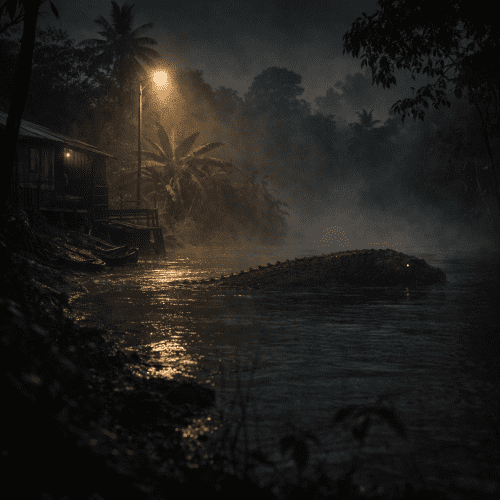
Te Ngārara Huarau is a giant reptilian being in Māori mythology, remembered in traditions that connect supernatural creatures, the natural world, and the landscapes of Aotearoa New Zealand. Often classified as a taniwha, he appears in accounts describing a formidable creature whose movements brought destruction and whose encounters with people ended in attempts to defeat him.
The name is also written as Ngārara Huarau or Ngārara-huarau. The figure is particularly associated with Hawke’s Bay and Wairarapa, where traditions describe his journey across the land and his encounters with local communities.
One well-documented account begins at Waimārama in Hawke’s Bay, where Ngārara Huarau lives in a cave. When he leaves, his scales remain behind and become tuatara. He subsequently travels towards Wairarapa, where his appetite for animals and people brings him into conflict with the inhabitants. Eventually, the people of Ngāti Tara seek the help of the warrior Tūpurupuru to stop him. The creature is trapped and sinks into the Uwhiroa swamp, although the story leaves open the question of whether he truly dies.
Not every version follows this narrative. Other traditions describe Ngārara Huarau being burned alive, with his scales or tail escaping the flames and becoming lizards. These variations reflect the diversity of Māori oral traditions, which preserve different accounts connected to particular communities and places.
Physical Traits
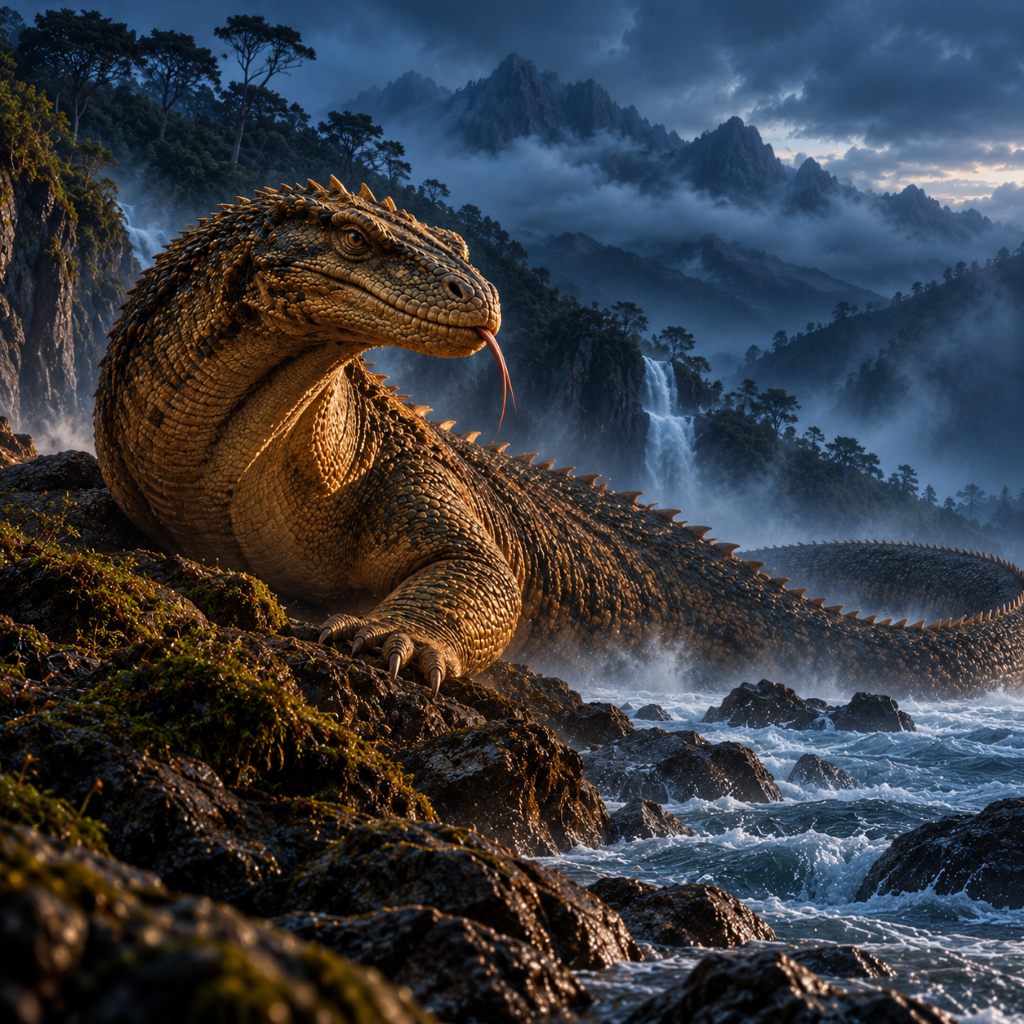
Te Ngārara Huarau is primarily described as an enormous reptile, resembling a gigantic lizard or tuatara. His physical identity places him among the ngārara, a term used in Māori for reptiles, including lizards, tuatara, and the giant reptilian beings found in traditional narratives. His immense size distinguishes him from ordinary animals. In the Wairarapa tradition, he is powerful enough to pursue his prey through the landscape, creating a threat that requires an organised response from the local population. His scales are particularly significant because their transformation into tuatara connects his body with the natural world.
Another tradition associates Ngārara Huarau with a fire that destroys his enormous body but fails to prevent his scales and tail from escaping. These remnants subsequently become lizards, making his death part of an explanation for the existence of reptiles.
Descriptions of his appearance are not entirely consistent across the surviving records. Some accounts emphasise a giant lizard-like creature, while other representations give him more unusual characteristics. It is therefore more accurate to identify his defining feature as his enormous reptilian form rather than assign him a single appearance shared by every tradition. His connection with caves, swamps, and the physical landscape also reinforces his identity as a creature belonging to a world where the boundaries between the supernatural and the natural are not always sharply separated.
Family
The most clearly documented family relationship of Te Ngārara Huarau is his connection to Pari-kawhiti, his sister. According to the account popularised in Maxine Hemi’s graphic novel, Ngārara Huarau travels from Hawke’s Bay to Wairarapa in search of her. His journey becomes a significant part of the narrative because it brings him into contact with communities living along his route. As he travels, his enormous body shapes the landscape, while his hunger for birds, seals, seafood, and people causes fear among those he encounters. His arrival in Wairarapa ultimately leads to the confrontation with Tūpurupuru and the warriors who attempt to defeat him.
A broader genealogical tradition connects ngārara with Punga, the son of Tangaroa, who is associated with the sea. Punga’s descendants include reptiles and other creatures, establishing a place for these animals within Māori understandings of the natural world. However, this wider genealogy should not automatically be treated as a complete family tree for Ngārara Huarau himself. The available accounts do not consistently establish his parents, spouse, or children. His relationship with Pari-kawhiti remains the most direct and recognisable family connection in the principal published narrative.
Other names
Te Ngārara Huarau appears under several spelling variations, including Ngārara Huarau, Ngārara-huarau, and Te Ngārara-huarau. These forms refer to the same figure in the relevant published accounts. He is also described as a taniwha or ngārara. These terms explain the kind of being he represents rather than functioning as separate personal names.
In Māori traditions, taniwha are powerful supernatural beings whose forms, behaviour, and relationships with people vary considerably between tribal narratives. Some are dangerous, while others are respected as guardians associated with particular waterways, caves, or territories. Many are described as enormous reptiles or serpentine creatures. The term ngārara has a more direct association with reptiles. It encompasses familiar animals such as skinks, geckos, and tuatara, as well as the giant reptilian creatures described in Māori traditions.
A separate recorded account identifies Mokonui as a name associated with the creature. However, the surviving references do not establish that this name is used universally across all traditions concerning Ngārara Huarau. The different names and descriptions demonstrate why regional context matters when studying Māori traditional narratives. Rather than assuming that every account presents an identical character, it is more useful to understand how different communities have preserved and interpreted his story.
Powers and Abilities
The principal abilities attributed to Te Ngārara Huarau arise from his extraordinary size, formidable physical strength, and capacity to threaten both people and animals. His enormous appetite is central to the Wairarapa narrative. As he travels south, he consumes wildlife, marine animals, and human travellers. His behaviour transforms his journey into a serious danger for the communities living along his route.
His movement is also associated with changes to the landscape. In the account published by Huia Publishers, his passage from Hawke’s Bay towards Wairarapa shapes the terrain through which he travels. This feature presents him as more than a giant predator: his physical presence becomes part of the story’s explanation of the surrounding environment.
Another important characteristic is his connection with the origins of reptiles. In one tradition, the scales left behind when he abandons his cave become tuatara. In another, fire destroys his body, but his scales and tail escape and become lizards. These episodes connect his extraordinary nature with the existence of familiar animals.
Despite his immense power, Ngārara Huarau is not invulnerable. In the Wairarapa account, the people devise a trap using trees that have been cut almost through. They provoke the creature into pursuing a dog, leading him towards the weakened trees. When the trees fall, they crush him. His defeat demonstrates that physical strength alone does not guarantee victory. Planning, cooperation, and knowledge of the environment allow the community to confront a threat that individuals could not easily overcome.
Modern Day Influence
Te Ngārara Huarau continues to appear in Māori cultural publishing, educational resources, and representations of Aotearoa’s traditional heritage. One important modern retelling is Maxine Hemi’s graphic novel Ngārara Huarau, illustrated by Andrew Burdan and published in 2016 by Huia Publishers in association with Ngāti Kahungunu ki Wairarapa Trust. Available in both English and Māori editions, the book presents the creature’s journey from Hawke’s Bay to Wairarapa and the efforts to stop him. Its ending retains an element of uncertainty by asking whether the taniwha truly died after sinking into the Uwhiroa swamp.
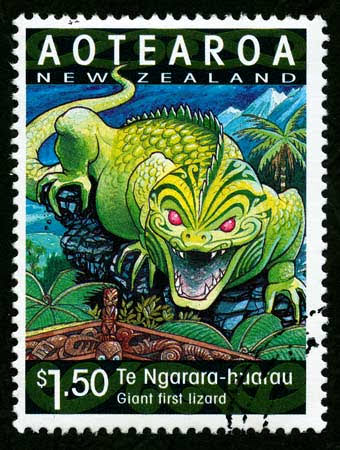
The story also reached a wider public through New Zealand’s 2000 Spirits and Guardians postage-stamp series. The stamp depicted Ngārara Huarau as a giant lizard and reflected traditions connecting his remains with the origins of other reptiles. This placed the figure within a broader collection celebrating supernatural beings from New Zealand’s cultural traditions.
Reference works such as Te Ara: The Encyclopedia of New Zealand preserve accounts of Ngārara Huarau alongside discussions of taniwha and the traditional significance of reptiles. These resources help readers understand the relationship between individual stories, Māori knowledge, and the natural environment. His continued presence in books and educational material also provides opportunities to introduce younger readers to Māori traditional narratives. The story combines adventure with questions about community, environmental knowledge, and the consequences of uncontrolled power.
Ultimately, Te Ngārara Huarau is more than a frightening giant reptile. His story connects family, landscape, danger, and the origins of living creatures within a traditional narrative that has been preserved through different accounts. Understanding those differences is essential to appreciating his place in Māori mythology and the continuing cultural life of these stories.
Related Images

Source
Haami, B. (2009, March 1). Ngārara – reptiles. Te Ara—the Encyclopedia of New Zealand. https://teara.govt.nz/en/ngarara-reptiles
Hemi, M. (2016). Ngārara Huarau (A. Burdan, Illus.). Huia Publishers. https://huia.co.nz/products/ngarara-huarau-maori
Keane, B. (2012, September 22). Taniwha: Page 4 – Ngārara Huarau. Te Ara—the Encyclopedia of New Zealand. https://teara.govt.nz/en/taniwha/page-4
Macdonald, R. R. (1893). Te patunga o Ngarara-Huorau. Journal of the Polynesian Society, 2, 211–219. https://www.jps.auckland.ac.nz/document/?wid=419
Ministry for Culture and Heritage. (2022, May 15). Ngārarahuarau. Kauwhata Reo. https://kauwhatareo.govt.nz/en/resource/ngararahuarau/
National Library of New Zealand. (n.d.). Ngārara Huarau / story told by Maxine Hemi; illustrated by Andrew Burdan. https://natlib.govt.nz/records/37151637
Te Aka Māori Dictionary. (n.d.). Unahi. https://maoridictionary.co.nz/word/8889
Wohlers, J. F. H. (1875). The mythology and traditions of the Maori in New Zealand. Transactions and Proceedings of the Royal Society of New Zealand, 8, 108–123. https://paperspast.natlib.govt.nz/periodicals/TPRSNZ1875-8.2.4.1.8
Frequently Asked Questions
Who is Te Ngārara Huarau in Māori mythology?
Te Ngārara Huarau is a giant reptilian taniwha in Māori tradition, associated with Hawke’s Bay, Wairarapa, and stories about dangerous encounters between supernatural beings and people.
What does Te Ngārara Huarau look like?
Te Ngārara Huarau is generally described as an enormous lizard-like reptile with a powerful body and scales. His exact appearance varies between Māori traditional accounts.
Who is Te Ngārara Huarau's sister?
His sister is Pari-kawhiti, also written Pari-ka-whiti. In a well-known account, Te Ngārara Huarau travels from Hawke’s Bay to Wairarapa in search of her.
How was Te Ngārara Huarau defeated?
In one tradition, the people of Wairarapa use a trap involving weakened trees to crush him. Another account describes him being burned alive, reflecting regional variations in the story.
What is Te Ngārara Huarau known for?
Te Ngārara Huarau is known for his enormous size, destructive appetite, journey across the landscape, and connection with traditions explaining the origins of tuatara and lizards.


