


Tau : The Guaraní Spirit Who Fathered Seven Monsters
At a glance
| Description | |
|---|---|
| Origin | Guarani Mythology |
| Classification | Spirits |
| Family Members | Kerana (Wife) Teju Jagua, Mbói Tu’ĩ, Moñái, Jasy Jatere, Kurupi, Ao Ao and Luison (Children) |
| Region | Paraguay |
| Associated With | Evil, Malevolence, Deception, Shapeshifting |
The Mythlok Perspective
In Mythlok’s Perspective, Tau is fascinating because he is less interesting as a simple embodiment of evil than as a figure whose actions generate an entire mythology of danger. Compared with Angatupyry, who represents goodness through direct opposition, Tau operates through deception, making his shapeshifting far more meaningful than a conventional display of supernatural power. Compared with the Seven Legendary Monsters he fathers, however, Tau almost becomes secondary; his children have inherited the cultural imagination more completely than their father. That makes Tau a particularly interesting example of how a mythological villain can become important not because of what he rules, but because of the mythology his actions set into motion.
Tau
Introduction
Tau, also written as Taú, is an evil spirit and personification of malevolence in the Paraguayan Guaraní mythological tradition. He is best known through the story of Tau and Kerana, a narrative that ultimately explains the origins of the seven legendary beings who became some of the most recognizable figures in Paraguayan folklore. Tau is therefore important not simply because he represents evil, but because his actions establish a supernatural lineage that continues to shape how Guaraní-inspired mythology is understood in Paraguay.
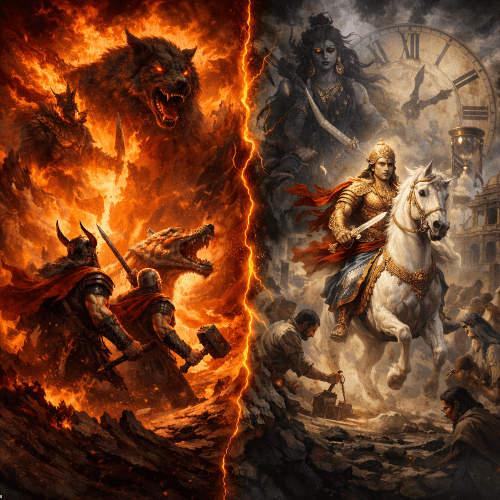
In the best-known account, Tau is associated with Tupã and exists as the counterpart of Angatupyry, the spirit of goodness. Tau becomes fascinated by Kerana, the daughter of Marangatu, and disguises himself as an attractive young man to approach her. After a confrontation with Angatupyry, Tau eventually succeeds in taking Kerana, and their relationship produces seven children who become monstrous or supernatural beings.
This story is especially important because much of the familiar written version comes through Narciso R. Colmán’s Ñande Ypykuéra, a Guaraní-language ethnogenetic and mythological poem first presented in 1922 and published in book form in 1929. Modern scholarship cautions that Colmán’s work brought together oral traditions with his own literary reconstruction, so the story should not automatically be treated as a complete representation of every Guaraní tradition.
Physical Traits
Tau does not possess one universally consistent physical appearance. His defining characteristic is actually his ability to change appearance. In the most widely circulated account, he transforms himself into a handsome young man in order to approach Kerana. His attractive human appearance is therefore a disguise rather than his permanent form.
This distinction matters because later illustrations and popular retellings sometimes portray Tau as a horned demon, monstrous humanoid, or heavily supernatural creature. Such imagery can make him resemble the Christian Devil, but that comparison should be treated as a later interpretive layer rather than as a definitive feature of the Guaraní figure. Sources describing the Paraguayan tradition identify him primarily as an evil or malevolent spirit.
Tau’s lack of a fixed physical form also reinforces his narrative function. He does not need to appear monstrous to represent danger. His ability to appear attractive allows him to conceal his intentions, making deception and transformation more significant to his identity than claws, horns, or other conventional monster characteristics.
The seven children associated with Tau and Kerana have far more distinctive physical forms. Their descriptions include serpent-like, reptilian, canine and humanoid characteristics, and their appearances became particularly influential in later Paraguayan representations of the Seven Legendary Monsters.
Family
Tau’s most important relationship is with Kerana, the daughter of Marangatu. In the traditional Paraguayan account, Kerana is associated with sleep, and Tau becomes captivated by her. He approaches her in human form before attempting to take her. Angatupyry, representing goodness, intervenes, leading to a prolonged supernatural conflict between the two opposing spirits.
Tau and Kerana are traditionally identified as the parents of seven legendary children: Teju Jagua, Mbói Tu’ĩ, Moñái, Jasy Jatere, Kurupi, Ao Ao and Luisõ. In Colmán’s literary tradition, these seven become malevolent or dangerous supernatural figures with distinct identities. A scholarly study specifically identifies them as the seven sons associated with Tau and Kerana in Ñande Ypykuéra.
Teju Jagua is associated with caves and fruits; Mbói Tu’ĩ with waterways and aquatic creatures; Moñái with open fields; Jasy Jatere with the siesta and, in some accounts, yerba mate; Kurupi with sexuality and fertility; Ao Ao with hills and mountains; and Luisõ with death.
These children are often described collectively as the Seven Legendary Monsters. Their importance arguably exceeds Tau’s own because each developed an individual mythology that survives independently in Paraguayan folklore.
Other names
Tau is the principal name of the figure, while Taú represents a spelling used in some Spanish-language and Guaraní-related sources. He is also commonly described through titles such as “evil spirit,” “spirit of evil,” or “malevolent spirit.” These expressions describe his nature rather than functioning as separate personal names.
Tau should not simply be translated as the Guaraní equivalent of the Devil. Although colonial and later popular interpretations sometimes placed him in a demonological framework, the comparison can obscure the cultural setting in which Tau operates. His role is specifically connected to a Paraguayan Guaraní mythological narrative involving Angatupyry, Kerana and the Seven Legendary Monsters.
The name also appears in discussions of the broader Tupí-Guaraní cultural sphere, but closely related Indigenous traditions should not automatically be treated as identical. For an accurate Mythlok presentation, Tau is best identified as a figure of the Paraguayan Guaraní tradition, particularly the literary and folkloric tradition associated with Colmán.
Powers and Abilities
Tau’s most clearly established supernatural ability is shapeshifting. His transformation into a handsome young man allows him to approach Kerana without immediately revealing his supernatural identity. This makes deception one of the defining powers associated with him.
He is also portrayed as possessing considerable supernatural strength. His confrontation with Angatupyry lasts seven days and seven nights in the commonly circulated narrative. The outcome varies between retellings, with sources differing over precisely how Tau is defeated or ultimately succeeds in taking Kerana.
Tau’s most important mythological influence, however, comes through his role as the father of the Seven Legendary Monsters. It would be misleading to attribute all the individual powers of these seven beings directly to Tau. Instead, his importance lies in creating the lineage through which these distinct supernatural forces enter the mythology.
Tau is therefore better understood as an embodiment of malevolence, deception and disruption than as a god of a particular natural domain. Unlike a deity whose authority is tied to thunder, rain, fertility or a specific landscape, Tau functions primarily through opposition and transgression.
Modern Day Influence
Tau remains one of the most recognizable figures in Paraguayan mythology, largely because of his connection with the Seven Legendary Monsters. The stories of Teju Jagua, Mbói Tu’ĩ, Moñái, Jasy Jatere, Kurupi, Ao Ao and Luisõ continue to appear in Paraguayan folklore, literature, visual art and cultural interpretation.
His modern reputation is closely connected to Ñande Ypykuéra. Colmán’s work played a major role in bringing together and popularizing a body of Guaraní-related mythological material in written form. The work was presented at the 1922 International Congress of Americanists in Rio de Janeiro, while the major Paraguayan publication appeared in 1929 and a Spanish version followed later.
This literary history is important when discussing Tau today. His story is not simply a preserved snapshot of an ancient, unchanging Guaraní religion. It is part of a living tradition shaped by oral transmission, Indigenous memory, Paraguayan folklore and twentieth-century literary reconstruction. Scholarship specifically notes that Colmán’s version incorporated both traditions he had heard and elements of his own creation.
Tau’s continuing appeal comes from the unusual way his story connects personal deception with a much larger supernatural genealogy. He begins as a malevolent spirit seeking Kerana, but the consequences of his actions extend far beyond the two characters. Through their seven children, Tau becomes indirectly connected to caves, waterways, fields, forests, sexuality, mountains, sleep and death.
Related Images

Source
Cadogan, L. (1959). Ayvu rapyta: Textos míticos de los Mbyá-Guaraní del Guairá. Universidad de São Paulo.
Colmán, N. R. (2009). Ñande Ĭpĭ Cuéra: Nuestros antepasados: Poema etnogenético y mitológico seguido de un estudio etimológico de los mitos, nombres y voces empleados. Editorial El Lector. (Original work published 1922)
Díaz Valiente, L. (2024). Disrupting colonial education with the Indigenous Praxis Model. Cultural and Pedagogical Inquiry, 16(1), 27–36. https://journals.library.ualberta.ca/cpi/index.php/cpi/article/view/29770
Lustig, W. (2006). Tau ha Kerana. Johannes Gutenberg University Mainz. https://www.staff.uni-mainz.de/lustig/guarani/tau_ha_kerana.htm
Métraux, A. (1946). Myths of the Tupi-Guarani. In J. H. Steward (Ed.), Handbook of South American Indians: Vol. 3. The tropical forest tribes (pp. 3–204). Smithsonian Institution.
Portal Guaraní. (2009). Tau y Kerana: Escultura del Museo Mitológico Ramón Elías. https://portalguarani.com/detalles_museos_otras_obras.php?PqwoiflUYTeslk=MjQwMA==
Wikipedia contributors. (n.d.). Guarani mythology. In Wikipedia. Retrieved August 11, 2026, from https://en.wikipedia.org/wiki/Guarani_mythology
Wikipedia contributors. (n.d.). Tau (mythology). In Wikipedia. Retrieved August 11, 2026, from https://en.wikipedia.org/wiki/Tau_(mythology)
Frequently Asked Questions
Who is Tau in Guaraní mythology?
Tau is an evil or malevolent spirit in the Paraguayan Guaraní mythological tradition. He is best known for his relationship with Kerana and for being associated with the Seven Legendary Monsters.
Is Tau the Devil in Guaraní mythology?
Who are the children of Tau and Kerana?
The seven children traditionally associated with Tau and Kerana are Teju Jagua, Mbói Tu’ĩ, Moñái, Jasy Jatere, Kurupi, Ao Ao and Luisõ. They are collectively known as the Seven Legendary Monsters.
What powers does Tau have?
Tau is principally associated with shapeshifting and supernatural strength. His ability to appear as a handsome young man is central to his story with Kerana, while his prolonged battle with Angatupyry demonstrates his supernatural power.
Where does the story of Tau come from?
The best-known written version of the Tau and Kerana story is associated with Narciso R. Colmán’s Ñande Ypykuéra, a Guaraní-language ethnogenetic and mythological work presented in 1922 and published in book form in 1929. Scholars note that Colmán combined oral traditions with literary reconstruction, so his account should not be treated as a complete record of all Guaraní traditions.


