

Ao Ao : The Relentless Man Eating Beast of Guarani Folklore
At a glance
| Description | |
|---|---|
| Origin | Guarani Mythology |
| Classification | Hybrids |
| Family Members | Tau (Father), Kerana (Mother), Teju Jagua, Mbói Tu’i, Moñái, Jasy Jatere, Kurupi, Luison (Siblings) |
| Region | Paraguay |
| Associated With | Relentless pursuit, Mountains, Wilderness, Hunting, Strength |
The Mythlok Perspective
In Mythlok’s Perspective, Ao Ao is much more than a fearsome predator from Guarani mythology—it is the embodiment of nature’s unforgiving laws. Unlike monsters such as the Greek Minotaur, which guard a single place, or the Norse Fenrir, which represents cosmic destruction, Ao Ao patrols the wilderness itself, reminding people that forests and mountains are not realms meant to be conquered without respect. Its legend reflects an indigenous worldview in which the natural world is alive, powerful, and capable of punishing human arrogance. Rather than existing solely to terrify, Ao Ao serves as a timeless warning that survival depends as much on wisdom and humility as it does on strength.
Ao Ao
Introduction
Ao Ao is one of the most feared creatures in Guarani mythology, where it is remembered as a relentless predator that roams the hills and forests of Paraguay, northern Argentina, southern Brazil, and parts of Bolivia. Unlike many mythical monsters that exist simply to frighten, Ao Ao represents the dangers hidden within the wilderness and the consequences of ignoring nature’s boundaries.
The creature is best known as one of the seven monstrous children of Tau and Kerana, whose cursed offspring became some of the most recognizable beings in Guarani folklore. While modern retellings often describe Ao Ao as little more than a man-eating beast, traditional stories present a more complex figure. It is the guardian of rugged landscapes, a supernatural hunter that punishes those who wander recklessly into its domain.
The name “Ao Ao” is believed to imitate the terrifying cry the creature makes while chasing its victims. According to legend, hearing that repeated howl echo across the mountains meant escape was already becoming unlikely.
Physical Traits
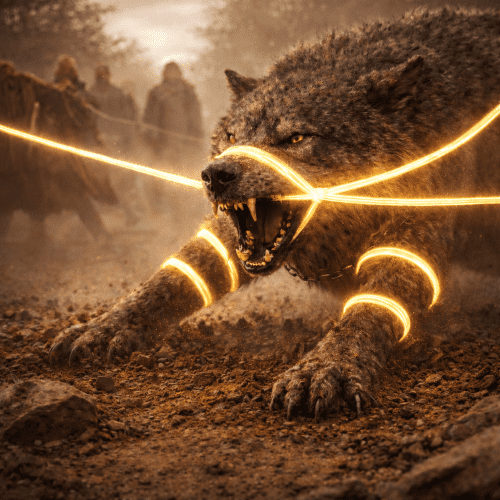
Ao Ao’s appearance varies slightly across different Guarani oral traditions, but its frightening nature remains consistent. Most accounts describe it as a muscular quadruped covered in thick wool or coarse fur, giving it the appearance of an oversized sheep. This harmless resemblance quickly disappears when its enormous fangs, powerful jaws, and razor-sharp claws come into view.
Some regional versions portray Ao Ao as resembling a giant peccary or wild boar rather than a sheep. Others describe it with a bear-like head attached to a stocky body built for speed and endurance. Despite these differences, every version emphasizes its immense physical strength and its ability to move effortlessly across steep hills, rocky terrain, and dense forests. The creature’s terrifying howl is perhaps its most distinctive feature. The repeated cry of “Ao… Ao…” echoes through the mountains, warning anyone nearby that the hunter has begun its pursuit.
Family
Ao Ao belongs to one of the most famous families in Guarani mythology. It is traditionally identified as the sixth of the seven cursed children born to Tau, the spirit of evil, and Kerana, the beautiful daughter of the human leader Marangatú. According to the legend, Tau abducted Kerana after a lengthy pursuit. Their union angered the goddess Arasy (also spelled Araci in some traditions), who cursed each of their children to become monstrous beings. Every sibling came to embody a different danger, fear, or aspect of the natural world.
Ao Ao’s brothers include Teju Jagua, Mbói Tu’i, Moñái, Jasy Jatere, Kurupi, and Luison, all of whom remain central figures in Guarani folklore. Together, they form one of South America’s best-known mythological lineages. Some local traditions also claim that Ao Ao produced numerous offspring that inherited its ferocity and continued guarding the hills, although this belief is not found consistently across every version of the mythology.
Other names
The creature is most commonly known simply as Ao Ao, although spellings such as Aó-Aó, Ao-Ao, and occasionally Aho Aho appear in Spanish and Portuguese sources. Unlike many mythological beings whose names describe their appearance or powers, Ao Ao’s name is believed to be onomatopoeic. It imitates the terrifying cry that echoes through the hills while the creature hunts. It should not be confused with the Guarani cosmological figure named Ao, which represents clouds or the sky in certain creation traditions. Although the names are similar, they refer to entirely different beings.
Powers and Abilities
Ao Ao’s greatest strength is its relentless determination. Legends consistently describe it as a hunter that never abandons its prey. Once it begins the chase, it follows relentlessly across forests, mountains, rivers, and rocky landscapes until its victim is caught.
Its immense physical strength allows it to tear through vegetation and uproot many trees where frightened travellers attempt to hide. The creature’s claws are powerful enough to dig through roots and loose soil, while its fangs are capable of killing large animals—or humans—with ease.
One of the best-known aspects of the legend is the creature’s unusual weakness. Although Ao Ao can topple most trees, it cannot bring down the pindó palm (Syagrus romanzoffiana). The palm’s deep root system and smooth trunk prevent the monster from uprooting or climbing it. For this reason, Guarani folklore says that anyone who reaches the top of a pindó palm can escape the beast.
Some older traditions also associate Ao Ao with extraordinary fertility because of its ability to produce many offspring. However, this interpretation appears less frequently than its role as a supernatural predator and is not considered one of its primary characteristics.
Modern Day Influence
Ao Ao remains one of the best-known creatures in Guarani folklore and continues to occupy an important place in Paraguayan cultural identity. Its story is preserved through oral traditions, folklore collections, museum exhibits, literature, children’s books, and educational programmes that celebrate indigenous heritage.
Parents have long used the legend to discourage children from wandering alone into forests or hills, giving Ao Ao a role similar to that of the bogeyman found in many other cultures. Rather than serving only as a frightening monster, it reinforces lessons about respecting nature and recognising that the wilderness demands caution.
Artists and writers frequently include Ao Ao alongside the other six children of Tau and Kerana, helping introduce new generations to Guarani mythology. Today, the creature also appears in digital media, tabletop games, and modern fantasy inspired by South American folklore, ensuring that its legend continues to evolve while remaining rooted in its indigenous origins.
Related Images




Source
Colman, N. R. (1929). Ñande Ypy Kuéra (“Nuestros antepasados”). Asunción, Paraguay.
González Torres, D. M. (1995). Folclore del Paraguay. Asunción, Paraguay.
Micó, T. L. (1997). Leyendas del Paraguay: Mitología guaraní. Imprenta Salesiana.
Melià, B. (1991). El Guaraní: Experiencia religiosa y mística. CEADUC.
Portal Guarani. (n.d.). AO – AO – Escultura popular paraguaya – Obra de José Escobar. Retrieved August 3, 2026, from
https://www.portalguarani.com/1036_jose_escobar/1885_ao__ao__escultura_popular_paraguaya__obra_de_jose_escobar.html
Taú y Keraná. (n.d.). Wikipedia, la enciclopedia libre. Retrieved August 3, 2026, from
https://es.wikipedia.org/wiki/Ta%C3%BA_y_Keran%C3%A1
Ao Ao. (n.d.). Wikipedia. Retrieved August 3, 2026, from
https://en.wikipedia.org/wiki/Ao_Ao
Guarani mythology. (n.d.). Wikipedia. Retrieved August 3, 2026, from
https://en.wikipedia.org/wiki/Guarani_mythology
Frequently Asked Questions
Who is Ao Ao in Guarani mythology?
Ao Ao is a legendary beast from Guarani mythology known as one of the seven cursed children of Tau and Kerana. It is famous for relentlessly hunting humans through forests and mountains.
What does Ao Ao look like?
Ao Ao is usually described as a large sheep-like creature with massive fangs and sharp claws, although some traditions portray it as a giant carnivorous peccary or boar.
How can someone escape Ao Ao?
According to Guarani folklore, the safest way to escape Ao Ao is by climbing a pindó palm, as the creature cannot uproot or climb this particular tree.
Is Ao Ao considered a god?
What does Ao Ao symbolize?
Ao Ao symbolizes the dangers of the untamed wilderness, respect for nature, and the consequences of venturing carelessly into places governed by powerful supernatural forces.
