


Marangatu : The Guarani Ancestor of Seven Legendary Monsters
At a glance
| Description | |
|---|---|
| Origin | Guarani Mythology |
| Classification | Mortals |
| Family Members | Rupave (Father), Sypave (Mother),Tumê Arandu, Japeusa (Siblings), Kerana (Daughter), Teju Jagua, Mbói Tu’ĩ, Moñái, Jasy Jatere, Kurupí, Ao Ao and Luison (Grandchildren) |
| Region | Paraguay |
| Associated With | Generosity, Benevolence, Virtue, Leadership, Human ancestry |
The Mythlok Perspective
In Mythlok’s Perspective, Marangatu stands apart from many mythological ancestors because his significance comes not from supernatural power, but from generosity and leadership. Where figures such as Tau represent destructive influence and the seven monsters embody the darker consequences of his family’s story, Marangatu represents the human ideal of benevolence. His contrast with his own descendants makes him a particularly compelling figure in Guarani tradition.
Marangatu
Introduction
Marangatu is a benevolent ancestral figure in the Guarani mythological tradition, best known as the second son of Rupavẽ and Sypavẽ, the primordial human couple. He occupies an important place in the genealogical stories associated with Paraguayan Guarani folklore, particularly because he is identified as the father of Kerana. Through Kerana, Marangatu becomes part of the ancestry of the seven legendary monsters who occupy a prominent place in later Guarani legends.
Marangatu is traditionally characterized by generosity, virtue and benevolent leadership. His identity is therefore quite different from the supernatural creatures that emerge later in his family line. He is not remembered primarily as a warrior, magician or nature spirit, but as an exemplary human ancestor whose character is expressed through the way he leads and cares for his people.
There is also an important linguistic dimension to his name. In Guarani, marangatu carries meanings associated with goodness, virtue, honour, holiness and moral righteousness. Historical and modern Guarani dictionaries preserve several of these meanings.
A factual distinction is useful here: the Marangatu genealogy most frequently presented online comes particularly from Paraguayan folkloric traditions and the writings associated with Narciso Ramón Colmán. Guarani peoples have diverse traditions, so this account should not be treated as a universal description of every Guarani community’s beliefs.
Physical Traits
Traditional accounts provide very little information about Marangatu’s physical appearance. The sources describing his place in the ancestral genealogy focus on his character, family relationships and leadership rather than recording details such as height, clothing, hairstyle, body markings or distinctive physical features. Colmán’s account identifies him principally through his moral character, calling him virtuous and benevolent.
This makes Marangatu unusual when compared with many of the better-known beings in Guarani folklore. His descendants include figures whose identities are defined by striking animalistic or supernatural characteristics, while Marangatu remains firmly associated with the human ancestral generation.
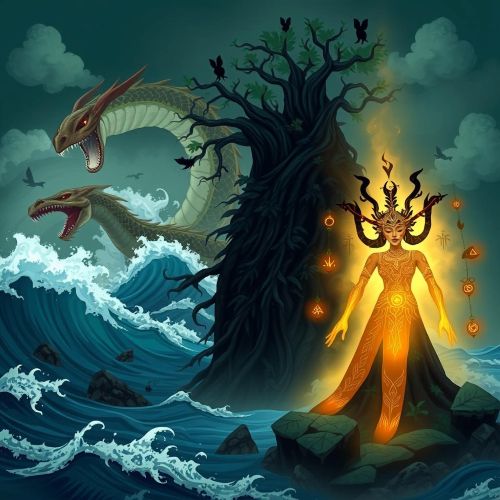
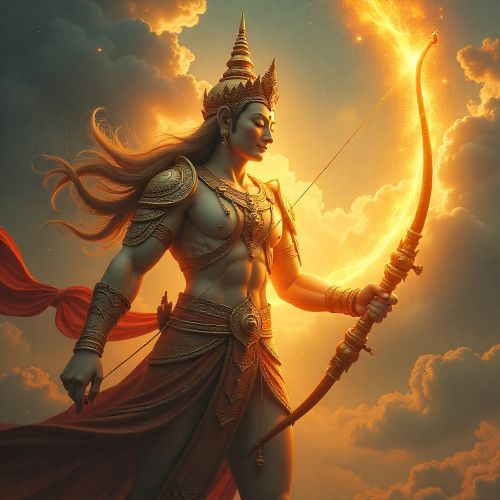
For this reason, a historically responsible depiction of Marangatu should avoid giving him invented supernatural features. He can be represented as a dignified Guarani ancestral leader, but details such as elaborate ceremonial costumes, weapons or magical attributes should be treated as artistic interpretation rather than documented mythology. His physical presence is ultimately less important to the tradition than what he represents. Marangatu embodies an ideal of human leadership in which generosity and moral conduct establish authority.
Family
Marangatu belongs to the first human generation in the Paraguayan Guarani creation and ancestral tradition. Rupavẽ and Sypavẽ are described as the primordial human couple, and their sons include Tumê Arandu, Marangatu and Japeusa. Tumê Arandu is remembered as a great prophet and wise figure, while Japeusa becomes associated with deception and eventually with the crab. Marangatu occupies the middle position in this family and is distinguished by his benevolent character.
His most significant relationship is with his daughter Kerana. Traditional Paraguayan accounts describe Kerana as exceptionally beautiful, and her encounter with Tau, the spirit or personification of evil, becomes the turning point in the family genealogy. Tau takes human form in some versions and becomes involved with Kerana, resulting in the birth of seven monstrous children.
These seven figures are generally identified as Teju Jagua, Mbói Tu’ĩ, Moñái, Jasy Jatere, Kurupí, Ao Ao and Luisõ. Through Kerana, therefore, Marangatu becomes their grandfather. This connection gives an otherwise relatively quiet ancestral figure a major place in the larger cycle of Guarani legendary beings.
Other names
Marangatu is primarily known by the name Marangatu, although the spelling Marangatú appears in some Spanish-language sources. The variation reflects different orthographic conventions rather than necessarily indicating a separate character.
The meaning of the name is particularly significant. Guarani lexical sources associate marangatu with concepts including “holy,” “virtuous,” “good,” “just,” “noble” and “sacred.” An older Guarani lexicographical tradition recorded meanings connected with virtue, goodness, honour and moral character.
This meaning closely corresponds to the way Marangatu is characterized in the mythology. In Colmán’s genealogy, the name is explicitly associated with a virtuous and benevolent individual.
It is important, however, not to confuse the personal name Marangatu with every modern use of the word. Marangatu is also an ordinary Guarani term carrying ethical and religious meanings. Consequently, references to something as marangatu do not automatically refer to the mythological ancestor.
Powers and Abilities
Marangatu is not traditionally associated with a defined set of supernatural powers. There is no reliable basis for describing him as a god of a particular natural element, wielder of a magical weapon or supernatural warrior. His principal attributes are generosity, benevolence and leadership. These qualities are effectively his defining powers within the story. He represents the strength that comes from moral authority rather than physical force or supernatural intervention.
This distinction matters because modern mythology websites sometimes expand the abilities of characters to fit familiar fantasy categories. There is little evidence for doing that with Marangatu. His significance comes from his position as an exemplary ancestor and leader. His greatest mythological importance is genealogical. As Kerana’s father, he links the primordial human family with Tau and the seven legendary monsters. The contrast is striking: the benevolent Marangatu stands at the beginning of a family line that later produces some of the most frightening beings in Paraguayan folklore.
The meaning of marangatu reinforces this characterization. Since the word is associated with virtue, goodness and holiness, the figure’s name and personality work together to present an ideal of moral conduct.
Modern Day Influence
Marangatu remains part of the modern presentation of Guarani mythology, particularly in Paraguay, where the stories of Rupavẽ, Sypavẽ, Kerana, Tau and the seven legendary monsters continue to appear in cultural, educational and folkloric material. Contemporary accounts continue to identify Marangatu as the generous second son of the primordial couple and the father of Kerana.
His name also survives beyond the specific mythological character. Because marangatu carries meanings related to virtue, goodness, holiness and moral conduct, it remains part of the living Guarani language. This makes the word culturally broader than the individual figure found in Paraguayan folklore.
Marangatu has also entered modern literary adaptations. Brígido Ibanhes published Marangatu: Dois Mitos Guarani through Cortez in 2015. Interestingly, the publisher’s description shows that the book concerns the stories of Jasy Jatere and Kyvy Mirim rather than functioning simply as a biography of the ancestral Marangatu. This illustrates how the name and wider mythological tradition continue to inspire contemporary storytelling.
For modern audiences, Marangatu is therefore best understood as more than the grandfather of legendary monsters. He represents an ancestral ideal in which generosity and responsible leadership define greatness. His place in the genealogy also demonstrates how Guarani folklore connects human ancestry, moral behaviour and the supernatural world within a single narrative framework.
Related Images



Source
Cadogan, L. (1953). Ayvu Rapyta: Textos míticos de los Mbyá-Guarani del Guairá. Revista de Antropologia, 1(1), 35–42. https://doi.org/10.11606/2179-0892.ra.1953.130577
Cadogan, L. (1951). Mitología en la zona guaraní. América Indígena, 11(3), 195–207. Instituto Indigenista Interamericano. https://etnolinguistica.wdfiles.com/local–files/biblio:cadogan-1951-mitologia/Cadogan_1951_MitologiaEnLaZonaGuarani.pdf
Guirau, K. M. (2011). Ñande Ru Marangatu nos dizeres de um contralaudo antropológico [Master’s thesis, Pontifícia Universidade Católica de São Paulo]. PUC-SP Repository. https://tede2.pucsp.br/bitstream/handle/3288/1/Karine%20Michelle%20Guirau.pdf
Ibanhes, B. (2015). Marangatu: Dois mitos Guarani (M. Széliga, Illus.). Cortez.
Montoya, A. R. de. (1876). Vocabulario y tesoro de la lengua guaraní, ó más bien tupí. F. Vieweg.
The Editors of Encyclopaedia-style reference source. (n.d.). Guarani mythology. Wikipedia. Retrieved August 17, 2026, from https://en.wikipedia.org/wiki/Guarani_mythology
Asunción Times. (2026, March 23). Guaraní legends #3: Rupavẽ and Sypavẽ: The first humans and their legendary descendants. The Asunción Times. https://asunciontimes.com/culture/paraguayan-history/guarani-legends-3-rupave-and-sypave-the-first-humans-and-their-legendary-descendants/
Frequently Asked Questions
Who is Marangatu in Guarani mythology?
Marangatu is a benevolent ancestral figure in the Paraguayan Guarani mythological tradition. He is described as the second son of Rupavẽ and Sypavẽ and as the father of Kerana.
What does the name Marangatu mean?
The Guarani word marangatu is associated with goodness, virtue, holiness, honour and moral righteousness. The meaning closely reflects the character traditionally attributed to Marangatu.
Who are Marangatu's children?
The best-known child of Marangatu is Kerana. Her relationship with Tau leads to the birth of the seven legendary monsters of Paraguayan Guarani folklore.
Is Marangatu a god?
No. In the commonly cited Paraguayan tradition, Marangatu is presented as a human ancestor and benevolent leader rather than a major deity. He is therefore best classified as an ancestral figure or mortal.
What is Marangatu associated with?
Marangatu is associated primarily with generosity, virtue, benevolent leadership and human ancestry. His greatest mythological significance comes from his role as Kerana’s father and ancestor of the seven legendary monsters.
