


Suiren : The Legendary Fire Maker of Ancient China
At a glance
| Description | |
|---|---|
| Origin | Chinese Mythology |
| Classification | Mortals |
| Family Members | Youchao Shi (Father), Huaxu (Wife), Fuxi (Son) |
| Region | China |
| Associated With | Fire-making, Invention, Cooking, Warmth, Protection |
The Mythlok Perspective
In Mythlok’s Perspective, Suiren represents a different kind of greatness from the conventional mythological hero. While Prometheus challenged the gods to bring fire to humanity, Suiren represents the human ability to understand nature and transform it through knowledge. The distinction is important because his legend celebrates invention rather than rebellion. His story also reminds us that civilisation owes as much to practical intelligence as it does to divine intervention. Sometimes, the greatest mythological achievement is simply making human life better.
Suiren
Introduction
Suiren (燧人), also known as Suiren Shi (燧人氏), is a legendary culture hero in Chinese mythology credited with introducing humanity to the art of making fire. His name is commonly translated as Fire Maker or Fire Driller, reflecting his association with producing fire through friction, particularly by drilling one piece of wood against another. Unlike deities remembered for supernatural powers or cosmic battles, Suiren represents something fundamental to human civilisation: the ability to understand nature and use its resources to improve everyday life.
Suiren occupies an important position in the traditional accounts of China’s earliest civilisation. He is frequently identified as one of the Three Sovereigns (Sanhuang), a group of legendary rulers associated with humanity’s earliest cultural and technological achievements. However, the identities of the Three Sovereigns differ between historical texts, and there is no universally accepted list. In traditions that include Suiren, he is commonly associated with Fuxi and Shennong.
One of the most influential accounts of Suiren appears in the Han Feizi, a philosophical work from the Warring States period. Its chapter known as Wu Du describes an ancient society where people survived on raw food, including fruits, shellfish and other natural resources. This diet supposedly caused illness and hardship. A wise figure eventually discovered how to produce fire by drilling wood and taught people to cook their food. The people recognised the importance of his achievement and called him Suiren.
His story is not simply about discovering a useful technique. Fire provided warmth, light, protection and a way to transform food. It also changed how communities could organise their lives after sunset. Through this achievement, Suiren became a symbol of human ingenuity and the transition from survival towards organised civilisation.
Physical Traits
Unlike many prominent figures in Chinese mythology, Suiren does not have a consistently recorded physical appearance. Ancient accounts concentrate on his contribution to humanity rather than describing his face, clothing, age or bodily characteristics. There is no established canonical description that allows his appearance to be reconstructed with certainty.
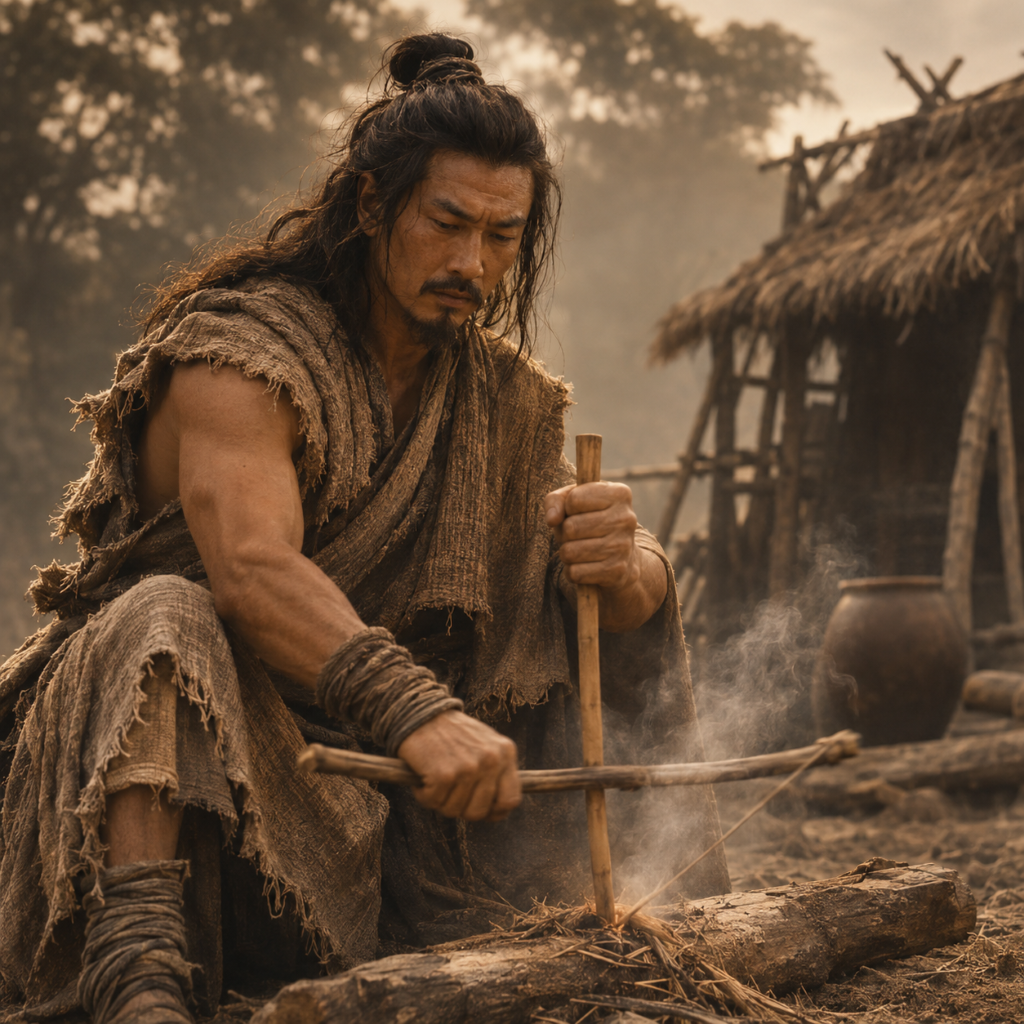
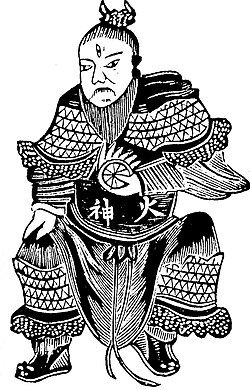
Most interpretations present Suiren as a human sage, tribal leader or early ruler. His identity is closely connected with intelligence, observation and practical knowledge rather than supernatural physical attributes. Later artistic representations commonly depict him as an elderly or mature man, sometimes carrying wooden fire-making implements.
A particularly interesting tradition connects Suiren with the mythical Sui Ming or Suiming Kingdom. In accounts preserved through later compilations, he encounters a remarkable tree whose branches produce fire through friction. Some versions describe him observing birds pecking at the tree and learning from the sparks they create. This encounter inspires him to develop a technique for producing fire independently. Such stories give Suiren a distinctive identity as an observer of nature. Rather than receiving knowledge from a supernatural being, he discovers a practical solution by studying the natural world.
Family
Suiren’s family relationships are not consistently established across Chinese mythological traditions. Some later genealogical accounts connect him to the legendary ancestry of China’s earliest rulers, while others describe him primarily as the leader of a clan. One tradition identifies Suiren as the son of Youchao Shi, another legendary culture hero credited with teaching humanity to construct elevated shelters or nests. This genealogy appears in later compilations of ancient Chinese rulers, including traditions preserved in the Tongzhi.
Some accounts also identify Huaxu as Suiren’s wife and connect him to Fuxi, one of China’s most important culture heroes. However, this relationship is not universally accepted. Other influential traditions describe Fuxi as the son of Huaxu without identifying Suiren as his father. The distinction is important because Fuxi’s birth is associated with a separate legend involving Huaxu encountering a giant footprint near Leize. Consequently, Suiren’s relationship with Fuxi should be understood as part of particular genealogical traditions rather than an established element of every account.
Suiren is also sometimes understood as the name of a clan or community rather than a single historical individual. The designation Suiren Shi can refer to a lineage or people associated with the mastery of fire-making. This interpretation suggests that the legend may preserve the memory of a collective cultural achievement represented through a legendary ancestral figure. For this reason, Suiren’s family history remains uncertain, with his cultural contribution being considerably more consistent across the surviving traditions.
Other names
Suiren appears under several names and titles in Chinese mythology, reflecting variations in historical texts, translations and traditions surrounding this legendary culture hero. The most commonly used name is Suiren (燧人), generally translated as Fire Maker or Fire Driller, referring to his association with producing fire through friction. He is also known as Suiren Shi (燧人氏), a traditional designation in which the character Shi (氏) can indicate a clan, lineage or ancestral title.
Another name associated with him is Sui Huang (燧皇), commonly translated as Fire Emperor or Emperor of Fire, emphasising his elevated position among the legendary rulers of ancient China. In English retellings, he is sometimes called the Fire Driller, a descriptive title highlighting his traditional wooden fire-making technique rather than a separate identity. The Chinese character 燧 is associated with fire-producing implements, including tools used to generate sparks. This linguistic connection reinforces his association with humanity’s mastery of fire. Although these names are sometimes used interchangeably, Suiren and Suiren Shi remain the most widely recognised forms in discussions of Chinese mythology.
Powers and Abilities
Suiren is not primarily remembered as a supernatural deity with magical powers. His importance in Chinese mythology comes from the technological knowledge and civilising abilities attributed to him. His legendary achievements revolve around understanding fire, discovering ways to produce it and teaching humanity how to use it.
His most significant achievement is fire-making. The best-known tradition credits Suiren with developing the technique of drilling one piece of wood against another to generate fire through friction. Some later retellings associate his discovery with striking stones together to create sparks, although the wooden fire-drill remains his defining attribute.
Suiren is also associated with cooking and food preparation. By teaching people to make fire, he enabled early communities to cook their food rather than depend entirely on raw ingredients. The Han Feizi specifically connects this development with reducing illnesses associated with eating raw food. This achievement represents an important transition in the mythological understanding of human civilisation.
The discovery of fire also provided warmth and protection. It helped communities survive colder conditions, offered light after sunset and provided a means of keeping dangerous animals away from settlements. These practical benefits made fire essential to everyday survival and the development of organised communities.
Another defining characteristic of Suiren is his knowledge of nature. Some traditions describe him observing natural phenomena, including the relationship between wood, friction and sparks. Rather than presenting his discovery as a gift from the gods, these accounts emphasise his intelligence, curiosity and ability to turn observation into practical knowledge.
His contribution also reflects leadership and civilisation. Suiren did not simply discover a useful technique; he shared that knowledge with others, improving collective survival and changing how communities lived. Some later accounts additionally associate him with observing celestial phenomena, particularly the Chen constellation, connecting his identity with the study of the heavens as well as practical invention.
Although these achievements give Suiren an extraordinary position in Chinese mythology, there is little textual justification for attributing immortality, elemental control, supernatural healing or combat abilities to him. His significance lies in the symbolic power of knowledge and innovation, making him a culture hero whose greatest achievement was transforming human life through the mastery of fire.
Modern Day Influence
Suiren continues to occupy a place in China’s cultural memory as one of the legendary figures associated with the foundations of civilisation. His story is frequently discussed alongside Fuxi and Shennong, whose traditional achievements include the development of social institutions, agriculture and medicine. One of the places associated with his legacy is Shangqiu in Henan Province. Local traditions identify the region with Suiren and preserve his memory through the Mausoleum of Suiren. The association has contributed to the city’s cultural heritage and its connection with China’s legendary past.
Suiren also appears in classical Chinese literature. References to his fire-making achievement can be found in works such as Journey to the West, where the technique of drilling wood to produce fire is recalled as an ancient cultural invention. His story is sometimes compared with that of Prometheus from Greek mythology. Both figures are associated with bringing fire to humanity and transforming the human condition. However, their stories have different foundations. Prometheus is remembered for taking fire from the gods and defying divine authority, while Suiren is celebrated for discovering a practical method of producing fire and teaching it to humanity.
Modern interpretations of Suiren increasingly focus on the broader meaning of his legend. He represents experimentation, observation and the ability to turn natural resources into useful technology. His story also provides a cultural explanation for why fire became central to human survival, cooking and community life. Whether understood as an individual culture hero, an ancestral ruler or the symbolic representation of an early community, Suiren remains an important figure in Chinese mythology. His legacy reminds us that civilisation did not emerge through grand supernatural events alone. Sometimes, it began with a simple discovery that changed how humanity lived.
Related Images


Source
Birrell, A. (1993). Chinese mythology: An introduction. Johns Hopkins University Press.
Campany, R. F. (2005). A Chinese religious world: The Han Feizi and early Chinese thought. University of Hawai‘i Press.
Han, F. (2003). Han Feizi: Basic writings (B. Watson, Trans.). Columbia University Press.
Jordan, D. K. (n.d.). How Flint Man (Suìrén Shì 燧人氏) tamed fire: Chinese folk stories. University of California, San Diego. https://pages.ucsd.edu/~dkjordan/chin/chtales/story225.html
Theobald, U. (2012, January 23). Sui Ren 燧人. ChinaKnowledge.de. http://www.chinaknowledge.de/History/Myth/personssuiren.html
Wang, C. (n.d.). Zhu Rong. Visit Beijing. https://english.visitbeijing.com.cn/article/47ONgKqT7fD
Yuan, K. (1985). Zhongguo shenhua chuanshuo cidian [Dictionary of Chinese myths and legends]. Shanghai Cishu Chubanshe.
Zhao, Y. (n.d.). Suirenshi “cha chen xin er chu huo” de keneng niandai [The possible era of Suiren’s “observing the Heart constellation and producing fire”]. http://www.lamost.org/~yzhao/history/suiren
Frequently Asked Questions
Who is Suiren in Chinese mythology?
Suiren is a legendary Chinese culture hero credited with teaching humanity how to make fire through friction, transforming cooking, survival and early civilisation.
What is Suiren famous for?
Suiren is famous for discovering or introducing the wooden fire-drill technique, allowing humans to produce fire independently and cook their food.
Was Suiren one of the Three Sovereigns?
Yes. Some Chinese traditions identify Suiren as one of the Three Sovereigns alongside Fuxi and Shennong, although the group varies between historical texts.
Who were Suiren's family members?
Some genealogical traditions identify Youchao Shi as his father and Huaxu as his wife. Fuxi is considered his son in certain accounts, but this varies.
Was Suiren a god or a human?
Suiren is generally understood as a legendary human culture hero or ancestral ruler rather than a supernatural god with magical powers.


