


Nezha : The Rebellious Young God of Chinese Mythology
At a glance
| Description | |
|---|---|
| Origin | Chinese Mythology |
| Classification | Gods |
| Family Members | Li Jing (Father), Lady Yin (Mother) |
| Region | China |
| Associated With | Mischief, Strength, Magic |
Mythlok Perspective
In Mythlok’s Perspective, Nezha represents a form of rebellion that is deeply different from the defiance seen in figures such as Prometheus or Loki. Prometheus challenges the gods for humanity, while Loki disrupts the cosmic order; Nezha’s struggle is far more personal, beginning with his conflict with his own family and the expectations placed upon him. His eventual sacrifice and rebirth transform rebellion into self-definition. Like many great mythic figures, Nezha suggests that identity is not simply inherited. It is tested, broken, and ultimately rebuilt through the choices one makes.
Nezha
Introduction
Nezha is one of the most recognizable figures in Chinese mythology, remembered for his extraordinary powers, fierce independence, and complicated relationship with his family. His story developed over centuries through Buddhist traditions, Chinese religious practices, folklore, and classical literature, eventually becoming one of the most enduring legends associated with Chinese popular culture.
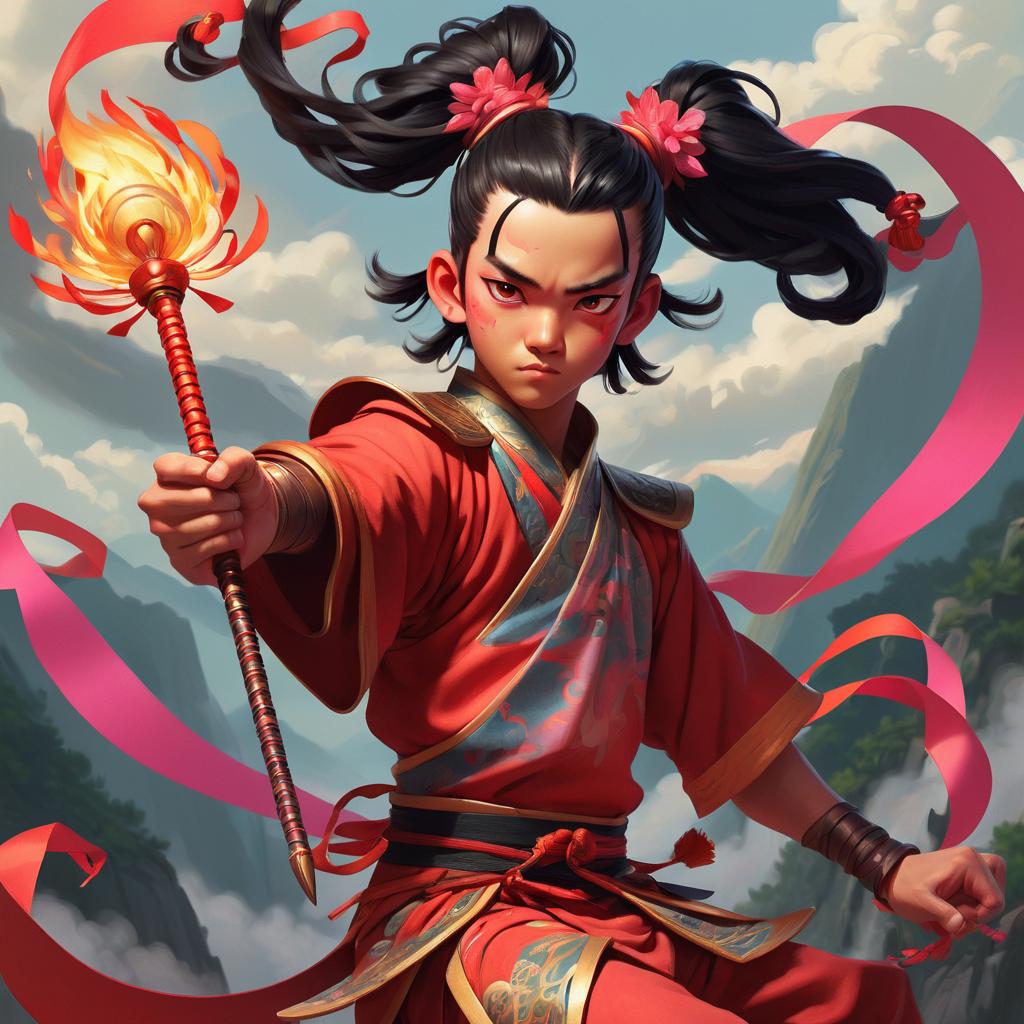
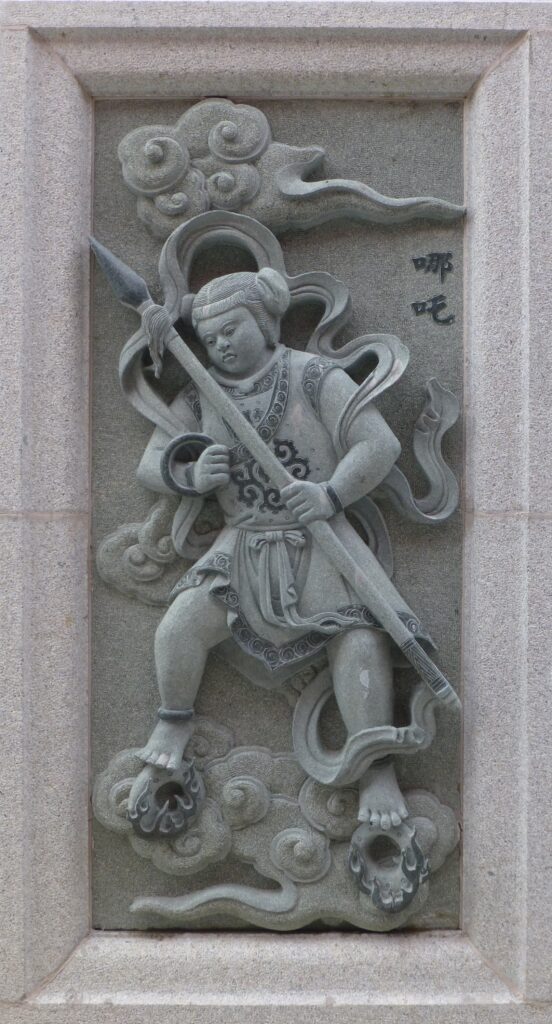
Known as 哪吒 in Chinese, Nezha is usually portrayed as a youthful divine warrior who rides the Wind Fire Wheels and carries the Fire-Tipped Spear. His most influential literary appearances include Fengshen Yanyi (Investiture of the Gods), a Ming-dynasty novel, and Journey to the West. While these works share elements of his character, they also present different aspects of his story and abilities.
At the heart of Nezha’s legend is a story of conflict and transformation. His unusual birth, difficult relationship with his father Li Jing, confrontation with the Dragon King, self-sacrifice, and eventual rebirth give the character a narrative that extends far beyond that of a conventional warrior deity. His story explores family loyalty, personal identity, sacrifice, and the possibility of starting again after tragedy.
Physical Traits
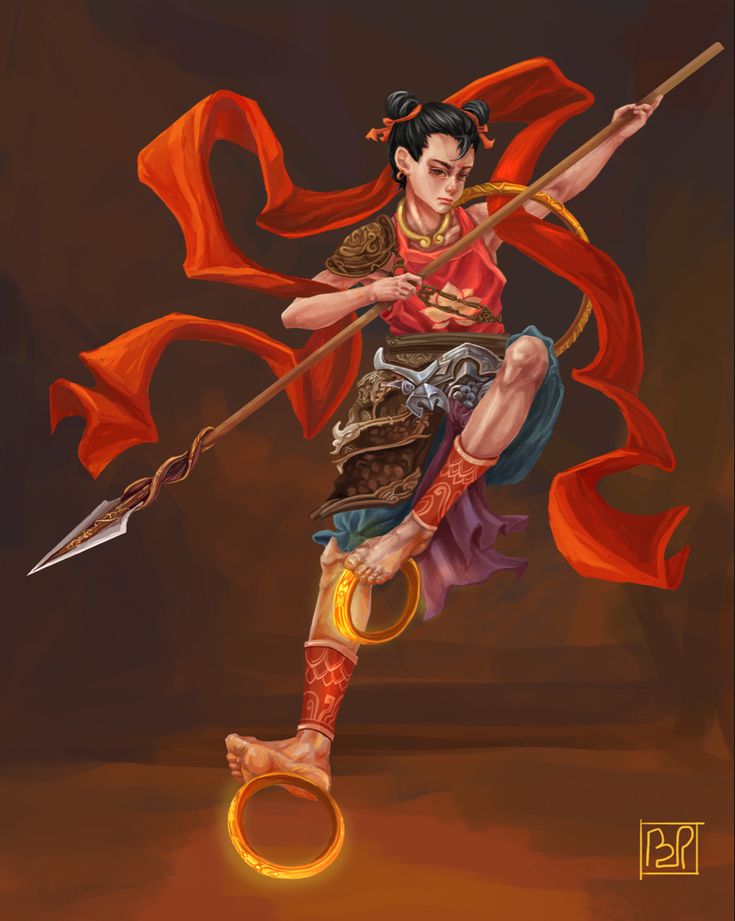
Nezha is traditionally depicted as a youthful warrior, often shown with a slender, energetic appearance that reflects his identity as a young deity rather than an older celestial general. His most recognizable attributes are the Fire-Tipped Spear and the Wind Fire Wheels, which allow him to move rapidly through the air and enter battle with supernatural speed.
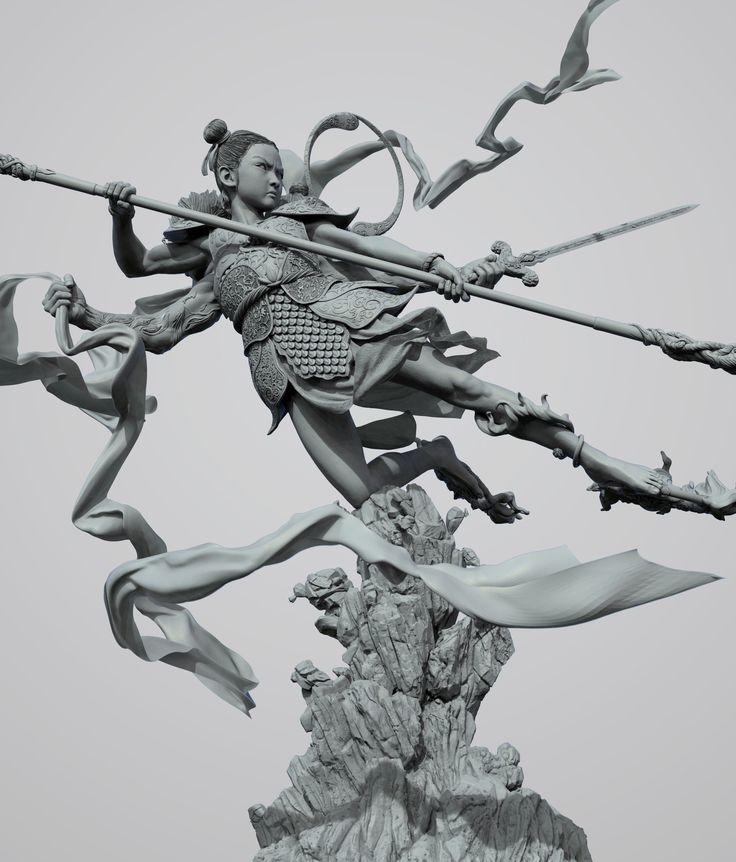
One of the most striking aspects of Nezha’s appearance is his ability to assume a supernatural multi-headed and multi-armed form. The exact depiction varies between traditions. In Fengshen Yanyi, Nezha manifests three heads and eight arms, allowing him to wield several divine weapons simultaneously. The novel specifically describes him using the Qiankun Ring, Huntian Ling, Fire-Tipped Spears, and other magical weapons in this form.
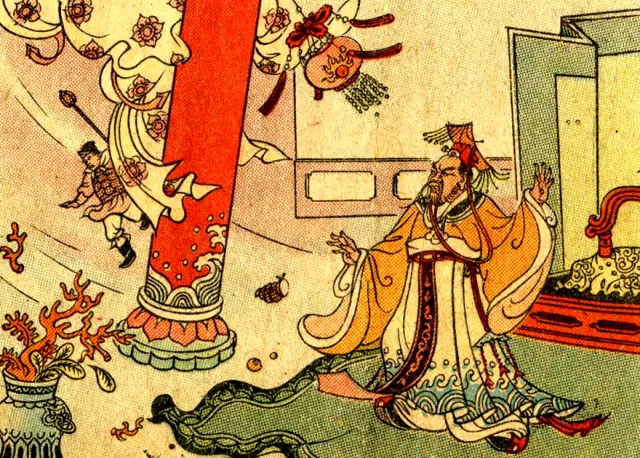
His visual appearance has changed considerably across paintings, temple sculptures, opera, animation, and contemporary cinema. Modern portrayals often emphasize his youthful face, distinctive hairstyle, colorful clothing, and warrior-like appearance, but these details should be understood as artistic interpretations rather than a single fixed traditional appearance.
The combination of a youthful body and formidable supernatural abilities is central to Nezha’s identity. He can appear playful and youthful while simultaneously possessing the strength and magical abilities of a divine warrior.
Family
Nezha is traditionally described as the son of Li Jing, a military commander who later becomes known as the Pagoda-Bearing Heavenly King, and Lady Yin. He has two older brothers, Jinzha and Muzha, who also become important figures within the broader mythology surrounding the family. His relationship with Li Jing is one of the defining elements of his story. In the best-known literary traditions, Nezha’s extraordinary birth and unruly nature create fear and conflict within the family. His actions eventually bring him into direct confrontation with the Dragon King of the Eastern Sea and place his family in danger.
Seeking to protect his parents and prevent further conflict, Nezha makes the ultimate sacrifice and gives up his life. His death does not mark the end of his story. His master, Taiyi Zhenren, later restores him to life through a supernatural rebirth associated with a lotus body. Nezha’s return fundamentally changes his relationship with the world around him. His story becomes one of transformation rather than simply revenge or conquest, with the conflict between father and son remaining an important part of his character.
Other Names
Nezha is known by several names and titles across Chinese religious and literary traditions. Among his best-known religious titles is Marshal of the Central Altar (中壇元帥), a title associated with his role as a divine protector and warrior. He is also known as the Third Prince, or Third Lotus Prince (蓮花三太子), a reference connected with his rebirth.
The name Nezha has a much older and more complicated history than his later Chinese legends might suggest. Scholars have traced the figure’s development to Nalakūbara, an Indian mythological figure associated with Kubera. Through the transmission of Buddhist texts and religious ideas between India and China, the figure underwent significant transformation before becoming the Nezha known from Chinese religious and literary traditions.
This history makes Nezha an especially interesting example of how mythology changes as stories move between cultures. His later Chinese identity is distinctly rooted in Chinese religion, folklore, and literature, even though elements of his earlier history can be traced beyond China.
Powers and Abilities
Nezha is best known for his combination of supernatural physical abilities, magical weapons, and transformative powers. His speed and mobility make him a formidable warrior, while his collection of divine weapons gives him several ways to attack and restrain his opponents.
The Fire-Tipped Spear (火尖槍) is one of his most recognizable weapons. It serves as his primary weapon in combat and is closely associated with his identity as a divine warrior. The Wind Fire Wheels (風火輪) allow Nezha to travel through the air at extraordinary speed. They are among his most distinctive attributes and are frequently used to represent his ability to move freely between the earthly and celestial realms.
The Qiankun Ring (乾坤圈), sometimes translated as the Universe Ring or Cosmic Ring, is a powerful magical weapon that Nezha uses against supernatural enemies. The Huntian Ling (混天綾), commonly known as the Red Armillary Sash or Red Silk Sash, is another important weapon capable of binding and restraining opponents. In Fengshen Yanyi, Nezha can also manifest three heads and eight arms, greatly increasing his combat abilities. In this form, he can wield several weapons simultaneously and becomes an especially formidable opponent.
His abilities are also connected to his training under Taiyi Zhenren, who teaches him supernatural techniques and helps him master his transformed state. Nezha’s power therefore comes not simply from physical strength, but from the combination of divine weapons, magical training, supernatural transformation, and extraordinary mobility.
Modern Day Influence
Nezha has remained one of the most visible figures from Chinese mythology in modern popular culture. His story has been repeatedly reimagined through animation, television, literature, games, and film, with each generation finding new ways to interpret the young warrior. One of the most important early modern adaptations was the 1979 animated film Nezha Conquers the Dragon King. Produced by Shanghai Animation Film Studio, the film became an important milestone in Chinese animation and helped introduce Nezha’s story to a modern mass audience.
The character received another major reinterpretation with the 2019 animated film Ne Zha. The film presented a contemporary version of his story while retaining many of the traditional characters and mythological elements. Its success demonstrated how an ancient mythological figure could be reworked for modern audiences without losing his cultural identity.
The story reached an even larger global audience with Ne Zha 2, released in 2025. The film continued the modern cinematic interpretation of Nezha and became a major commercial success, contributing to the franchise’s extraordinary box-office performance and further establishing Nezha as one of the most commercially significant characters in contemporary Chinese animation.
Nezha has also appeared in video games and other forms of popular entertainment, including SMITE. Outside entertainment, he continues to be venerated in Chinese religious and folk traditions, where he is associated with divine protection and martial power. Modern versions of Nezha frequently emphasize themes of individuality, self-determination, family expectations, and the struggle to define one’s own identity. These themes have helped keep the character relevant well beyond the literary traditions in which his best-known stories were recorded.
From Buddhist and Chinese religious traditions to classical literature, temple worship, animation, and blockbuster cinema, Nezha’s long journey reflects something fundamental about mythology itself: stories survive not because they remain unchanged, but because each generation finds something of its own in them.
Related Images
Source
Mythopedia. (n.d.). Nezha. Retrieved from https://mythopedia.com/topics/nezha/ Mythopedia
Localiiz. (2023, January 15). Chinese Mythology 101: Nezha, the patron god of children. Retrieved from https://www.localiiz.com/post/chinese-mythology-101-nezha Localiiz
The World of Chinese. (2025, February). Ne Zha: From myth to cultural icon. Retrieved from https://www.theworldofchinese.com/2025/02/ne-zha-from-myth-to-cultural-icon/ The World of Chinese
“Nezha – Wikipedia.” Last modified April 18, 2004. https://en.wikipedia.org/wiki/Nezha.
Ne Zha – The Most Unusual Boy in Chinese Mythology.” Shen Yun Performing Arts, Last modified February 19, 2014. https://fr.shenyunperformingarts.org/explore/view/article/e/1Puo-xmwOG8/ne-zha-child-deity-of-chinese-mythology.html.
Nezha: The Patron Saint of Young Adults.” Gods and Demons Wiki. Last modified January 1, 2019. https://gods-and-demons.fandom.com/wiki/Nezha.
Needham, Joseph. Science and Civilisation in China. Vol. 1. Cambridge: Cambridge University Press, 1956.
Yang, L., An, D., & Anderson Turner, J. (2005). Handbook of Chinese Mythology. ABC-CLIO.
Xu, Z. (Trans.). (2014). The Investiture of the Gods (F. J. Roberts, Trans.). Shang-wu Yinshuguan. (Original work published in the 16th century)
Shahar, M. (2011). Chinese and Tibetan Esoteric Buddhism. Brill.
“Calling for a Hero: The Displacement of the Nezha Archetypal Image in Chinese Animated Films” (2022). Humanities and Social Sciences Communications, 9, Article 123. https://doi.org/10.1057/s41599-021-00923-7
Frequently Asked Questions
Who is Nezha in Chinese mythology?
Nezha is a powerful child deity known for his rebellious spirit, martial skills, and role as a protector against demons and injustice.
What is Nezha’s origin story?
According to legend, Nezha was miraculously born in a ball of flesh and gained divine abilities as a youth, later sacrificing himself to save his family and being reborn to continue his heroic battles.
What weapons does Nezha use?
Nezha wields iconic weapons including the Universe Ring, Fire-tipped Spear, and Wind-Fire Wheels, which give him unmatched speed and power in combat.
Who are Nezha’s main rivals?
One of his most famous conflicts is with Ao Bing, the Dragon King’s son, alongside clashes with demons, spirits, and celestial beings who threaten the mortal world.
Why is Nezha popular in modern culture?
Nezha appears in movies, series, animation, and games as a symbol of courage, independence, and resisting oppression, making him a beloved cultural hero across generations.
