


Mythology vs. Reality : The Science Behind 8 Legendary Creatures
Legends of extraordinary creatures can be found in almost every corner of the world. Dragons, sea serpents, one-eyed giants, monstrous hybrids and enormous birds have appeared in stories for centuries, often occupying the uncertain space between the known and the unexplained. Before modern science gave people the tools to study fossils, genetics, animal behaviour and natural phenomena, unusual discoveries were frequently interpreted through mythology. A strange bone could become evidence of a giant, an unfamiliar animal could become a monster, and a terrifying experience at sea could grow into a story about a supernatural beast.
That does not mean science can simply “prove” or “disprove” mythology. Mythological creatures are part of cultural traditions, religious beliefs, oral histories and symbolic storytelling. Many were never intended to be zoological descriptions in the first place. However, science can help investigate some of the natural phenomena and real animals that may have contributed to particular legends. In some cases, the natural world is almost as extraordinary as the mythology it inspired. Here are eight legendary creatures whose stories reveal fascinating connections between mythology, reality and science.
1. Dragons: Could Fossils Have Inspired the World’s Great Serpents?
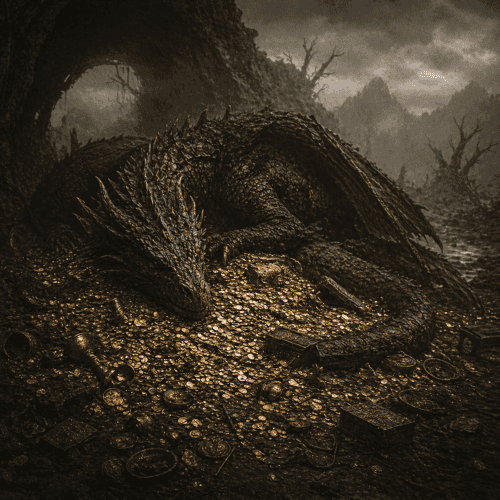
Dragons are among the most recognisable legendary creatures in the world, but the dragon is not a single universal creature. European traditions often portray dragons as enormous reptiles with wings, claws and the ability to breathe fire, while Chinese dragons traditionally have long, serpentine bodies and are associated with rain, rivers, storms and cosmic forces. Science offers no evidence for a creature possessing the complete combination of characteristics associated with the classic Western dragon. Nevertheless, several real-world phenomena could have contributed to the development of dragon imagery.
Fossils are one particularly intriguing possibility. Before modern paleontology existed, people occasionally encountered enormous fossilised bones and skulls without knowing that they belonged to prehistoric animals. Large dinosaur fossils, particularly skulls, could easily be interpreted as belonging to gigantic reptiles or monsters. Even today, dinosaur fossils can look astonishingly unfamiliar. In addition to fossils, living reptiles such as crocodiles, large snakes and monitor lizards may have influenced dragon traditions. The Komodo dragon demonstrates just how imposing a real reptile can appear, with a powerful body, large claws and a formidable set of teeth. Science therefore does not reveal a hidden population of dragons, but it does show that the natural world contains many of the physical ingredients from which dragon mythology could have been constructed.
2. The Kraken: When Science Discovered a Sea Monster Was Real
Few legendary creatures have a relationship with science as fascinating as the Kraken. Scandinavian maritime traditions described the Kraken as an enormous creature of the ocean, capable in some accounts of threatening ships and dragging sailors into the depths. For centuries, such descriptions sounded like classic sea-monster folklore. Then science began discovering what actually lives in the deep ocean.
The giant squid (Architeuthis) is a genuine deep-sea animal with enormous eyes, long tentacles and a body capable of reaching remarkable proportions. An even more imposing species, the colossal squid (Mesonychoteuthis hamiltoni), possesses a massive body and rotating hooks on its tentacles. These animals live in environments that are difficult for humans to observe directly, which helps explain why they remained mysterious for so long. A rare encounter with a giant squid, particularly before the existence of modern photography and marine biology, could easily have produced an extraordinary story. Science does not prove that the mythological Kraken existed exactly as described, but it demonstrates that the underlying idea of an enormous tentacled creature living in the ocean was not as impossible as earlier generations might have assumed.
3. Sea Serpents: Could Real Marine Animals Explain the Legend?
Stories of enormous serpentine creatures in the sea occur in many maritime traditions. Sailors have described long bodies moving across the water, mysterious shapes appearing beside ships and creatures that seemed far larger than any familiar marine animal. While there is no scientifically confirmed species corresponding to the legendary sea serpent, several real animals could help explain some historical observations.
The oarfish is particularly interesting because it can grow to extraordinary lengths and has a long, ribbon-like body that looks dramatically different from most familiar fish. Oarfish generally live at considerable depths, but individuals occasionally appear near the surface or wash ashore, producing spectacular sightings. Other possible explanations include groups of animals moving together, floating vegetation and the effects of waves and perspective. Human perception is especially vulnerable to misjudging the size and distance of objects on open water, where there are few familiar reference points. Science therefore offers several plausible explanations for individual sea-serpent sightings without requiring the existence of a gigantic unknown reptile. The legend remains fascinating because it sits at the intersection of genuine encounters, environmental uncertainty and human storytelling.
4. Cyclops: The Fossil Clue Behind the One-Eyed Giant
The Cyclops is one of Greek mythology’s most memorable beings, traditionally described as a gigantic creature with a single eye in the centre of its forehead. Homer’s Odyssey made the Cyclops Polyphemus particularly famous, portraying him as a dangerous giant encountered by Odysseus. While there is no biological evidence for a race of one-eyed giants, science and paleontology offer a fascinating hypothesis about how such imagery might have emerged.
The skulls of ancient elephants and their relatives contain a large opening in the centre of the face. This opening is not an eye socket; it is associated with the nasal passage and the attachment of the trunk. However, to someone who had never encountered an elephant and discovered only its enormous skull, the structure could potentially be interpreted as the socket of a single giant eye. Elephant fossils have been found across parts of the Mediterranean region, and some researchers have suggested that such discoveries could have contributed to ancient stories of giant one-eyed beings. This remains a hypothesis rather than a proven explanation for the Cyclops myth, because mythology rarely develops from one source. Nevertheless, the comparison provides a remarkable example of how paleontological discoveries may have influenced ancient imagination long before humans understood fossils scientifically.
5. The Manticore: How Real Animals Become Mythical Hybrids
The Manticore is a legendary creature originating in ancient Persian tradition and later appearing in Greek and European accounts. It is generally described as having a human-like face, the body of a lion and a dangerous tail, sometimes associated with a scorpion or other venomous creature. No known animal possesses this combination of anatomy, and science provides no reason to believe that such a hybrid species existed.
The more interesting scientific question is why humans create hybrid creatures so frequently. The human brain is highly effective at recognising familiar forms and combining them into new concepts. A lion represents strength and predation; a human face introduces intelligence and familiarity; a venomous tail adds another layer of danger. Combining these features creates an animal that does not exist in nature but immediately communicates threat. Ancient travellers also described unfamiliar animals using comparisons with species they already knew, which could further transform real observations into fantastic descriptions. The Manticore therefore demonstrates that the science behind mythology does not always require a lost species or fossil. Sometimes the explanation lies in human cognition itself and our remarkable ability to construct new creatures from familiar pieces of the natural world.
6. The Thunderbird: Myth, Nature and Giant Prehistoric Birds
The Thunderbird is a powerful supernatural being found in the traditions of several Indigenous peoples of North America. Its stories vary between nations and should not be reduced to a single generic monster narrative. In many traditions, the Thunderbird is associated with immense power and storms, and its presence can be connected with thunder and other forces of nature. Unlike some legendary creatures, the Thunderbird belongs within living Indigenous cultural traditions and should be understood in its own cultural context rather than simply treated as a supposed misidentified animal.
Science nevertheless provides an interesting point of comparison through Earth’s prehistoric birdlife. The fossil record shows that enormous birds once existed, including species considerably larger than most birds alive today. Some prehistoric birds possessed impressive wingspans and powerful bodies, demonstrating that the history of flight includes animals that would appear extraordinary by modern standards. There is no scientific evidence that the Thunderbird was simply a prehistoric bird remembered through oral tradition, and such a claim would oversimplify complex Indigenous traditions. Instead, the fossil record reminds us that the natural world has repeatedly produced animals of extraordinary scale, making the boundary between what seems mythical and what is biologically possible more complicated than it first appears.
7. The Minotaur: The Science and Archaeology of the Bull-Man
The Minotaur, traditionally depicted with the body of a human and the head of a bull, is one of Greek mythology’s most enduring creatures. According to the myth, it lived within the labyrinth constructed by Daedalus for King Minos of Crete. Science cannot provide a biological explanation for a human-bull hybrid because no such creature is supported by zoology or genetics. Archaeology, however, provides important context for understanding why the bull became such a powerful element of the story.
Bull imagery was deeply significant within Bronze Age Minoan culture. Archaeological discoveries on Crete and surrounding regions reveal numerous representations of bulls, including artwork and objects associated with ritual and ceremonial activity. The famous bull-leaping imagery of Minoan art demonstrates the cultural prominence of the animal. The Minotaur may therefore be better understood as a mythological expression of a society in which the bull possessed considerable symbolic power rather than as a distorted memory of a real hybrid animal. Science and archaeology help illuminate that cultural environment without reducing the myth itself to a simple historical event.
8. The Loch Ness Monster: When Science Tests a Modern Legend
Few legendary creatures have been examined by modern science as extensively as the Loch Ness Monster. Reports of a mysterious creature in Scotland’s Loch Ness became particularly famous during the twentieth century, generating theories ranging from a surviving prehistoric marine reptile to an unknown species of enormous fish. The creature became a global cultural phenomenon, but repeated scientific investigations have found no convincing evidence for a large unknown animal living in the loch.
One particularly interesting approach involved environmental DNA, or eDNA. Scientists can collect water samples and analyse genetic material released by organisms living in an environment. Research at Loch Ness found evidence of many species, including substantial evidence of eels, but did not identify genetic material supporting the existence of a giant reptile or other unknown monster. This does not mean every reported sighting was necessarily fraudulent. Waves, boats, floating objects, birds and animals can appear very different when observed from a distance, particularly on a large body of dark water. The Loch Ness Monster demonstrates how science approaches extraordinary claims: rather than relying solely on belief or disbelief, researchers can formulate hypotheses, gather evidence and test what the environment actually contains.
What Science Really Tells Us About Legendary Creatures
The most fascinating lesson from the science behind legendary creatures is not that every monster can be explained away. Instead, science reveals how closely mythology has always interacted with humanity’s attempts to understand an unfamiliar world. Fossils could raise questions about enormous animals that no longer existed. Rare encounters with deep-sea creatures could become stories about monsters. Unusual animal anatomy could inspire descriptions of giants and hybrids, while natural forces such as storms could become embodied as supernatural beings.
At the same time, it is important not to treat mythology as nothing more than primitive science. A mythological creature can have cultural, religious, moral and symbolic significance that cannot be explained by identifying a possible animal behind it. The Minotaur, for example, is more than a bull with a human body, while the Thunderbird cannot be reduced to a hypothetical prehistoric bird. Mythology frequently uses animals and supernatural beings to explore much larger questions about nature, power, danger, identity and the relationship between humans and the world around them.
Science and mythology therefore approach the unknown from different directions. Science asks what physical evidence can tell us about the natural world, while mythology records the ways human cultures have interpreted, remembered and given meaning to that world. Sometimes the two perspectives intersect in remarkable ways. A fossil can illuminate an ancient legend, an unfamiliar animal can explain part of a monster story, or a scientific discovery can reveal that an apparently impossible creature actually has a natural counterpart.
That may be the greatest lesson of all. Humans have always encountered things they could not immediately explain, and we have always created stories to make sense of them. The legendary creatures of mythology may not exist in the form described by ancient storytellers, but the world that inspired humanity’s imagination is itself astonishing. Science does not necessarily make these myths less magical. In many cases, it reveals that reality was extraordinary enough to inspire them in the first place.


No posts were found.


