


Magu : Chinese Immortal of Longevity and Eternal Youth
At a glance
| Description | |
|---|---|
| Origin | Chinese Mythology |
| Classification | Gods |
| Family Members | N/A |
| Region | China |
| Associated With | Hemp, Longevity, Healing |
Mythlok Perspective
In Mythlok’s Perspective, Magu represents an unusual idea of immortality: not the power to escape time, but the burden of witnessing it. Like the Greek Tithonus, she is connected to the consequences of living beyond ordinary human limits, yet her mythology takes a different path. While Tithonus experiences immortality as endless decline, Magu experiences it as perspective, watching seas become fields and generations disappear. Her legend therefore makes longevity less about preserving oneself and more about understanding change.
Magu
Introduction
Magu (麻姑), also known as Mago, is a female immortal associated with Daoist tradition and Chinese folklore. She is closely connected with longevity, youth, immortality, and the passage of time. Rather than being defined by a single domain, Magu appears in a range of stories and artistic traditions in which she represents the enduring nature of life and the hope for a long existence.
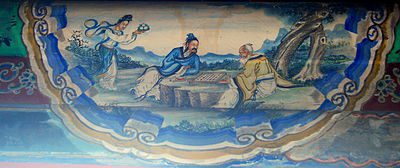
Her best-known legend places her in the company of the immortal Wang Fangping. During their meeting, Magu describes having witnessed the East Sea transform into mulberry fields three times, an extraordinary image that became associated with the immense changes brought about by the passage of time. This story helped establish Magu as one of the most recognizable female immortals in Chinese tradition.
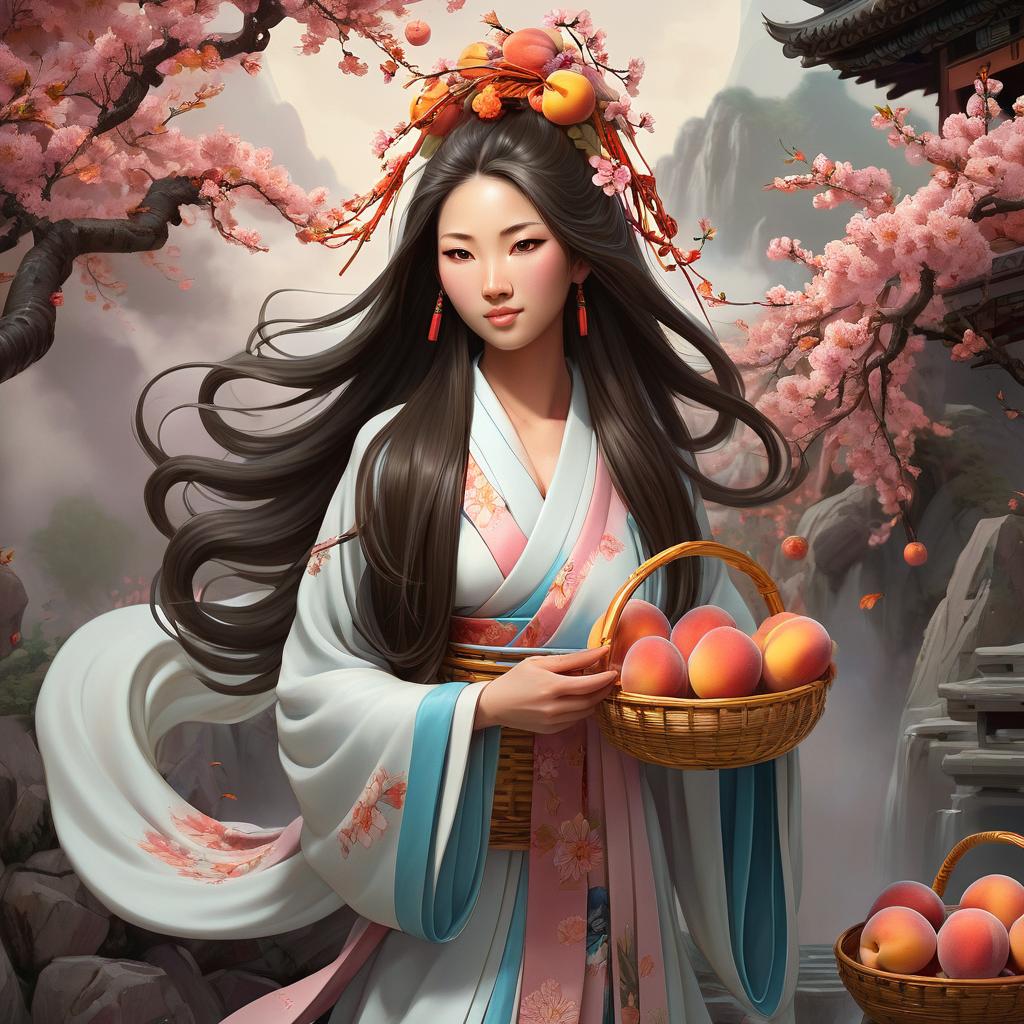
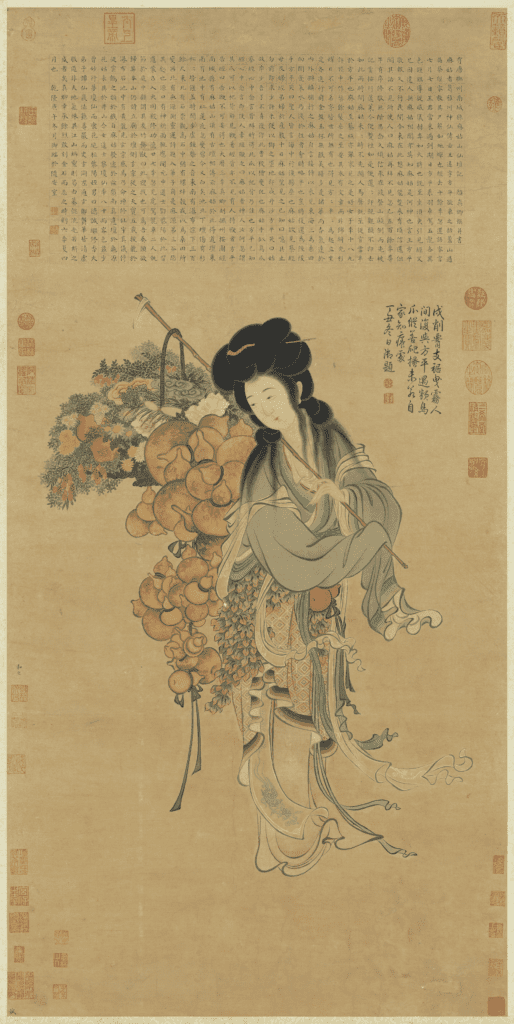
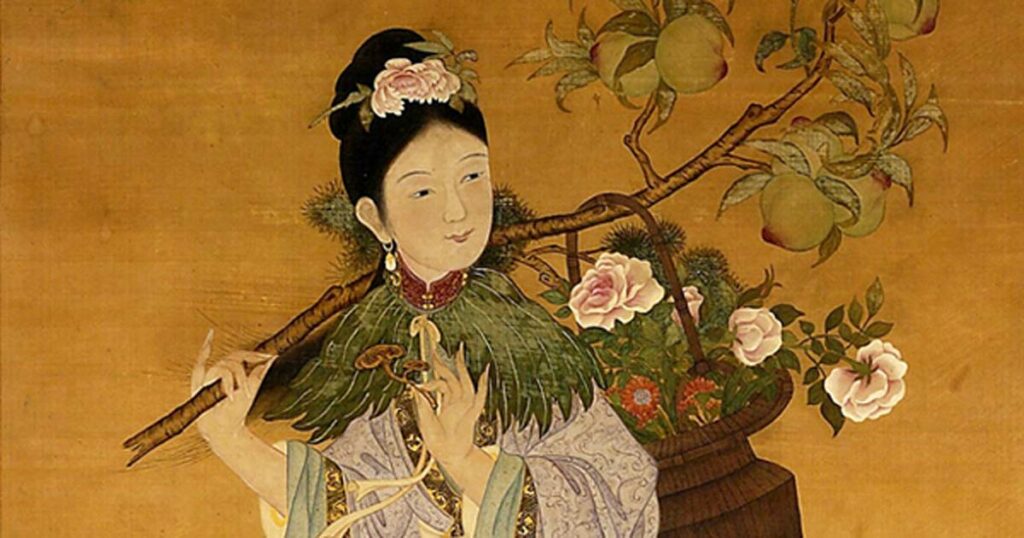
Over the centuries, her image became particularly popular in Chinese art and celebrations associated with longevity. She is frequently portrayed as a graceful young woman carrying objects associated with long life, including peaches, flowers, or vessels of longevity wine.
Physical Traits
Magu is traditionally depicted as an eternally youthful woman with an elegant appearance. One of the earliest descriptions of her portrays her as looking around eighteen or nineteen years old, with her hair arranged in a high style while the rest falls down toward her waist.
Later artistic representations developed this description into a more elaborate visual identity. Magu is commonly shown wearing long, flowing robes and an ornate hairstyle, sometimes decorated with flowers. Her appearance emphasizes the contrast between her youthful beauty and her extraordinary age as an immortal.
One unusual feature associated with Magu is her long, bird-like fingernails. This detail appears in the traditional story of her meeting with Wang Fangping and became one of the distinctive elements of her mythology. In Chinese art, Magu may carry a basket of flowers or plants, a vessel of wine, lingzhi fungus, or a peach associated with longevity. Deer and cranes can also appear alongside her, reflecting broader Chinese artistic traditions in which these animals symbolize long life and good fortune.
Family
Magu does not have a consistently defined family lineage in Chinese mythology. Her identity is instead established through her relationships with other immortals and celestial figures. She is particularly associated with Xi Wangmu, the Queen Mother of the West. In later traditions and works of art, Magu appears in connection with Xi Wangmu and is sometimes portrayed as part of her celestial circle. Their association is especially strong in stories involving celebrations of longevity and immortality.
Magu is also connected with Wang Fangping, the immortal who summons her in one of her best-known legends. Their encounter provides the setting for the famous story in which Magu describes witnessing enormous transformations of the natural world. Later artistic traditions sometimes place Magu alongside the Eight Immortals, although she is not generally counted as one of the Eight Immortals themselves. These representations reflect the broader popularity of immortal figures in Chinese religious and artistic culture.
Other Names
Magu (麻姑) is her most widely recognized name. The name is commonly translated as “Hemp Auntie,” although the meaning of the name should not be taken as evidence that she was originally a goddess of herbal medicine. She is also known as Mago in some romanizations and translations. Different periods and regional traditions have used variations in the way her name and titles are written or pronounced.
Magu should not be confused with Hua Mulan, the legendary Chinese heroine. Although both figures have appeared in modern retellings and popular culture, they are distinct characters with separate mythological traditions. Likewise, Magu and Xi Wangmu are distinct figures. Their association in Daoist and Chinese artistic traditions reflects their shared connection with immortality and longevity rather than an established mother-daughter relationship.
Powers and Abilities
Magu’s supernatural nature is most closely associated with immortality and her extraordinary perception of time. Unlike a deity whose mythology revolves around a single supernatural power, her significance comes from her status as an immortal who has existed long enough to witness enormous changes in the world.
Her most famous supernatural episode concerns the transformation of the East Sea. During her meeting with Wang Fangping, Magu remarks that she has seen the sea turn into mulberry fields three times. The statement conveys an almost unimaginable span of time and became associated with the Chinese expression canghai sangtian, describing dramatic changes in circumstances over a long period.
Magu is also closely connected with symbols of longevity. Later traditions associate her with peaches, lingzhi, flowers, and longevity wine. In particular, stories and artworks portray her presenting or carrying objects associated with long life and immortality. Her association with longevity does not necessarily mean that Magu functions as a healer or physician. Rather, she embodies the broader aspiration for a long and prosperous life. This symbolism made her especially appropriate for birthday celebrations and works of art created to convey wishes for longevity.
Modern Day Influence
Magu remains an important figure in Chinese visual and religious culture. Her graceful appearance and association with long life have made her a recurring subject in paintings, porcelain, sculptures, prints, and other forms of decorative art. Her image became particularly popular in works created for birthdays and other celebrations, where Magu could serve as an auspicious symbol of longevity. Artists often portray her carrying a peach, flower basket, vessel, or other object associated with long life, sometimes accompanied by deer, cranes, or other auspicious imagery.
Her connection with Xi Wangmu and other immortals has also allowed Magu to remain part of the wider visual tradition surrounding Daoist immortals and celestial figures. In some works, she appears among groups of immortals or in scenes celebrating longevity. Magu’s most enduring cultural legacy, however, may be the image of the world changing across immense stretches of time. Her observation that the East Sea had repeatedly become mulberry fields transformed a moment from an immortal’s life into a powerful Chinese metaphor for profound change. Through this tradition, Magu represents not simply the desire to live forever, but the extraordinary perspective that comes with witnessing generations, landscapes, and civilizations transform.
Related Images

Source
“ Magu (deity) .” (n.d.). In Wikipedia. Retrieved from https://en.wikipedia.org/wiki/Magu_(deity)
“Magu, Goddess of Longevity.” (n.d.). Google Arts & Culture. Retrieved from https://artsandculture.google.com/asset/magu-goddess-of-longevity/xgFECOBWZ_bHGw
“Magu Goddess: The Hemp Healer of Women in Taoist Mythology.” (2024, January 9). Green Nursery Blog. Retrieved from https://greennursery.com/green-nursery-blog/magu-goddess-the-hemp-healer-of-women-in-taoist-mythology/
Geng, Q. (2023). A goddess with bird’s claws: An exploration of the image evolution of Magu. Religions, 14(7), 944. https://doi.org/10.3390/rel14070944
Campany, R. F. (2002). To live as long as heaven and earth: Ge Hong’s traditions of divine transcendents. University of California Press.
Eberhard, W. (1968). The local cultures of South and East China. E.J. Brill.
Needham, J. (1974). Science and civilisation in China: Volume 4, Physics and physical technology, part 3: Civil engineering and nautics. Cambridge University Press.
Frequently Asked Questions
Who is Magu in Chinese mythology?
Magu is an immortal deity celebrated as the Goddess of Youth, Longevity, and Spring, often associated with everlasting life and natural renewal.
What does Magu look like?
She is commonly depicted as a beautiful young woman with long flowing hair and an ethereal glow, symbolizing eternal youth and divine vitality.
Why is Magu connected to peaches and immortality?
Legends describe her serving the peaches of immortality at heavenly banquets, linking her to the Daoist belief in long life and spiritual transcendence.
Where is Magu worshipped or celebrated?
She appears prominently in Daoist traditions, folk celebrations, and artworks throughout East Asia, especially in regions where longevity is culturally revered.
What does Magu represent spiritually?
Magu embodies themes of healing, rejuvenation, nature, and feminine power, offering blessings of health and vitality to those who honor her.


