


Kuwahailo : The Fearsome Man-Eating God of Hawaii
At a glance
| Description | |
|---|---|
| Origin | Hawaiian Mythology |
| Classification | Gods |
| Family Members | Pele (Daughter), Haumea (Wife), Na-maka-o-Kahaʻi (Son), Hina (Sister) |
| Region | Hawaii |
| Associated With | Man-eating, Sorcery, Human sacrifice, Death |
The Mythlok Perspective
In Mythlok’s Perspective, Kuwahailo represents the unsettling side of divine authority, where spiritual power inspires fear as much as reverence. Unlike Pele, whose destructive volcanic power is inseparable from creation and renewal, Kuwahailo’s surviving stories emphasise consumption, sacrifice, and death. This contrast reveals the complexity of Hawaiian mythology, where gods cannot always be neatly divided into benevolent protectors and malevolent forces. His legends preserve a difficult but important dimension of a religious tradition shaped by the relationship between supernatural power, society, and survival.
Kuwahailo
Introduction
Kuwahailo is a fearsome deity in Hawaiian mythology associated with man-eating, sorcery, human sacrifice, and death. Also recorded as Kū-waha-ilo, his name is commonly translated as “Kū of the maggot-mouth” or “Kū with the wormy mouth.” His unsettling name reflects his reputation as a supernatural being connected with the consumption of human victims and the destructive aspects of divine power.
Kuwahailo belongs to the wider religious traditions surrounding Kū, one of the principal gods of ancient Hawaiian religion. However, he should not simply be treated as interchangeable with every manifestation of Kū. While other forms of the god are associated with warfare, agriculture, fishing, and prosperity, Kuwahailo appears in historical accounts as a particularly terrifying figure linked to sorcery and death.
Some Hawaiian legends also identify Kuwahailo as the husband of Haumea and the father of Pele, the goddess of volcanic fire. This genealogy places him within a divine family whose stories explore the relationships between fire, the ocean, and other supernatural forces. His role varies between traditions, illustrating the diversity of Hawaiian mythology and the challenges of reconstructing a single, consistent account of its deities.
Kuwahailo’s stories are particularly important for understanding the relationship between religion and chiefly authority in pre-Christian Hawaiʻi. Historical accounts connect him with human sacrifice and rituals intended to secure supernatural power. These narratives reveal a religious world in which divine beings could inspire reverence and fear, embodying both the forces that sustained society and those that threatened it.
Physical Traits
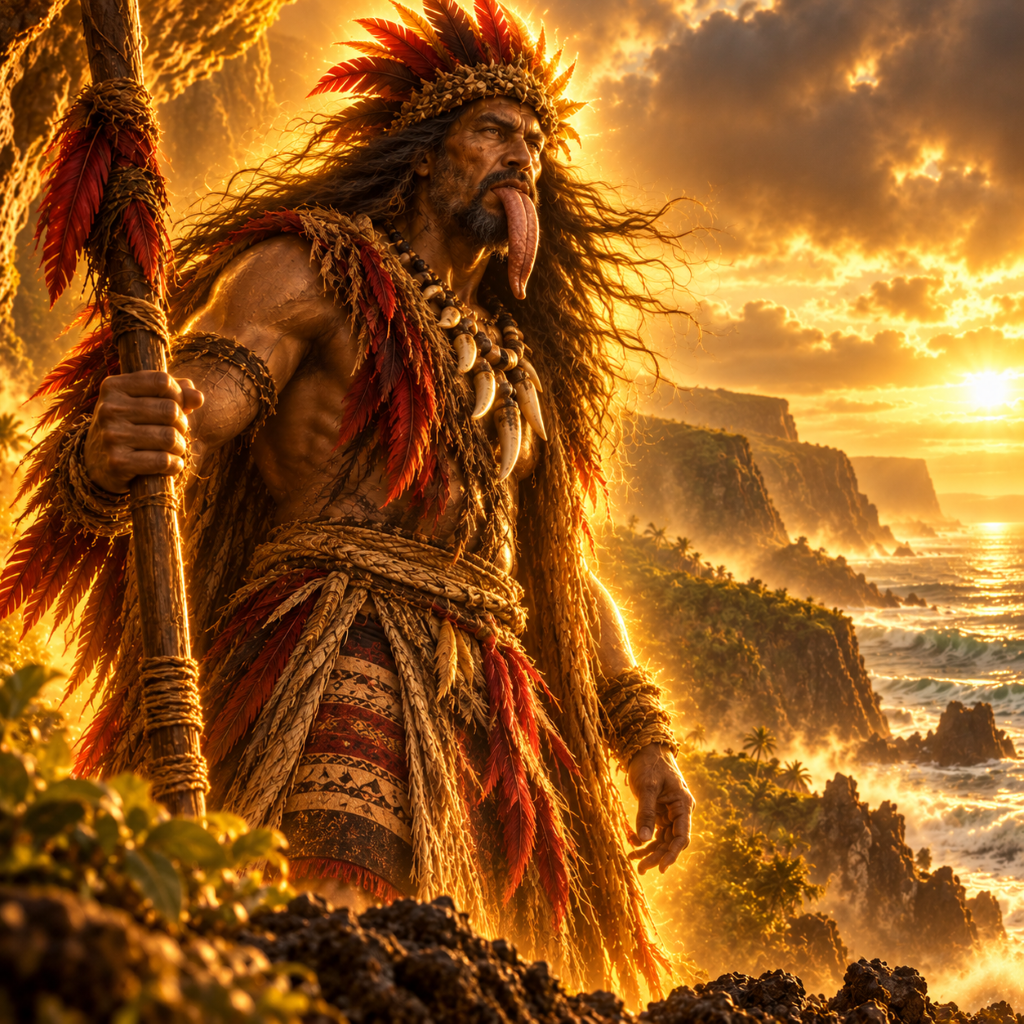
Kuwahailo does not have one consistently documented physical appearance across Hawaiian mythology. Instead, traditional narratives emphasise his terrifying mouth, his association with human flesh, and the extraordinary disturbances that accompany his arrival. His name provides the clearest indication of his frightening nature. The form Kū-waha-ilo is commonly translated as “Kū of the maggot-mouth” or “Kū with the wormy mouth.” This imagery connects him with decay, death, and consumption. Rather than suggesting an ordinary physical characteristic, the name reinforces his identity as a supernatural man-eater.
Some legends describe Kuwahailo’s arrival through dramatic changes in the environment. The earth shakes, trees bend, and violent winds sweep across the landscape. In one account, his tongue reaches his victims before the rest of his body appears, creating an image of a being whose extraordinary reach makes escape difficult.
Other narratives associate him with manifestations such as whirlwinds, earthquakes, streams of blood, and caterpillars. One account describes him appearing in the form of a moʻo, a class of supernatural beings in Hawaiian tradition often associated with lizards and water. Such descriptions suggest that Kuwahailo’s terrifying presence could manifest in different ways, depending on the story being told.
These accounts do not establish a single physical form, nor do they consistently describe his height, clothing, skin, or facial features. His defining characteristics are instead his monstrous mouth, his association with human victims, and the unsettling effects attributed to his supernatural presence. The imagery surrounding Kuwahailo distinguishes him from more familiar Hawaiian deities whose stories focus on creation, fertility, or the natural abundance of the islands. His appearance reflects the fear associated with his powers rather than a standardised artistic representation.
Family
Kuwahailo’s family relationships vary between Hawaiian genealogies and historical collections of legends. One significant tradition identifies him as the husband of Haumea and the father of Pele, the goddess associated with volcanic fire. This connection places him within the divine family central to many Hawaiian stories about the origins of volcanic activity and the relationships between supernatural beings.
Haumea is an important figure in Hawaiian cosmology and is sometimes associated with Papa, an ancestral figure connected with the earth. In accounts recorded by the Hawaiian folklorist W. D. Westervelt, Kuwahailo and Haumea are presented as Pele’s parents. Some versions also connect the couple with Na-maka-o-Kahaʻi, a goddess associated with the sea.
The relationship between Pele and Na-maka-o-Kahaʻi is significant because their stories frequently involve conflict between fire and water. Their opposing powers help explain the tensions that shape several Hawaiian legends, particularly those concerning Pele’s movements between islands and her encounters with other divine beings.
Certain accounts also identify Hina as Kuwahailo’s sister. In these narratives, Hina’s disapproval of his man-eating contrasts with his frightening reputation. However, Hawaiian traditions contain multiple figures named Hina, and their identities and relationships differ between stories. This connection should therefore be understood within the specific narrative in which it appears.
These genealogies demonstrate the complexity of Hawaiian mythology, where relationships between gods could vary across regional traditions and storytelling lineages. Kuwahailo’s connection with Pele is documented in historical collections, but it should not be presented as a universally consistent genealogy.
Other names
Kuwahailo appears under several related spellings in historical accounts of Hawaiian mythology. These variations reflect differences in transcription and the ways Hawaiian names were recorded in English-language publications. Kū-waha-ilo is one of the most recognisable forms. Its name is generally translated as “Kū of the maggot-mouth” and is associated with the deity’s reputation as a man-eater.
Kū-aha-ilo is an alternative spelling found in historical accounts. W. D. Westervelt records this form alongside Kū-waha-ilo, connecting both with the meaning “Kū with the wormy mouth” or “Kū, the man-eater.” Kūwahailo is another spelling used in modern references and educational resources. It is closely associated with the name Kuwahailo and is often used when discussing the deity’s role in Hawaiian mythology.
Kū-waha-ilo-o-ka-puni is a longer form associated in historical accounts with Kuwahailo’s worship as a god of sorcery. This name reflects his connection with the use of supernatural power against enemies and his place within traditions concerning chiefly religious practices. The differences between these spellings do not establish that they refer to separate deities. They are generally treated as related forms of the same name, although individual sources may emphasise different aspects of the figure.
It is also important to distinguish Kuwahailo from Kū’s other manifestations. Kū was associated with numerous domains, including warfare, agriculture, fishing, and other activities essential to Hawaiian life. The name Kuwahailo is particularly connected with man-eating, sorcery, and death, making it inappropriate to assign his characteristics automatically to every form of Kū.
Powers and Abilities
Kuwahailo’s powers centre on man-eating, sorcery, human sacrifice, and destructive supernatural manifestations. Historical narratives portray him as a dangerous deity whose influence extended beyond physical violence into the religious and political life of ancient Hawaiʻi. One of his most distinctive characteristics is his reputation as a man-eater. Traditional accounts associate him with the introduction of human sacrifice, connecting his worship with rituals performed under particular chiefly and religious circumstances.
A narrative involving the chief ʻUmi describes the demand for additional sacrificial victims following a military victory. According to the account, eighty enemy captives were eventually offered. Other details describe the god’s arrival amid thunder, lightning, and dark clouds, with his tongue appearing above the altar. These stories reflect historical accounts of particular sacrificial traditions and should not be taken as evidence that every Hawaiian community followed identical practices. Religious ceremonies varied according to their purpose, location, and political circumstances. Kuwahailo’s association with sacrifice represents one aspect of the broader religious world of ancient Hawaiʻi.
Another important aspect of his power is sorcery. Historical sources identify Kū-waha-ilo-o-ka-puni as a name under which male chiefs worshipped him in this capacity. Sorcery traditions involved attempts to influence or harm others through spiritual means, reflecting beliefs about the relationship between supernatural power and human affairs. The concept of mana, understood as spiritual power or authority, is central to discussions of traditional Hawaiian religion. Kuwahailo’s association with sorcery places him within a context in which supernatural forces could be sought for protection, political advantage, or the defeat of enemies. His role differs from that of forms of Kū primarily associated with productive activities such as cultivation and fishing.
Kuwahailo is also connected with death and the fate of the dead. Some historical accounts associate him with receiving or consuming souls, while another supernatural figure, Ka-ʻōnohi-o-ka-lā, appears in related traditions concerning their passage. The precise responsibilities of these figures vary between accounts, so Kuwahailo is best described as a deity associated with death rather than assigned one universally accepted role in the afterlife.
His powers are further expressed through the disturbances accompanying his appearance. Earthquakes, violent winds, whirlwinds, thunder, and lightning feature in accounts of his manifestations. Other stories describe unusual forms, including caterpillars, streams of blood, and a moʻo-like body. These descriptions connect Kuwahailo with the unpredictable and destructive dimensions of the supernatural world. His association with Pele in certain genealogies strengthens his place within a group of deities whose stories involve fire, upheaval, and dangerous natural forces.
Together, these characteristics establish Kuwahailo as a figure whose power is expressed through destruction, ritual authority, and fear. He is not simply a god of warfare but a complex supernatural being associated with the consequences of death and the dangerous use of spiritual power.
Modern Day Influence
Kuwahailo is less widely recognised in contemporary popular culture than Hawaiian figures such as Pele, Maui, and Kū. Nevertheless, his stories remain accessible through historical publications, folklore collections, and educational archives that preserve traditional narratives. The Hawaiian Legends Index maintained by the University of Hawaiʻi at Mānoa Library provides a useful resource for exploring stories associated with Kuwahailo. The figure appears in the index alongside legends concerning Aukelenuiaiku, Pele’s family, and other traditional narratives. These references help readers trace the different contexts in which his name appears.
Martha Warren Beckwith’s Hawaiian Mythology is another important resource for understanding the wider religious and narrative traditions surrounding Kuwahailo. Her work examines Hawaiian gods, genealogies, legendary figures, and supernatural beings through a collection of historical sources. As with other older folklore studies, it is useful to consider her interpretations alongside contemporary Hawaiian scholarship and the cultural contexts of the original traditions.
Kuwahailo’s presence in these records contributes to the preservation of stories that might otherwise remain unfamiliar to readers outside Hawaiʻi. Digital archives and published collections make it possible to compare accounts, examine differences in spelling, and understand how individual figures fit into larger mythological traditions.
However, evidence of his specific influence on contemporary Hawaiian ceremonies, festivals, films, or popular entertainment remains limited. His continuing relevance is more securely established through the preservation and study of Hawaiian legends than through claims of widespread modern worship or representation. Kuwahailo also provides an opportunity to understand Hawaiian mythology beyond its most internationally recognised characters. His associations with sacrifice, sorcery, death, and chiefly power reveal a religious tradition that explored both the sustaining and threatening aspects of supernatural authority.
His connection with Pele further demonstrates how individual deities belong to interconnected stories rather than isolated categories. Kuwahailo’s surviving narratives are unsettling, but they offer valuable insight into the complexity of Hawaiian cosmology and the different ways traditional communities understood the relationship between gods, people, and the natural world.
Related Images





Source
Beckwith, M. W. (1940). Hawaiian mythology. University of Hawaii Press. https://www.sacred-texts.com/pac/hm/index.htm
Ellis, W. (1963). Journal of William Ellis: A narrative of an 1823 tour through Hawaii. Advertiser Publishing Company. (Original work published 1825)
Kamakau, S. M. (1991). Tales and traditions of the Hawaiian people (M. W. Beckwith, Trans.). Bishop Museum Press. (Original work published 1865–1871)
Malo, D. (1951). Hawaiian antiquities (N. B. Emerson, Trans.). Bishop Museum Press. (Original work published 1898)
Pukui, M. K., Haertig, E. W., & Lee, C. A. (1972). Nānā i ke kumu: Look to the source (Vols. 1–2). Hui Hānai.
Thrum, T. G. (Ed.). (1907). Hawaiian folk tales: A collection of native legends. A. C. McClurg & Company. https://www.gutenberg.org/files/66516/66516-h/66516-h.htm
Westervelt, W. D. (1916). Hawaiian legends of volcanoes. Ellis Press. https://www.gutenberg.org/files/66516/66516-h/66516-h.htm
Valeri, V. (1985). Kingship and sacrifice: Ritual and society in ancient Hawaii. University of Chicago Press.
Frequently Asked Questions
Who is Kuwahailo in Hawaiian mythology?
Kuwahailo is a fearsome Hawaiian deity associated with man-eating, sorcery, human sacrifice, and death in traditional legends.
Is Kuwahailo related to Pele?
Some Hawaiian legends identify Kuwahailo as Pele’s father and Haumea’s husband, although genealogical accounts differ between traditions.
What does the name Kuwahailo mean?
Kuwahailo, also written Kū-waha-ilo, is commonly translated as “Kū of the maggot-mouth” or “Kū with the wormy mouth.”
What powers does Kuwahailo possess?
Kuwahailo is associated with man-eating, sorcery, destructive natural manifestations, and traditions involving human sacrifice.
Is Kuwahailo the same as Kū?
Kuwahailo is associated with the wider traditions of Kū, but his specific identity centres on man-eating, sorcery, and death.
